


Seats. Part 11
Description
This section is from the book "Furniture", by Esther Singleton. Also available from Amazon: Furniture.
Seats. Part 11
The "bar-back" was a novelty. It appeared as if four open-back chairs were placed side by side, the end ones, of course, supplied with an arm. Though we are told that this sofa was a recent invention, it was only a development of the old double chair (see Plate LXXXV.). "The lightness of its appearance has procured it a favorable reception in the first circles of fashion. The pattern of the back must match the chairs; these will also regulate the sort of framework and covering."
Sheraton was particularly fond of the leg reeded, turned and decorated with twisted flutes and fillets. We find upon his chair the husk, or bell-flower, the festoon, the lyre, the vase, the column, the lotus, the urn and the patera used to hide the joining of chair frames. His drawing-room furniture is preferably white and gold, rosewood, ordinary wood painted and japanned. Although mahogany was used for chairs with carved backs, they are never seen out of the library, dining and bedrooms. The upholstery for the drawing-room seats was of silk or satin in oval medallions or stripes.
Sheraton writes: "It appears from some of the latest specimens of French chairs, some of which we have been favored with a view of, that they follow the antique taste, and introduce into their arms and legs various heads of animals; and that mahogany is the chief wood used in their best chairs, into which they bring in portions of ornamental brass; and, in my opinion, not without a proper effect, when due restraint is laid on the quantity." His drawing-room chairs followed the French taste of the day. They were gilded, painted in any color and covered with silk. In 1792 he recommends an arm-chair of carved mahogany or black rosewood and gold; and "if a brass-beading is put round the stuffing to hide the tacks," this chair, he tells us, "will produce a lively effect." Another chair frame he wishes "finished in burnished gold, the seat and back covered with printed silk. In the front rail is a table with a little carving in its panels. The legs and stumps have twisted flutes and fillets done in the turning, which produce a good effect in the gold." Among his designs, we find chairs of the latest French style, namely: "a hunting-chair with square back and wings," stuffed all over except the legs, which are of mahogany, and having a slide-out frame in front to make a resting-place for one that is fatigued, as hunters usually are; an "easy and warm" chair for sick persons called a "tub chair," with side wings coming forward to keep off the air; chairs that he calls "curricle" "from their being shaped like that kind of carriage," and another original design that he calls "Her-culaneum," "so named on account of their antique style of composition."
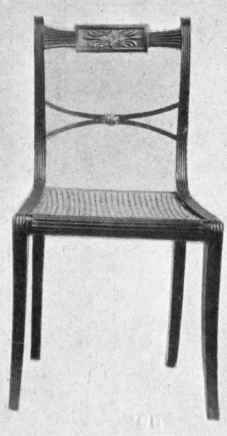
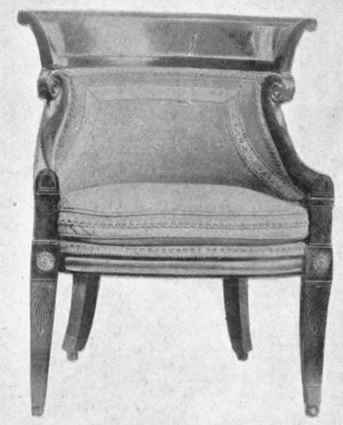
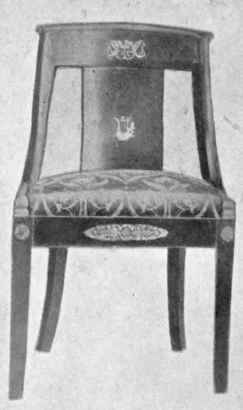
Plate XCVIII Adam Chairs
His " Conversation chairs " follow precisely the model of the voyelle (see page 196).
The Sheraton settees also exhibit backs similar to those of his chairs - particularly those known as the "Fancy Chair." ( See Plate C.)
Among Sheraton's latest designs is a bergere (1803) with a caned back and seats: "The stumps and legs are turned," he says, "and the frames generally painted." The bergere is rendered more comfortable with the addition of loose cushions. About this time cane became very popular. Sheraton informs us in 1803 that "Caning cabinet work is now more in use than it was ever known to be. About thirty years since, it was quite gone out of fashion, but on the revival of japanning furniture it began to be brought gradually into use, so that at present it is introduced into several pieces of furniture which it was not a few years past."
Two chairs from a set of Sheraton satin-wood furniture consisting of six chairs and a settee, with four-chair back supported on right legs (Plate XLII.) show the beginning of the "Fancy Chair." The backs have a rectangular panel of open trellis and rosettes at each intersection. The top rail is painted. The side supports and rail of the cane seats painted with arabesque foliage in grisaille. The front legs are turned balusters; the back, continuations of the side supports.
Sheraton's stuffed sofas resembled the sofas in use in France, and matched the chairs. Two sofas accompanied the drawing-room set of seats, and the seat of his sofa was stuffed up in front about three inches high above the rail. "Our sofas," he says, "are never covered with a carpet, but with various pattern cottons and silks."
He also gave designs for Grecian squabs or couches, the frames turned up at one end and made of white and gold or mahogany; the chaise longue with "a stuffed back and arm at each side with a bolster," their use being "to rest or loll upon after dinner "; and the Turkey sofa, a novelty recently introduced into the most fashionable homes. " They are," Sheraton remarks, "an imitation of the Turkish mode of sitting and are made very low, scarcely exceeding a foot to the upper side of the cushion."
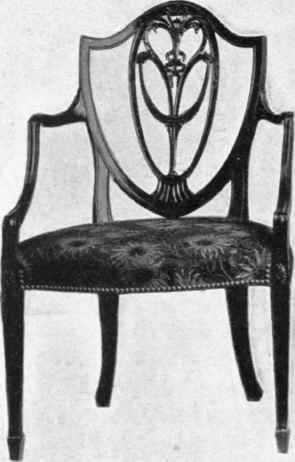
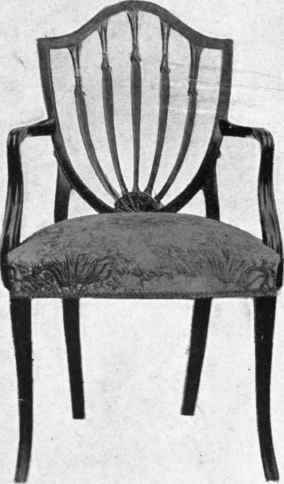
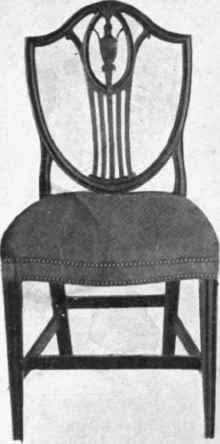
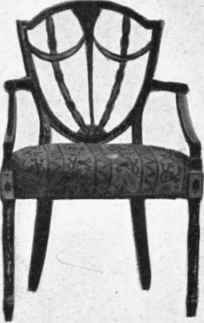
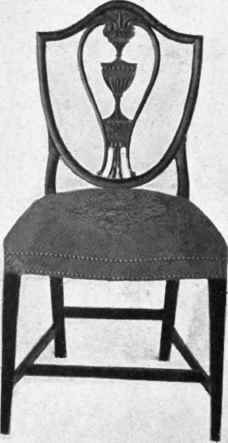
Plate XCIX - Heppelwhite Shield-back Chairs
During the Directoire, the open-backed chair increased in popularity, and remained a favorite in the days of the Empire. The lion's head reigned for a time as a decoration for the arm or elbow, but was soon superseded by the sphinx and the swan's head, - two very characteristic motives of this period. Gondola-shaped chairs, bar-backed chairs and heavy scrolled arm-chairs, as well as the double arm-chair that followed the style of the sofa, reigned during this period.
Continue to:


My Books

