


Seats. Part 12
Description
This section is from the book "Furniture", by Esther Singleton. Also available from Amazon: Furniture.
Seats. Part 12
A set of drawing-room furniture consisted of two sofas, always placed on either side of the chimney-piece, six armchairs, six chairs, two bergeres and two tabourets.
The draped sofa disappeared, and the most popular was the canape pommier, the back of which was low and square and extended round the sides to take the place of arms. The back of the sofa was stuffed but not the sides or wings. A feather pillow, covered with the same material as the sofa, was placed at each end. Figured damask, satin, tapestry, or printed cloth, put on with braid, was used for upholstering these sofas. The meridienne was a variation of the canape pommier, introduced during the Directoire period.
The banquette and chaise longue and the bergere en gondole with a low and rounded back were very popular. The divan came in during the last days of the Empire period. It came from the East.
The framework for chairs was mahogany or painted and bronzed, and frequently, in very rich houses, of gilded wood. Gondola-shaped chairs and heavy scrolled armchairs were the favorites for drawing-rooms. The square form was the most popular, and the arm-chair and double arm-chair were rarely supplied with extra cushions. Back and seats were stuffed and then covered with silks or satin of a solid color, with a design painted upon it. Braids were employed to hide the nails. Worsted damasks and printed cottons were used for less expensive seats. Leather was often chosen for the library and dining-room chairs.
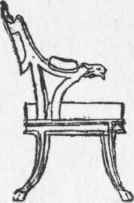
Directoire, 1796
The bar-back, or open back, chair was very popular, and legs were often X-shaped. Sometimes the front leg was cut in the form of a sabre. The shield shape, too, was popular for the back, ornamented with military trophies, or laurel leaves. Desk chairs were of the round or gondola form, and the feet generally in the console shape, or carved like chimaerae, or lions, whose heads came up to the level of the arms.
The following extracts from sales at Christie's auction rooms, 1797-1800, will give an idea of fashionable seats at the close of the century:
"4 chair seats, flowers on yellow velveteen.
8 landscapes for chair backs, greys on blue satin.
6 chair seats and 6 chair backs, arabesque in greys on blue satin.
6 chair seats and 6 chair backs, arabesque in greys on yellow satin.
12 ornaments, antique reliefs, purple on white satin for chair backs.
12 tablets for chair backs, antique brown on white satin.
12 tablets for chair backs, antique blue on white satin.
6 chair backs, greys on green dimity.
1 chair and seat, greys on poppy-colored satin.
6 chair backs or fire screens, colors on white satin.
6 mahogany vase-back chairs and 1 elbow chair, with horsehair seats, brass-nailed.
6 mahogany square-back chairs with horsehair seats, brass-nailed.
12 mahogany back-stool chairs covered with crimson damask, brass-nailed.
10 green and gold japanned elbow chairs, green mixed damask seats.
1 mahogany cabriole chair covered with crimson velvet.
8 mahogany wheel-back elbow-chairs, fluted legs on castors.
4 japanned bamboo elbow-chairs and cushions.
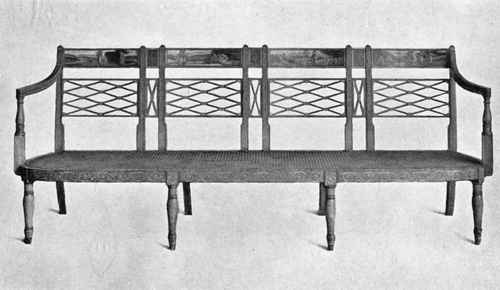
Plate C Sheraton Four-back Settee, Cane-seat
A drawing-room suite in green and gold consisting of a sofa and two bolsters, 6 plain cabriole chairs and 12 elbow chairs, covered with white figured satin and cotton cases."
The Fancy Chair (see page 85) was popular in New York. In 1797, "William Challen, Fancy Chair-maker from London, makes all sorts of dyed, japanned, wangee and bamboo chairs, settees, etc., and every article in the Fancy Chair line, executed in the neatest manner and after the newest and most approved London patterns."
From this date onward we have many advertisements in the New York papers of men who make Fancy and Windsor chairs, and undertake to regild and paint old chairs in the newest fashion. In 1802, we read:
"Fancy Chairs and cornices - William Palmer, No. 2 Nassau Street, near the Federal Hall, has for sale a large assortment of elegant well-made and highly finished, black and gold, etc., Fancy Chairs with cane and rush bottoms. He has also some of the newest pattern cornices and a variety of other articles in the Japan line. Old chairs repaired, regilt, etc., at the lowest price and agreeably to any pattern. Ornamental painting and gilding neatly executed."
In 1810, "Paterson & Dennis, No. 54 John Street, inform their friends and the public that they have now on hand a large and very elegant assortment of Fancy chairs of the newest patterns and finished in a superior style. Elegant white, coquelico, green, etc., and gilt drawing-room chairs, with cane and rush seats, together with a handsome assortment of dining and bedroom chairs, etc."
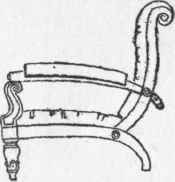
Easy Chair With Adjustable Back, By Smith
Two years later, "Asa Holden, 32 Broad Street, has a superb assortment of highly finished Fancy Chairs, such as double and single cross, fret, chain, gold, ball and spindle back, with cane and rush seats, etc., of the latest and most fashionable patterns. The cane seats are warranted to be American made, which are well known to be much superior to any imported from India." (1812.)
In 1817, "Wheaton and Davies, Fancy Chair manufacturers, have removed from No. 15 Bowery to 153 Fulton Street, opposite St. Paul's Church, where they offer for sale an elegant assortment of curled maple, painted, ornamented, landscape, sewing and rocking-chairs, lounges, settees, sofas, music-stools, etc. Old chairs repaired, painted and ornamented."
A favorite chair of the period was the "Trafalgar," which received its name from Nelson's great victory. This chair was generally of mahogany, and was in vogue as late as 1830.
Continue to:


My Books

