


The Screen
Description
This section is from the book "Furniture", by Esther Singleton. Also available from Amazon: Furniture.
The Screen
Screens are of three kinds: the folding-screen composed of two, three, or more leaves; the screen on a horse frame; and the pole-screen supported on a rod. The folding-screen is found in every country, with a more or less decorated frame, covered with leather, tapestry, silk, velvet damask, and even paper.
In the days of Louis XIV. the paravent, or folding-screen, and the ecran, or horse-screen, were in every room. The material was usually tacked to the frame with large gilt-headed nails, as in the handsome example from the Cluny Museum represented on Plate CXVII. This belongs to the period of Louis XIV. The wood-work is gilded, and the covering of petit point tapestry, reminding us of the Marot designs. On the same plate a screen of the next period is also represented. This is also of carved and gilded wood framing a piece of tapestry, the subject of which is taken from AEsop's Fables. It represents the Wolf and the Lamb surrounded by flowers and shell-work on a dark brown ground. In general form, the frame resembles the favorite chair-backs of the day.
In Chippendale's book we find that the screens standing on four legs are called "horse fire-screens." Some of them fold and others slide up and down in a groove. Chippendale also made pole-screens. Pole-screens were also a favorite (see Plate CXVIL).
Heppelwhite's horse fire-screen "is supported by uprights standing on feet, and the screen slides up and down in grooves in these uprights." The framework is usually mahogany, and the screen of green silk or needlework.
Heppelwhite's "Pole fire-screen" is made of mahogany or japanned wood, and "may be ornamented variously with maps, Chinese figures, needlework, etc. The screen is suspended on the pole by means of a spring in the eye through which the pole goes." The two outer feet were often loaded with lead to keep them steady.
Sheraton has similar pole-screens; and he also gives designs for Tripod Fire-Screens, to be made in white and gold, mahogany or japanned. Sheraton says:
"The rods of these screens are all supposed to have a hole through them and a pulley let in near the top, on which the line passes, and a weight being enclosed in the tassel, the screen is balanced to any height. The rods are often made square, which, indeed, best suits those which have pulleys, while those that are made round, have only rings and springs. Such screens as have very fine prints, commonly have a glass before them. In which case a frame is made with a rabbet to receive the glass and another to receive the straining-frame, to prevent it from breaking the glass; and to enclose the straining-frame a bead is mitred round."
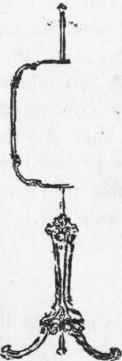
Pole-Screen, By Chippendale
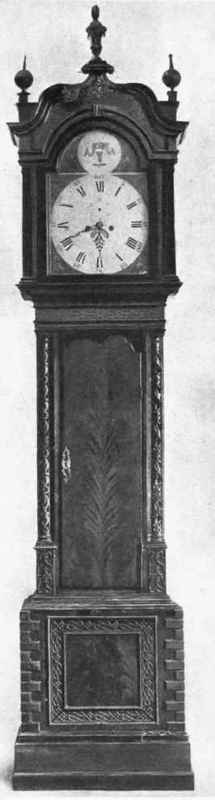
Plate CXVIII Chippendale Clock
Continue to:


My Books

