


The Clock
Description
This section is from the book "Furniture", by Esther Singleton. Also available from Amazon: Furniture.
The Clock
In the history of modern furniture the clock is of little interest until the pendulum clock, constructed by Huygens and described by him in 1658, was introduced. Then the long pendulum was enclosed in the tall pedestal-shaped box, and it quickly found favor everywhere.
Boulle and his sons, for instance, made many clock-cases, and of two kinds: clocks that were destined to stand on the chimney-piece or on brackets and long case clocks. The latter - about six feet high - wonderful creations of marquetry cabinet-work and bronze ornamentation.
Marot was another who designed clocks. Tall clocks, long case clocks, and clocks that stand on brackets and pedestals or terms appear in his books. Many of Marot's clocks, indeed, standing on pedestals or terms, appear at first glance as long case clocks; but close standing shows a break between the base of the clock and the top of the pedestal.
A clock and pedestal in the Wallace Museum (see Plate CXIX.) is a fine example of the decorative art of the transition period of Louis XIV. to the Regency. It is marquetry of metal on tortoise-shell, the frame, works and ornaments cast and chased in the Boulle atelier. The subject of the medallion on the pedestal is Hercules taking the world on his shoulders while Atlas goes to get the golden apples of the Hesperides.
In the Wallace Collection there is also a handsome clock and cabinet or vitrine in various woods, with groups and mounts of gilt bronze, cast and chased, and signed Herve a Paris. It is a fine example of the style of the Regency. On either side of the clock are groups of a boar and a stag being worried by dogs; and above it sits Diana patting a hound, while Cupid tries to deprive her of her spear.
During the first half of the Eighteenth Century there was quite a rage for japanned cases. The decorations were, of course, Oriental designs similar to those on the high case of drawers on Plate XXIV. A very handsome clock of this kind is preserved in the Boston Museum of Art.
Mahogany cases in the Chippendale Style were in great favor. The one represented on Plate CXVIII. is 8 feet, 3 inches high and 2 feet, 1 inch wide. The case is ornamented with carved lattice-work and boldly pierced columns at the corners, supporting a frieze of lattice-work and arches above which is a small toothed cornice. The face is enclosed in a band of carved lattice-work with arched top, and with pierced tapering square-shaped columns at the angles, supporting a scroll-shaped lattice and dental pediment terminating in rosettes, with low plinth in the centre and a metal gilt ball with steeple top at each side. The base has a square panel bordered by a broad band of lattice-work, and carved with broken masonry at the angles in relief.
In Sheraton's first book he gives a number of designs for tall clock-cases "painted and japanned," but in 1803 he says that he has given no design of the tall clock-case as "these pieces are almost obsolete in London," but intends to do so in his large work "to serve my country friends."
Regarding the more fashionable bracket he writes:
"Clock-brackets are used to place small time pieces upon, when there is no other convenient place; but in good rooms the chimney caps are made broad, of marble, and serve very advantageously to place a clock on. Sometimes they stand upon commodes, at the end of the room, facing the fire-place; but when these conveniences are wanting, a bracket supplies their place."
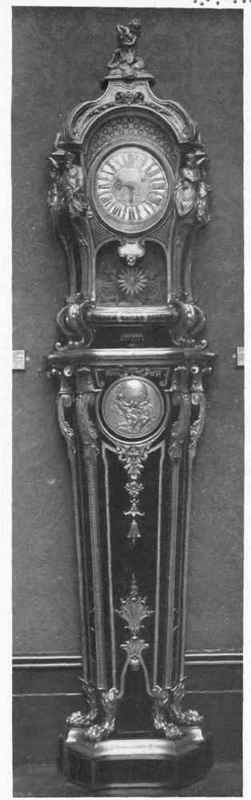
Plate CXIX - Boulle Clock and Pedestal, late Louis XIV. to Regency - Wallace Gallery
Continue to:


My Books

