


The Commode
Description
This section is from the book "Furniture", by Esther Singleton. Also available from Amazon: Furniture.
The Commode
The commode, the last transformation of the cabinet, was a very important piece of furniture in the Seventeenth and, more particularly, Eighteenth Century. Its place was in the drawing-room or bedroom. The commode is breast-high, stands on four feet, and is supplied with two long drawers. Exactly when it received its name is not known; for it does not appear in the first edition of the Dictionnaire de l'Academie (1694). Some people like to associate it with the headdress called Commode, introduced by Mademoiselle Fontange, and universally worn at the end of the Seventeenth and beginning of the Eighteenth Century, but its name was probably chosen to denote its usefulness. It appears in early French inventories as bureau de commode and bureau en commode.
It appears in the prints of Berain, who died in 1711; but its name must have been in general use before that time, as it constantly appears in inventories. It 1708, the room of the Due d'Orleans, at Versailles, contained "a bureau-commode in walnut, with two long drawers fastened with locks."
The great French cabinet-makers seem to have had a special affection for this form. Boulle's commode en tom-beau was famous and the great swelling curve of this tomblike form also occurs in his commodes a panse (paunch chests).
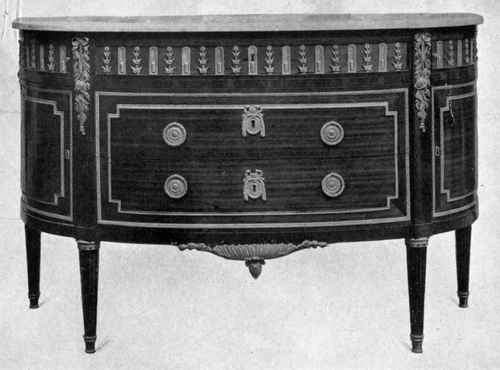
Plate LXVI Louis XVI. Half-Moon Commode made by L. Moreau
A commode of Louis XIV. period shown on Plate XXVI. is characteristic Boulle work, ornamented with splendid gilt-bronze mounts. The corners are adorned with bold and beautiful acanthus leaves forming scrolls. Three mascarons decorate the ends and base; and the handles of the drawers are formed of lions' heads with rings in their mouths. The gilt key-plates are also beautifully chiselled. This fine piece is in the Wallace Gallery in London. The earliest commodes are masterpieces of cabinet-work. The rarest woods were employed in their manufacture and they were enriched with inlays of mother-of-pearl, tortoise-shell and marquetry of colored woods and adorned with chiselled and gilt metal mounts and ornate leaf-shoes or carved and gilded feet. Handsome gilded figures often ornamented the corners and the mascaron or espagnolette decorated the centre of the drawers.
The espagnolette, it may be noted, is the name for the woman's head surrounded by a plaited ruff which is so frequently used for decoration by the masters of the Louis XIV. period. A very fine example appears on the commode on Plate XXVI.
The commodes of the Regency period were more elegant in form and less loaded with ornamentation. The chiselled bronze mounts were more restrained and stand out on a background of rosewood or amaranth, or some other rare exotic wood.
The metal-mounts were beautifully treated, especially by Cafneri. About this time, too, the Martins enriched these commodes with their beautiful paintings representing Chinese landscapes and scenes in imitation of Chinese lacquer. These panels were most exquisitely framed in borders of pierced metal, the chief motives of which were shells and scrolls. The slab was, as a rule, made of choice and costly marble; marble, beautifully colored and beautifully veined.
Cressent made Commodes a la Regence, a la Chartres, a la Bagnolet, a la Charolais, a la Harant and a la Dauphine; and the "bow-shaped," which he describes as en arbalete, was one of his favorites. One of his commodes was described by the maker in 1761, when it was sold, as follows: "A commode of a pleasing contour, made of violet-wood, having four drawers and ornamented with bronze-gilt (or moulu). This commode is a work (with regard to the bronzes) of extraordinary richness; they are very well executed, and the distribution of them very fine; among other things, you notice the bust of a Spanish woman placed between the four drawers; two dragons, whose tails turned up in relief form the handles for the two upper drawers, and the stems of two great leaves of a beautiful form are also turned up in relief to make handles for the two lower ones; you must admit that this commode is a veritable curiosity."
This description agrees perfectly with the example in the Wallace Gallery. The superb commode in the same Collection, by Caffieri, is one of the best specimens of the application of bronze decoration to furniture. With Caffieri, architecture is entirely subordinate to ornamentation; and this fine piece is a study of the art of the metal-worker.
The example shown on Plate LXIII. is a commode with two drawers in marquetry of colored woods, the design being of floral boughs and birds. The handles, key-plates, ornamental mouldings and leaf-shoes are of bronze, in rocaille. The slab is of marble. This handsome piece, which is almost perfect in proportion and extreme beauty of line, is a splendid example of the Louis XV. age. It is signed L. Boudin.
The elegant little Regency bureau (Plate LXIV.) was made for Louis XV. when a child. It is decorated with branch and foliage design of copper on tortoise-shell; the eagle claw-feet and other metal enrichments are of gilt bronze.

Plate LXVII - Bureau of Marie de'Medici - Cluny Museum
Sometimes at this period the lower part of an armoire was used as a commode, just as the lower part of an Eighteenth Century "high-boy" is also used to-day as a dressing-table.
Chippendale, who copied everything that was fashionable in France, made commodes which he calls "French commode tables," "commode bureau-tables," and "buroe dressing-tables." In his examples the drawers frequently reach to the floor. He decorated them profusely with leafy scrolls and light dripping water effects.
As the reign of Louis XV. comes to a close, and the new taste for the straight line asserts itself, the low-shaped and bombe commode gives place to a piece of furniture that returns to the chest in its rectangular lines. The commode now stands on grooved feet; sometimes it has doors, and sometimes long drawers; few lacquered commodes are made, and marquetry gradually gives place to panels ornamented with a vase of flowers or trophies inlaid in the centre, or plain panels framed in a delicately chased bronze moulding and adorned with a central metal ornament. Sometimes plaques of Sevres porcelain are used instead of panels of wood.
The cabinet-makers and designers all loved this form, and lavished all the resources of their skill and rich materials upon its composition.
The commodes that Riesener made at the end of the reign of Louis XV. are of two types. The richer form is somewhat similar to the form of his desks; the central part of the body beautifully decorated with marquetry or a medallion of chiselled bronze. The very low feet are encased in a leaf-shoe, or end in only a scroll. The moulding is enriched with metal work in the form of roses, garlands, ovolos, or flutings. The simpler commodes are less sumptuous regarding the use of marquetry and bronze; are shaped like a massive coffer; and stand on very low curved feet, which hardly seem to belong to the piece of furniture, so awkwardly do they jut from the corners.
During the Louis XVI. period Riesener made a series of commodes that are models of taste and execution. In the centre he placed a panel of marquetry of wood representing attributes of the field or bouquets of flowers, and on each side panels inlaid in lozenges, which set off the principal subject. Upon the moulding a row of floral crowns develops for a frieze, while figures of caryatides or Corinthian columns rising out of the leaf-shoe of copper form the uprights of the sides. Other of his commodes are entirely covered with flowers and fruits that stand out from the panels of old Chinese lacquer.
The commodes made at this period by Heppelwhite were often shaped like half of a drum and were of satin-wood, richly inlaid. Sheraton's commodes were also exceedingly rich. In a description of a drawing-room, when he was under the influence of the Louis XVI. taste, Sheraton wrote: "The commode opposite the fire-place has four doors; its legs are intended to stand a little clear of the wings; and the top is marble to match the pier-tables. In the frieze part of the commode is a tablet in the centre made of an exquisite composition in imitation of statuary marble. These are to be had of any figure, or on any subject, at Mr. Wedgwood's, near Soho Square. They are let into the wood, and project a little forward. The commode should be painted to suit the furniture, and the legs and other parts in gold, to harmonize with the sofas, tables and chairs."
Riesener's rival, Benneman, produced many commodes. Some of these are now in Fontainebleau and the Garde-Meuble; their forms already announce the imitation of heavy classic models soon to invade French art; but whose decorative metal mounts rank among the best French work. One of Benneman's achievements in this line was an enormous commode in mahogany in the form of the lower part of an armoire with terminal figures of women at the corners of gilded bronze.

Plate LXVIII - Bureau by Riesener Wallace Gallery
In the Louis XVI. period the rounded forms of the commode gave way to the straight line. Some had doors, and others had only drawers; these were called commodes tombeaux. They stood on short, upright legs. "Commodes were used more and more in furnishing bedrooms. They were made of four and sometimes five drawers one above another; naturally the legs lost some of their height, and the floral placages were supplanted by mouldings garnished with chiselled bronze, marquetry woods were replaced by mahogany, amaranth and even walnut, but few were made of palissandre. Two regular handles were used on each drawer on either side of a central keyhole; the tops were almost always of marble." 1
1 Deville.
Louis XVI. Style
"A half moon" mahogany commode is shown on Plate LXVI. with three drawers in front and a little cupboard and drawer at each side. It is mounted with gilt bronze ornaments and has a marble top. This piece was made by L. Moreau.
Commodes were proscribed during the Directoire and Empire, as they were considered out of keeping with antique furniture. Their exclusion did not become general, and did not last long. People had to return to this useful piece of furniture. The commode, however, never recovered its former elegance, and, thereafter was only a piece of heavy mahogany furniture slightly ornamented with metal-work, which decoration, after a time, disappeared altogether. Commode dressing-tables and commode writing-desks are still made. No piece of furniture is more prized by the collector than a fine specimen of the Seventeenth or Eighteenth Centuries.
Continue to:


My Books

