


The Cabinet. Part 4
Description
This section is from the book "Furniture", by Esther Singleton. Also available from Amazon: Furniture.
The Cabinet. Part 4
The following examples sold recently in London are all Sheraton pieces: Satin-wood cabinet (2 ft. 3 in. wide) with glazed folding-doors carved with foliage, drawers beneath, fluted legs, 56 guineas; satin-wood cabinet (7 ft. 9 in. high, 3 ft. 5 in. wide), consisting of shelves behind glazed folding-doors, central drawer forming desk, folding-doors below, the paintings, basket of flowers, 180 guineas; small cabinet (2 ft. wide), folding-doors enclosing drawers, bands and zigzags of tulip-wood, inlaid, fall-down front and drawers at end, 100 guineas.
An English painted cabinet on a stand (Plate LXI.) follows the old original form. The whole cabinet is painted inside as well as outside by Cipriani. The two panels on the doors represent Venus in her car drawn by doves and attended by Cupid and a Sacrifice to Flora; the sides are painted with Muses, medallions, ribbons and flowers, and the top with Cupid, doves and flowers. The borders are delicately painted arabesques, brightened with gilt headings. The doors are painted on the other side with mythological subjects and the eleven drawers they conceal with Cupids, doves, flowers and ribbons.
The table on which the cabinet stands is supplied with a drawer, the lines of which follow the lines of the cabinet. This is painted with medallions, classical figures, Cupids, masks, arabesques and swags of flowers, and is supported on tapering legs also sympathetically painted. The background of the whole cabinet inside and out is cream colored, the height 4 feet and length 2 feet 2 1/2 inches.
What some critics consider the most important piece of English furniture ever produced is a cabinet that was designed by Seddons in 1793 for the King of Spain (Charles IV.) and made by Seddons's foreman, Newham. It is nine feet high, six feet long and three feet at its greatest depth. It is decorated with panels, painted by William Hamilton, R. A., representing the insignia of the Spanish Orders of Knighthood, the Golden Fleece, the Immaculate Conception, Spring, Summer, Autumn and Winter, Fire and Water, Night and Morning, Ceres in a car drawn by lions, Juno and her peacocks and many Cupids.
"The inlaid work on it is superlative, whilst the chased and gilt metal-work mounted on it has no English rival. Inside, the carcase is fitted as a dressing-table, bureau and jewel-case in a most clever fashion. In contour a majestic dome rises from the centre, and this is flanked by two separate, square-shaped wings. Imperial eagles guard the top, whilst the whole rests on six lions couchant. Classic draped figures, cherubs and fauns' heads in relief carving further set off this remarkable example, which is to-day worth many thousands of pounds." 1
1 Wheeler.
To this class of furniture also belongs the china-cupboard and china-cabinet, known in France as the vitrine on account of its glass doors. Chippendale's china-cabinet stands on a frame and consists of a series of shelves enclosed behind glass doors. Sometimes the glass is encircled by a gilt moulding; but, as a rule, it consists of small panes brought together in a charming Gothic pattern of squares, lozenges, or ovals by means of strap mouldings. Small cabinets Chippendale made in the "Chinese style" with pagoda top and, perhaps, a single glass door with a fretwork border. The frame consisting of four straight legs sympathetically carved with Chinese ornamentation or fretwork.
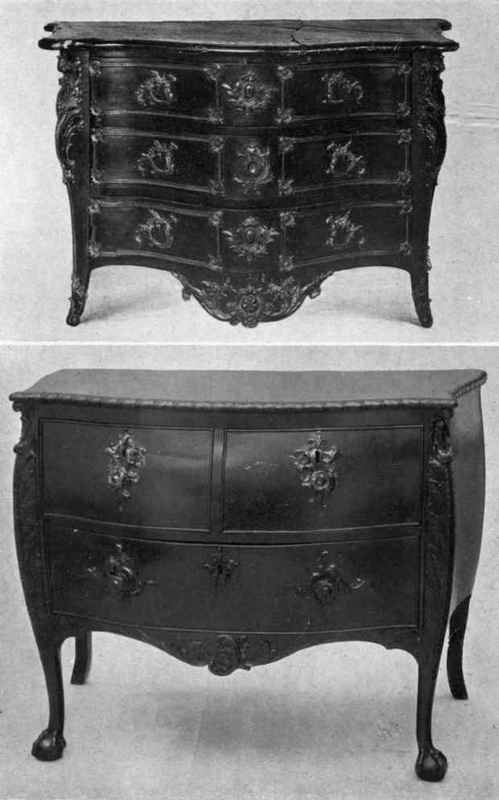
Plate LXV - Louis XV. Bureau-Commode with Bronze-gilt Ornamentation and Leaf Shoes Chippendale Bureau-Commode - Metropolitan Museum
China ware was at such a height in Chippendale's day that it is not surprising to find a great number of china-cases, shelves, cupboards and cabinets made purposely to display it. As a rule, the decoration of these was a conglomeration of Chinese motives: fretwork, pagoda roofs, mandarin-hats, little bells, leaves, scrolls and dripping-water. One of these he describes as "a very neat china-case upon a frame with glass doors in the front and ends; betwixt the middle feet is a stretcher with a canopy which will hold a small figure."He adds that" the design must be executed by the hands of an ingenious workman, and when neatly japanned will appear very beautiful." China-cases were to be made of "soft wood and japanned or painted and partly gilt" and one "very proper for a lady's dressing-room may be made of any soft wood and japanned any color."
"The china-case when carried out in the Chinese taste was usually crowned with a pagoda-shaped dome, a treatment extended to any wings abutting on the main or central portion of the body. The case proper was glazed, the glass being contained in lattice-work of a more or less Eastern character. Generally speaking these models rested on legs and feet, the decoration to which was in keeping with the rest of the scheme. From the eaves of the pagoda hung little ivory ornaments and the general effect arrived at suited the china of the period admirably. It would almost seem as though Chippendale had realized that of all the porcelain that had been produced or were to come, none would blend with his productions so happily as did those of the Oriental school."1
1 Wheeler.
Ince and Mayhew also made china-cabinets and china-shelves in the fantastic "Chinese taste" of the day which are so like Chippendale's productions that it is almost impossible to distinguish them.
The French corner-cabinets, or encoignures, of which a beautiful example of late Louis XV. is shown on Plate LXIL, were also of great importance during the Eighteenth Century in both England and France.
Continue to:


My Books

