


The Bureau
Description
This section is from the book "Furniture", by Esther Singleton. Also available from Amazon: Furniture.
The Bureau
The word bureau seems to have been used before the Seventeenth Century to describe a table or a counter covered with a rough kind of cloth called drap de bure. About 1650, upon it was placed a little box with drawers supplied with a flap to let down. In other words the Spanish cabinet - the vargueno - became the desk. (See Plate LVIII.)
The bureau of Marechal de Crequi and that belonging to Marie de' Medici, both in the Cluny Museum, are splendid examples of the type of bureau that dates from the first half of the Seventeenth Century. They are of rosewood incrusted with copper, shell, and other metal in the style that Boulle brought to such perfection. The Crequi piece dates from 1638 and is really a cabinet standing on a table supplied with drawers. The second piece, which tradition gives to Marie de' Medici, is mounted on eight balusters with capitals joined four on each side by stretches, and supplied with two drawers on each side of the table, and surmounted by an upper box composed of eight drawers and a panel that opens. (See Plate LXVIII.)
There seems to have been very little, if any, difference between the bureau and bureau en commode. The Duchess of Orleans, for instance, had a walnut commode three feet seven inches long and two feet wide, having three drawers with iron rings, and the Duke had a bureau en commode, three feet, five inches long, with two drawers with iron rings. Madame de Maintenon owned a walnut bureau inlaid with ebony, with seven drawers on each side, each having copper-gilt key-plates. (See Plate LXV.)
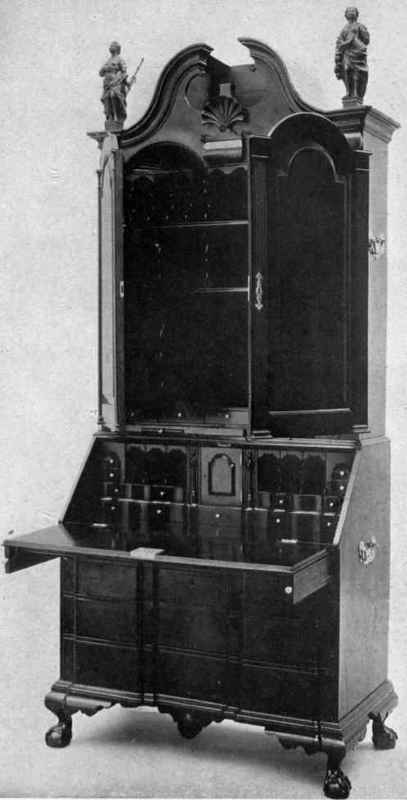
Plate LXIX - Eighteenth Century American Desk and Bookcase - Metropolitan Museum
The bureau, however, was a desk, while the commode was more of a dressing-table.
In the reign of Louis XV. the long bureau table was a favorite form of furniture, and sometimes at one end of it was placed a case of shelves, drawers, or pigeon-holes that was known as serre-papiers. Sometimes the serre-papiers was surmounted by a clock. (See Plate CX.)
The bureau or desk was of great importance in this reign, when the roll-top or cylinder bureau was invented or made popular by the Prince de Kaunitz, Maria Theresa's ambassador to France, from which it derived its name, "bureau a la Kaunitz." To this reign belongs the famous bureau du roi, which most critics consider the most beautiful piece of furniture of the Eighteenth Century. It was ordered for Louis XV. from J. F. (Eben who died before it was finished. Riesener completed the work and placed his signature upon it in 1769. How much Riesener did upon it is not known. Before OEben died, however, the model in wood was constructed and the bronzes had been modelled and cast by Duplessis, Winant and Hervieux; but the piece had to be brought together as a complete whole, the marquetry was not made, and the cylinder had to be combined.
The bureau du roi is five and a half feet long and three feet in depth. It is made of rosewood and amaranth, richly decorated with Riesener's best marquetry, representing flowers, leaves and attributes of royalty and poetry. The or moulu mountings are magnificent. There are swags of leaves, laurel wreaths, knots of ribbon, an open-worked gallery placed on a horizontal ornament of rods twined with ribbons, above the cylinder top, broken in the centre by a clock upon which two Cupids are playing, and on each side of the cylinder is a reclining figure of gilt bronze holding a flower that is intended for a candlestick. The back of this bureau is as finely decorated as the front. The whole work is admired for its form, its beautiful proportions, its fine lines, its simplicity, its or moulu work, its marquetry and the exquisite workmanship it represents.
This bureau was in the Tuileries in 1807; was removed to the Palace of St. Cloud by Napoleon III., and from there to the Louvre in 1870.
A similar bureau was made for Stanislaus, King of Poland, and also a copy by Zwiener of Paris is in the Wallace Collection. (See Plate LXVIII.) Other reproductions were made of this work and many other fine bureaux also went from Riesener's workshop, large and small, more or less decorated with bronzes, all of which prove how greatly this form was liked. A cylinder bureau of Riesener's second style, long at Trianon, is now in the Musee du Mobilier national. This is decorated in his favorite lozenge-shaped marquetry and ornamented with bronze.
A superb bureau made by Dubois, who frequently worked from designs by Pineau, is in the Wallace Collection. The desk and cartonnier are in green lacquer, ornamented with chiselled bronze, the feet being sirens and the serre-papiers surmounted by figures of Cupid, Psyche, Peace and War. This bureau was said to have been a present from Louis XV. to Catherine II. of Russia. To this period also belongs the delicate little desk or bureau designed especially for the boudoir and called bonheur du jour. It closed with doors, or a flap, which, when let down, formed the writing table. Behind the flap was an array of pigeon-holes and drawers which were generally lined with blue velvet. The bonheur du jour was variously ornamented with marquetry, or plaques of Sevres porcelain, and adorned with delicate or moulu mounts.
The desk that became popular in Queen Anne's day, standing on a frame supported on four cabriole legs, and with slanting flap that, when let down and supported on slides or rests, forms the table for writing, is precisely the same form; but it is interesting to see how much heavier the Anglo-Dutch writing-desk or "scriptor" is than its French relative. Instead of the gilt leaf-shoe, we have here the claw-and-ball foot, and the old cabinet arrangement of pigeon-holes and drawers is designed to hold documents and more serious correspondence than the perfumed missives of a Pompadour or a Du Barry.
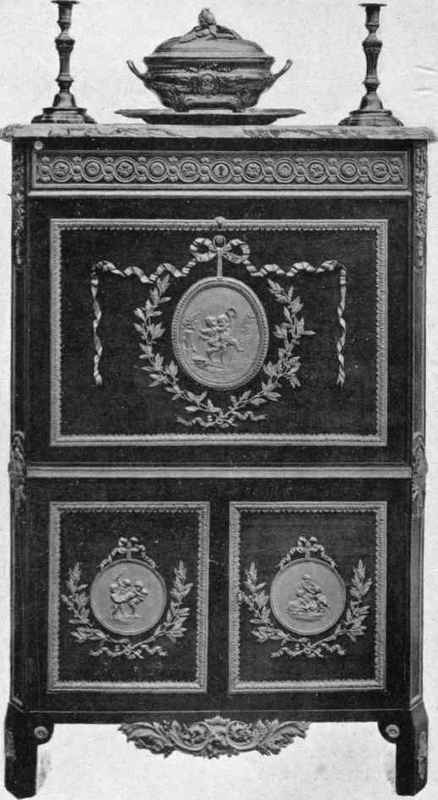
Plate LXX - Louis XVI. Secretary. Mahogany with Bronze-gilt Ornamentation
This, however, was not the only bureau of the period. Another form is the simple one as shown on Plate LXVIL, and another brings us back to the old armoire in two parts; the lower one consisting of a series of drawers reaching to the floor, while the upper part is a combination of bookcase and writing-desk (see Plate LXIX.).
Chippendale designed a great deal of library furniture; and many of his bookcases which follow the forms of the ancient armoire are combinations of bookcases and desks, and follow in the style of their ornamentation "the Gothic or the Chinese taste." Some of the bookcases contain a writing-drawer. One writing-table and bookcase for a lady has "the middle feet come out with the drawer, which hath a slider covered with green cloth or Spanish leather for writing upon."
Chippendale's bookcase, with glass doors, is much used to-day for the display of china. The base generally contains cupboards or drawers and sometimes the arrangement consists of a cupboard in the centre with a tier of drawers in each wing. The broken pediment often surmounts the cornice. Chippendale's lattice-like traceries for the glass panes are very decorative and very varied. He published a great number of designs for these.
Heppelwhite made desks after the styles that had become fashionable in his day. He made combination desks and bookcases and generally of mahogany, with drawers and internal conveniences of great variety. He also varied the patterns of the bookcase doors. "On the top, when ornamented," he says, "is placed between a scroll of foliage a vase, bust, or other ornament which may be of mahogany, or gilt, or of light-colored wood." He also made cylinder-shaped desks and often used a tambour-shutter with which to close them. In this shutter the reeds were horizontally placed, a form familiar now in the commonest office-desks.
Sheraton was also fond of the ornamental glass door for his bookcases, china cabinets and cupboards; but, as a rule, he instructed his customers to place green, pink, or white silk behind the glass. Many of his bookcases are a return to the ancient type of armoire a deux corps, the lower part being a desk and the upper part a series of shelves enclosed by wings, or a series of pigeon-holes and compartments. The example from the Metropolitan Museum on Plate LXIX. shows this form.
Plate LXX. and Plate LXXI. take us back to the old cabinet on a stand of the form shown on Plate LXIX.; although both are secretaries. The first is a secretary of the Louis XVI. period, made of mahogany and decorated with medallions representing children, garlands of leaves, ribbons, friezes, and cul-de-lampe of bronze gilt. The second piece is an Empire writing-desk with delicate bronze ornaments.

Plate LXXI - Empire Secretary - Metropolitan Museum
Continue to:


My Books

