


Louis XVI. Style
Description
This section is from the book "Furniture", by Esther Singleton. Also available from Amazon: Furniture.
Louis XVI. Style
Towards the end of the Louis XV. period, the general outlines of furniture become less carved and the straight line gradually asserts itself. Indeed, as early as 1760 some very straight, severe and heavy models appear, particularly those of Delafosse, and ultra-classic tendencies begin to predominate.
The general effect of Louis XVI. furniture lies in the almost exclusive use of the straight line. The curves that were so characteristic of the Louis XV. period gradually disappear, the rounded corners give place to the sharp angles and the curved, swelling leg becomes straight. The function of each part is plainly indicated; for instance, a foot is no longer concealed beneath a leafy scroll: it is a foot plainly seen; a drawer, or a door, is plainly indicated; and the handles that in the last period issued from dragons' tails, wings of birds, or spiky leaves, are banished for knobs, rings and rosettes. The construction of Louis XV. furniture was conceived from the point of view of the cabinet-maker and worker in wood; on the other hand, the Louis XVI. furniture follows the design of classic architecture - every object is separated into three distinct parts; and these different parts are outlined plainly with mouldings, headings and other ornamental motives that are never found in the age of Louis XV.
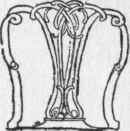
Chair-Back By Chippendale, 1754
Ornaments of the style of Louis XV. died hard, however; and we constantly find them upon pieces of furniture that show a very high development of the style Louis Seise.
Many different causes contributed towards a change of style. About 1748, the excavations at Pompeii and Her-culaneum (discovered in 1719) were begun. Caylus published his Recueil d'antiquites 1752-1762; and Winckel-mann his works on Greek art in 1754 and 1764. Another contributory influence was the publication of Piranesi's drawings of Etruscan, Egyptian, Greek and Roman architecture.
"Piranesi's work inspired many a founder, for example Thomire. As for the Egyptian Style, it is an error to believe that it originated in France after the expedition to Egypt. After this event, it is only just to note that it returned in favor; but towards the end of the reign of Louis XV. and during that of Louis XVI. this style flourished under the hands of the French artists. Gouthiere chiseled figures in the Egyptian style for the Due d'Aumont. The collections of antiquity engraved and published in France were quite sufficient to account for the flowering of a style, the dry and straight lines of which frame so well the strange idea that it was all developed from Greek and Roman art." 1

Plate XXXI Louis XV. Encoignure and Lady's Work-Table
The taste for the antique quickly took root, and was greatly favored by Madame de Pompadour.
The decorations and furnishings of Madame Du Barry's Pavilion de Louveciennes, moreover, were entirely in the new taste, - so much so, in fact, that modern criticism is sometimes disposed to call what has so long been called the style Marie Antoinette, the style Du Barry.
Gouthiere, doreur et ciseleur du roi, worked here, and many of the charming pieces in the Jones Collection in the South Kensington Museum, give an idea of what was produced at Louveciennes. Jean Francois Leleu was another who worked for Madame Du Barry.
During this period the designers were fortunate in having such skilful artisans as Dugourc, Cauvat, Prieur, Forty, Car-lin and Riesener to realize their compositions.
Many of the designers who became identified with the Louis XVI. Style had published works in the reign of Louis XV. One of these is Neufforge, a native of Liege. Among his productions are tables, commodes, sofas, cabinets, buffets, armoires, clocks, and consoles. Some of the designs are in the style Louis Quinze; but his works afford a complete view of the exterior and interior decoration of the style Louis Seize.
Another famous designer who overlaps the periods is Delafosse, who designed every kind of furniture and ornament, trophies and pastoral attributes, as well as ornamental devices in which musical instruments figure and attributes of painting, hunting, fishing, etc., etc. His sofas, chairs, beds, couches and settees are all in the newest taste of the day, so much so in fact that he is regarded as one of the leading exponents of the Louis XVI. Style. The "genre de la Fosse " is often used to designate both his productions and those of his followers.
Boucher, the son of the famous painter, was also a decorator whose designs for rooms and furniture give a correct idea of the Louis XVI. Style.
The artist in whose work we can best follow the evolution of the general lines of the furniture of this part of the Eighteenth Century is Jean Henri Riesener (1735-1806). One great interest in Riesener's furniture is that it exhibits the transition between the two styles of Louis XV. and Louis XVI.
Riesener's great forte was marquetry-work. Many models were furnished him by Jacques Gondouin (1737-1818), the architect and pupil of Blondel, who was a great lover of the Greco-Roman style. Gondouin was a designer for the furniture for royal residences. Riesener worked in both styles - the old and the new; and as Riesener did not die until 1806, he made a great deal of furniture. His most famous work was the Bureau de Louis XV. which he signed, but which was really begun by OEben. It is a cylinder desk in the shape that was new in those days, and it is decorated with magnificent marquetry and flowers and trophies of poetry and war. The splendid bronzes that adorn it, long attributed to Philippe Caffieri, were designed by Duplessis and Winant and were made by Hervieux. They include two bronze figures, Apollo and Calliope, who hold girandoles with two branches, a clock with figures of children, bas-reliefs and other ornaments. Riesener signed the work and dated it 1769 "a 1'Arsenal a Paris." This is now in the Louvre.
Continue to:


My Books

