


The Mirror. Part 2
Description
This section is from the book "Furniture", by Esther Singleton. Also available from Amazon: Furniture.
The Mirror. Part 2
The great carver, Grinling Gibbons, made a number of exquisite mirror-frames with beautifully executed flowers and fruits; but the richly carved frame of his style soon changed for that of Louis XIV. French mirrors were now imported into England. Many Huguenot refugee workmen now made frames in England in the French style and after designs of Marot. Instead of the great wreath of flowers and fruits, the decoration motives were heavy garlands of the bell-flower, the scroll, the mascaron and the urn.
When the Dutch styles came in with William and Mary the mirror frames were often inlaid with colored woods in the new taste.
A Queen Anne mirror, oblong in shape, with elegantly carved gilt frame, the design being foliage and gadrooning, was recently sold in London for £26; and one of the William III. period in English marquetry frame, with flowers and foliage, beautifully inlaid in colored woods and ivory on a walnut ground, for £43.
The mirror was equally if not still more important in the days of Louis XV. The frames are most ornate for pier-glasses, smaller mirrors and sconce arms which often encircle or spring from the frame of a looking-glass. The decorators of the day give many designs in which the curve is exhibited in every possible contortion. There are leafy scrolls, chutes of leaves and husks, shells, mascarons, flowery branches, crawling dragons, serpents, monkeys and mythological figures that are more and more fantastically treated until the styles change again.
Chippendale, being a carver, naturally delighted in designing frames for pictures and mirrors. In his day the tall pier-glasses between the windows were as important as the mantel-glass, and were frequently carved to correspond. Moreover, the girandoles that carried the side lights for the drawing-room and dining-room and which were hung on either side of the mantel-piece, were also furnished with a looking-glass, not only for ornament, but for the purpose of reflecting the lights of the candles and rendering the room more brilliant. Chippendale's frames naturally show him when he is perhaps in his most characteristic moods. They bristle with spiky leaves in which long-tailed, long-beaked birds peck at scrolls, leaves, and icicles, and sometimes squawk at mandarins standing under pagodas. Subjects from mythology and AEsop's Fables are blended with Chinese motives or the fantastic scroll and leaf-work of the Louis XV. Style which Chippendale used so beautifully. He was very clever - as clever as the French designers - in making the sconce-arms emerge from the leaves or scrolls in natural and graceful sweeps.
The Chippendale mirrors are frequently in several divisions; but the union of the separate plates is always hidden under the foliage or the rock and shell-work. Chippendale mirrors now bring large prices. Within the past five years the following sums have been realized in London:
A Chippendale gilt mirror, with three lights, 5 feet, 6 inches high and 4 feet wide, scroll frame with floral border, £89; a pair of Chippendale girandole mirrors, 4 feet, 5 inches high, 1 foot, 5 inches wide, gilt and carved in Gothic design, £27; a pair of Chippendale mirrors, 8 feet long, 3 feet, 6 inches wide, with Vauxhall plates in two divisions, scroll and floral carved frame, surmounted with masks, £79; a Chippendale mirror, carved and gilt, 7 feet, four inches long, 4 feet, 2 inches wide, 90 guineas; a Chippendale bevel-edged mirror, 7 feet high, 3 feet wide, upright black frame with festoons of flowers, foliage, rosettes, acorns, and arabesques in relief, 38 guineas.
Cornices were also carved in sympathy with the mirrors, and other furniture and wood-work of the room. In the bedrooms the window-curtains matched those of the bed.
The American colonists always kept up with the latest fashions in England. In the wealthy houses of both North and South the newest styles in silver and furniture were always to be seen. In the early days when mirrors came into use in England, the landed proprietors here had them also. The old inventories are full of entries of looking-glasses with olive-wood frames, looking-glasses with black lists, etc., etc.; and as the years go on and fashions change, the items in the wills and inventories show that the rich householders constantly bought the newest and the latest articles in furniture. Even if this were not the case, the many advertisements in the current newspapers of importations from London and the many cards from carvers and gilders and looking-glass makers who offer to remodel old glasses, cutting them into the correct shapes and sizes and framing them in the newest styles, show that there was a great demand for such work. A glance through the old New York newspapers shows the following facts:
In 1730 "James Foddy, Citizen and Glass-seller of London, who arrived here at the end of last June and brought with him a parcel of very fine looking-glasses of all sorts," acquainted the public that he " undertook to alter and amend old looking-glasses."
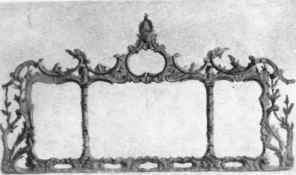
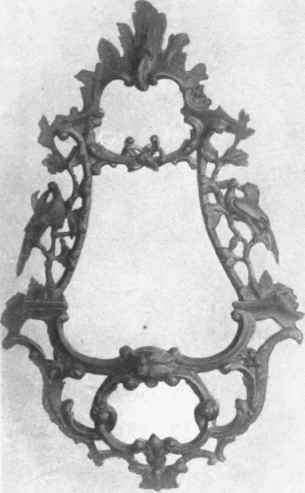
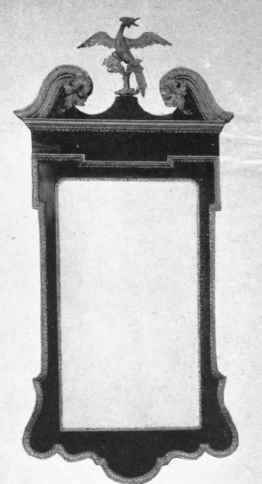
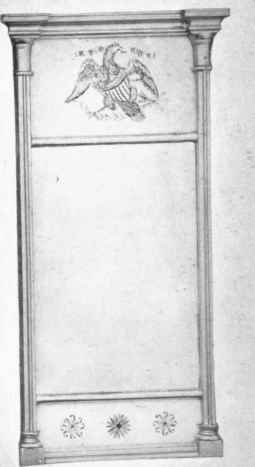
Plate CXVI - Chippendale Gilt Mirror Frames; Chippendale Walnut an Gilt Mirror Frame - American Gilt Frame Mirror (1800-1825) - Metropolitan Museum
In 1735 Mr. Duyckinck, at the Sign of the Two Cupids, near the Old Slip Market, had new looking-glasses and frames plain japanned or flowered.
Towards the middle of the Eighteenth Century chimney-glasses with carved walnut or gilt frames, valued at from thirty to eighty pounds, were not uncommon in rich New England houses. They were often supplied with arms for candles. A gilt-edged walnut frame in 1748 is valued at 120 pounds, and another with walnut frame and brass arms at 37 pounds, 10 shillings. All through the last threequarters of the Eighteenth Century mahogany was used for frames, and also pine-wood stained to resemble mahogany. Walnut and gilded wood was a very popular combination and the carved and gilded frame always held its own.
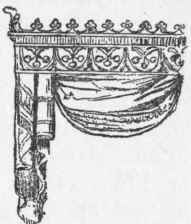
Cornice For Window-Drapery, By Adam
Continue to:


My Books

