


Gems. Part 3
Description
This section is from the book "A History Of Furniture", by Albert Jacquemart. Also available from Amazon: A History Of Furniture.
This section is from the "" book, by .
Gems. Part 3
Hence we can do no more than contribute towards such a study, by here reproducing the names that, after careful inquiry, the most distinguished writers on the subject have associated with genuine and recognised works: -
Admon.
Aelius *.
Aepolian.
Aetion *.
Agathangelos.
Agathemeres *.
Agathon.
Agathopos.
Alexa.
Allion
Almulus?
Alpheus and Arethon*.
Amaranthus. Ammonius *. Anteros*. Antiochus *. Apollodotus*. Apollonius*. Archion. Ariston**. Aspasius*. Aspus. Athenion*. Aulus*.
Axeochus *.
Bisitalus.
Boethius.
Caius.
Carpus *.
Chaeremon.
Charitus.
Chryses.
Classicus.
Cleon.
Cneius *.
Coenus.
Cronios.
Demetrius*.
Denton.
Diocles.
Dioscorides **.
Epitonus.
Epitynchanus **.
Eutyches.
Evhemerus.
Evodus •*.
Felix *.
Gamus.
Glycon **.
Helus*.
Hellen *.
Hyllus**' (often spurious).
Irenaeus.
Lucius.
Midias.
Mitharnes or Mithridates.
Mycon.
Myron.
Myrton.
Neisus or Nisus* Nepos. Nestor. Nicander. Nicomachus. Onesas*. Pamphilus **. Panseus. Perganius*. Pharnaces *. Philemon *. Phocas. Phrygillus *. Plato.
Polyclitus *. Polycrates *. Polytimus. Pothos. Protarchus *. Pyrgoteles? Rufus. Scopas*. Scylax*. Scymnus *, Seleucus *. Severus. Slecas. Socrates. Solon *. Sostratas *. Teucer *. Thamyrus *. Tryphon *.
In this list we have marked with one asterisk the names of the more celebrated engravers, and with two those whose works are preserved in the Paris Cabinet of Models, more especially Hyllus, whose best authenticated piece is our gem engraved with the bull of Dionysius. The names in italics are those of Italian or Roman engravers. To that of Pyrgoteles is attached a mark of interrogation, because it is uncertain whether the gems bearing it may not be the work of forgers, though that in the Blacas. collection may seem worthy of this master.
As might be expected, from the numismatics of the times, the Lower Empire is a period of rapid decline in the glyptic art. The iconographic subjects are so feebly executed that it becomes very difficult to detect the likenesses, or identify the effigies. Some stones with religious emblems are rather superstitious amulets than works of art, as may be seen from the legend on the setting of a blood-red jasper, representing Christ blessing and holding the Gospels: "Sortilegis vires et fluxuni tollo cruoris" (1 arrest the sorcerer's power and the issue of blood).
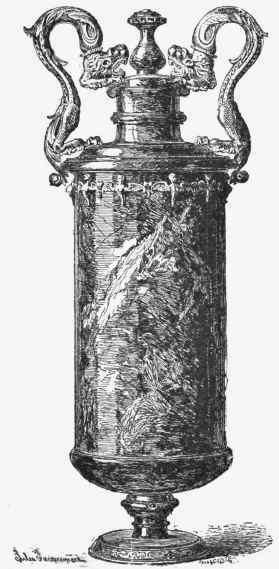
Oriental Jasper Vase, with enamelled mounting; attributed to Benvenuto Cellini. Period of Francis I. (Louvre.).
This brings us naturally to the subject of talismans or charms. Those stones called gnostic, works of a philosophic sect sprung of the Assyrian, Persian, Indian, and Egyptian doctrines, were as widely diffused during the first six centuries of the Christian era, as were the ideas embodied by them, ideas against which the Fathers of the Church had to contend so vigorously. At present the strange designs on these talismans are as obscure as are their cabalistic legends. But, as they have no interest from the artistic point of view, those desirous of making themselves acquainted with the present state of our knowledge on the subject, are referred to the ample notice devoted to it by M. Chabouillet in the general catalogue of the engraved gems preserved in the Paris National Library.
The Middle Ages, strictly so-called, did not practise the art of gem engraving, which did not again assert its true importance till the time of the Renaissance, when every description of material was brought into requisition. Italy, in which the movement was developed, under the influence of the recently exhumed ancient monuments, seems, at first, to have aimed at nothing beyond imitating, with equal taste and skill, the works of the Greek engravers; and this imitation is often so perfect as in many instances to perplex the most expert connoisseurs.
But artists, such as those of the Renaissance, could not long remain content with walking in the footsteps of others. Their own individuality strove to assert itself, and the pictorial art of their contemporaries, the representation especially of subjects associated with the Christian belief, exercised an irresistible power over their restless imagination. The best and oldest cameos are the Adoration of the Magi, and the Brazen Serpent; then come the busts of Louis II., Marquis of Saluzzo, and of Charles d'Amboise, Lord of Chaumont, and art critics have thought there is sufficient reason for crediting these two latter works to the Italian Domenico dei Cammei, so called from his exceptional skill in the art to which he devoted himself.
Continue to:


My Books

