


Louis Quinze
Description
This section is from the book "How To Collect Old Furniture", by Frederick Litchfield. Also available from Amazon: How To Collect Old Furniture.
Louis Quinze
About this period, and during the reign of Louis XV the manners and customs of the French aristocracy underwent a change; it was the age of the Boudoir rather than of the Salon de Reception, with smaller rooms, in which people lived and talked, and naturally there was smaller and less cumbrous furniture. The family of Martin made their famous Vernis Martin panels, enriching the more fanciful furniture of the period, metal mountings became more ornate and highly chased and finished, and towards the latter part of the reign decoration and wood-work became rococo and over-ornate, and design, which in the time of Louis Quatorze had been dignified, became debased by redundant and excessive ornament, a salient feature being the conventionalized curled endive.
Caffieri was the most famous mounter in bronze of this period, and was largely employed by King and Court. His designs were quaint, but somewhat rococo, introducing the Chinese mandarin and dragon, the pagoda and other eccentricities into his scheme of ornamentation. Monkeys playing with a skipping rope, and other odd and curious conceptions, gave to his designs a fanciful and grotesque effect, but possessing great merit by reason of the vigour and spirit of the work. Any piece of furniture mounted by Caffieri now realizes an enormous price, but copies of his designs, with the exception of those made by first-class makers, lack all the merits of his original work, and are only frivolous and rococo pieces of metal enrichment, appealing to those who like plenty of ornament, but are not too critical as to its quality.
As the habits of French society became more social and less formal, the fashion of furniture followed suit. Instead of the stately fauteuil of Louis Quatorze, we have the word chaise as a diminutive of chaire coming into vogue, and in place of the tapestry covering of Beauvais, with representations of a boar hunt or the chase, we have the looms of Aubusson or of Gobelins, furnishing the smaller and more domestic subjects for tapestry coverings. La Fontaine's fables, bouquets of flowers, representations of courtly gentlemen and charming ladies conversing or dancing, are the subjects for the chaises, the fauteuils, the canape's, and bergeres of the period. The canape was a sofa or settee large enough to hold three persons, as distinct from the causeuse, which only accommodated two. The bonheur du jour, a little cabinet table suitable for a lady's room, came in about this time. The cartonniere, a table with an arrangement for the storage of papers; the escritoire of a lighter description than formerly, the chaise-longue, and other useful and decorative articles were made during this reign. Our own comfortable English sofa, the "Chesterfield," has no counterpart in French furniture; and the chaise-longue is the nearest approach to a lounge.
The canape, or French sofa, is by no means a luxurious seat, being to all intents and purposes an upholstered settee, which, however beautiful and valuable its tapestry covering, would not rest the tired owner, like our own English sofa.
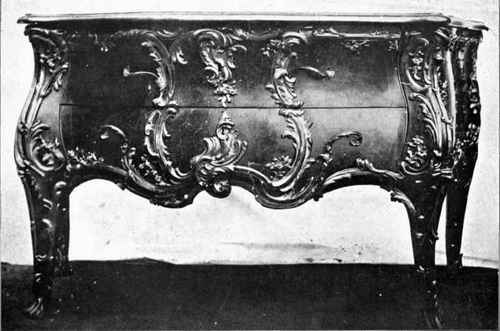
FRENCH COMMODE, PROBABLY BY CRESSENT, WITH FINE GILT MOUNTS.
(louis quinze).

A CANAPE, OR SOFA OF LOUIS XV PERIOD, CARVED AND GILT FRAME, WITH AUBUSSON TAPESTRY.
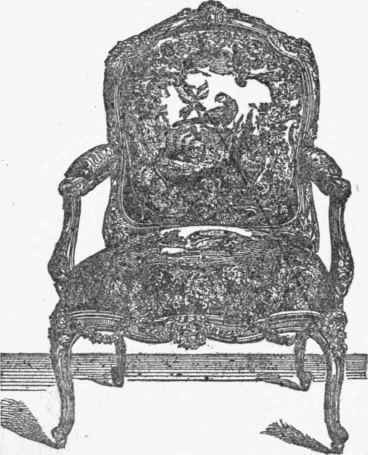
FAUTEUIL OF LOUIS XV PERIOD, CARVED AND GILT FRAME COVERED WITH AUBUSSON TAPESTRY.
A French suite of furniture of this period comprised the canape, two or four fauteuils or armchairs, and four or six single chairs, or chaises. The accessory furniture would be the above-mentioned chaise-longue, a pair of bergeres, which were easy chairs with padded arms, and perhaps some elegant footstools with carved and gilt frames.
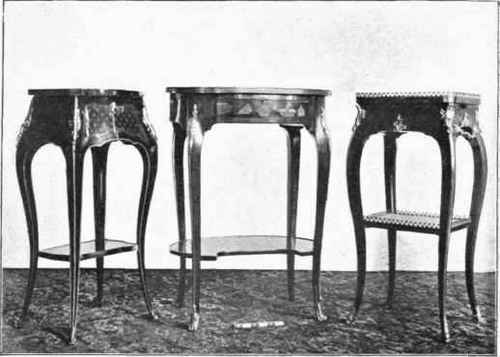

FRENCH OCCASIONAL TABLES WITH GILT MOUNTS LOUIS SEIZE.
Continue to:


My Books

