


The Renaissance - And After. Part 2
Description
This section is from the book "Old Oak Furniture", by Fred Roe. Also available from Amazon: Old Oak Furniture.
The Renaissance - And After. Part 2
It is curious to find that the severely classic style, with round arch and fluted pilasters on the panelling, came into vogue in some cases at startlingly early dates, while the pointed arch, with its Gothic tracery, was being carried on in the immediate vicinity with scarcely a sign of change. At the Cross Keys Hotel at Saffron Walden is an inlaid classic panel dated 1569, and of style which might be readily mistaken for work of the middle of the seventeenth century, while on Market Hill, in the same town, is a huge timber house with traceried windows and a pointed door, which to lovers of architecture is deeply interesting, as showing that the fusion of the Gothic and Renaissance styles, or rather the replacement of one by the other, was accomplished only with great difficulty. What has actually happened is this: the house has been doubtless enlarged at various periods, the earliest portion, which exhibits some very good Perpendicular windows with oak mullions, bearing the veritable date of 1600 carved on its woodwork, actually thirty years later than the classic panel in the Cross Keys. Then follows an extension, bearing the date 1625, in which certain features in the decoration of the earlier part are fairly adhered to, though with more recent developments in detail.
Again comes a later extension, dated 1676, this portion exhibiting some gigantic figures with long-skirted coats and square, high-heeled shoes worked on the pargeting.
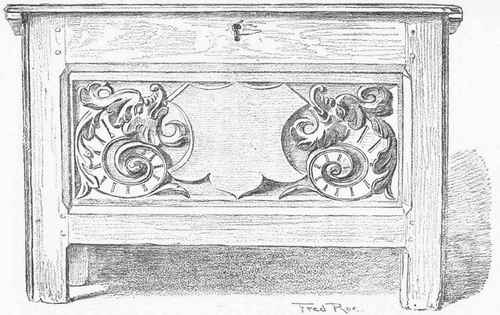
COFFER CARVED WITH DOLPHINS AND SHIELD, TEMP. HENRY VIII.
Even the novice can hardly help remarking how frequently conventional representations of the dolphin appear among the decorations of furniture made during the first half of the sixteenth century. Its use may be an echo of heathen mythology, or merely attributable perhaps to the adaptability of the form to decorative purposes. The most probable explanation of the use of this device, however, is that it became popular in England after the meeting of the English and French monarchs at the Field of the Cloth of Gold in 1520, the dolphin being primarily adopted by our own designers as a compliment to the alliance between the two nations. In the arabesques which were employed in the surface decoration during the early Renaissance the dolphin finds a place that appears almost natural, so admirably is its form adapted to the associated ornament, for the so-called arabesques of the Renaissance differ from their Arabian prototypes by introducing the animal form forbidden by the Mohammedan religion.
The peculiar aspect of the wood in certain old pieces of furniture has given rise to the theory, advanced by even serious men, that the material was not sawn or planed, but was split from the heart of the tree by means of iron wedges. It would, however, be obviously impossible to split heart of oak into such shapes as would be required by any method approaching to this. We have no knowledge of the genesis of the plane, but one thing is certain: mouldings in early-furniture were assuredly not worked complete with such planes as we know now, the unevenness of the members plainly proving this. Linen panelling is nowadays manufactured by the mile, being run out in vast lengths, cut up into sections, and the ends of the drapery then added. In the early days we are speaking of every hollow and bead had to be worked out by itself, giving a much greater freedom of handling.
It is not until we reach the period coeval with the reign of Elizabeth that we are able to find chairs, chests, cupboards, and other pieces of furniture in sufficient numbers to come within the scope of the ordinary collector. There is no doubt that internal trade and manufactures increased enormously during the reign of Elizabeth. The devastating effect of the Wars of the Roses had entirely died out, and the rapidly - growing population had settled down to peaceful arts and the luxuries attendant upon increased wealth. I am myself inclined to the belief that the growing use of brick, instead of timber and plaster, for the purposes of domestic architecture is to some extent responsible for the better preservation of Elizabethan houses and their contents.
Although the origin of the Elizabethan style was classical, there is no getting over the fact that its characteristics were often nondescript. Its classicalism was less pure than that of the early Renaissance that preceded it or the Jacobean that followed it. Some of its idiosyncrasies are purely national inventions, and cannot be traced to any prior source. It is difficult to explain the origin of certain details which came into prominence in design during the latter half of the sixteenth century - such, for example, as the strap moulding. The carved frieze in the dining-room at Haddon Hall, executed in Henry VIII.'s reign, exhibits some very delicate and beautiful specimens of the earliest form of interlaced strap, the development of which, later on, became extremely popular.
The art of inlaying with coloured wood was extensively practised during this period upon the finer productions of the craftsman. This art does not appear to have been adopted in England before the Renaissance, and when first used in this country frequently took the form of covering bare, flat surfaces with a monotonous diaper of design. It is astonishing how ugly and inartistic inlaid wood may be made. The true function of colour is to give expression and relief to form, and unless inlay is employed as an adjunct to carving, the effect bears some analogy to sauces without meat.
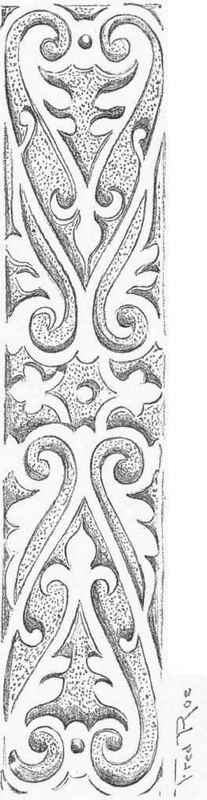
STRAP CARVING, FROM A CABINET, DATED 1594.
The pointed arch was occasionally used in the decoration of woodwork during Henry VIII.'s time, though it was, to a certain extent, unfashionable; but when Mary came to the throne it seems to have become almost entirely superseded by the round arch, which, however, was occasionally flanked by Gothic spandrills. A singular form of strap moulding may also be found somewhat resembling in design the SS collar. This description of strapwork is one of the rarest forms of decoration on Elizabethan furniture. The single and double guilloche was also freely used. In late Gothic times a species of diaper, formed by intersecting circles, was used for decorating furniture, and in the course of development the designer abandoned a portion of these circles, with their accompanying leafwork or cusping, leaving only the old sinuous ornament of Romanesque times, which thus becomes one of the commonest forms of decoration during the Jacobean period. It must always be borne in mind that the rough farmhouse dresser adorned with pewter plates which our art students affect nowadays in no way resembles the splendid productions made for the mansions of Leicester or Bess of Hardwick. There is a popular impression among certain classes that old things must necessarily be good.
Continue to:


My Books

