


The Renaissance - And After. Part 3
Description
This section is from the book "Old Oak Furniture", by Fred Roe. Also available from Amazon: Old Oak Furniture.
The Renaissance - And After. Part 3
The jerry-builder, however, is not exclusively a modern production any more than his counterpart in the furniture trade. The finest productions of the old makers and the coarser counterparts of the same period bear in a way an analogy to the manufactures of the modern makers.
The diamond, or lozenge, which we so often find carved on the backs of chairs and panels of chests and cupboards, is also a feature of this style. It may be generally considered a late characteristic of Renaissance decoration, seldom appearing as early as the reign of Elizabeth, being more often associated with Cromwellian and even later times. I have seen a chair of late appearance with the diamond on its back panel and dated a few years after the middle of the sixteenth century, but I have very strong doubts as to whether the date was authentic, though the chair itself was undoubtedly genuine.
We frequently find in Jacobean pieces of furniture that the edges of certain portions, such as the sides of chair seats or the edges of styles, are decorated with a small scoop moulding, presenting a serrated appearance. This feature would appear to have come into vogue during the reign of Elizabeth, when it was but sparingly used. It was, however, not unknown in earlier times, for some few late Gothic pieces remain which exhibit this characteristic. It was a cheap and easy method of ornamentation, and to this is due the fact that in later times, towards the end of the Jacobean period, it was employed to a degree that became perfectly monstrous, often excluding the finer details of surface decoration.
Old furniture with dates carved thereon is always specially interesting, and usually commands higher prices than similar specimens which have no distinguishing dates. It is exceedingly rare to find an example of any description of furniture incised with dates earlier than the reign of Elizabeth, and most of those which exist belong to the latter half of the seventeenth century, or even later. Two chairs which I have noticed were dated as recently as 1792, which may be considered as the very end of what is known as the oak period, mahogany and other woods having then been in vogue for many years. During the seventeenth century many new types of furniture came into fashion - such, for instance, as the long dresser and what is now known as the chest of drawers. The latter were not unknown in Elizabeth's days, but they were of smaller size, and approximated more to the cabinet or secretaire. The 'runners' in old drawers are mostly formed of broad grooves in the sides of the drawers themselves, a corresponding flange of wood being fixed on the interior surface of the chest for them to bear upon.
This detail is usually unnoticed or ignored by the forgers of antique furniture, who generally adopt the simpler device of a lateral widening of the bottom of the drawer.
Furniture of the Jacobean period frequently possesses an architectural character in its design, pilasters, pediments, and perspective views on the panels forming distinctive features, and in these the simple classic taste is strongly observable, the finest pieces being remarkable for the justness of their proportions. In Elizabeth's time the panels of such articles as chests and cupboards were mostly remarkable for their small size, while the mouldings around them were often deep and wide. In the Stuart period, on the other hand, the panels became much larger, while the mouldings were reduced, becoming mere fillets of flattened ogee moulding, and sometimes being dispensed with altogether.
It is extremely interesting to trace the developments in furniture towards the close of and after the reign of Elizabeth - the mingling of the pilaster with the melon bulb, or the remains of it; the degeneration of such details as strapwork; the growth towards severity which took place during the Commonwealth; and the free adoption of the Dutch style after the Restoration. These changes may be more readily traced by the student than those in earlier styles from the mere fact that examples of English oak of these later periods are numerous, and afford an infinite fund of decorative variations. The affectation of the Dutch Renaissance which Charles II. brought over from Holland is a frequent source of error on the part of those who are not thoroughly conversant with the subject. English furniture of the latter part of the seventeenth century exhibiting foreign inclinations is not necessarily to be referred to foreign origin any more than the earlier examples already referred to. It is well known that the Revocation of the Edict of Nantes in 1685 drove numbers of the best foreign craftsmen to these shores. The Dutch fashion, however, was so popular that no opening appears to have been found for the exercise of French influence as far as furniture was concerned.
One of the features of the imported Dutch Renaissance was the liberal use of inlay in such materials as ivory, ebony, and mother-o'-pearl, accompanied by the profuse application of ebonized oblong bosses of the jewel type. Pieces of furniture embellished in this manner are mostly dated in the third quarter of the seventeenth century. Charles II. brought the fashion over from the Hague, and for a brief period it reigned supreme. Furniture of a plainer type about this time often exhibited a conventional representation of the tulip amongst its carvings - a reminiscence of the tulipomania which pervaded Holland. This floral emblem, however, is often the only connection between the two styles of furniture which were being contemporaneously carried on. The plate, representing an oak desk carved with the tulip, and bearing the legend 'Robert Baker, 1660,' which appears in the chapter on 'Furniture with Secret Hiding-places,' should be compared with the frontispiece, showing the beautiful inlaid example, dated 1661.
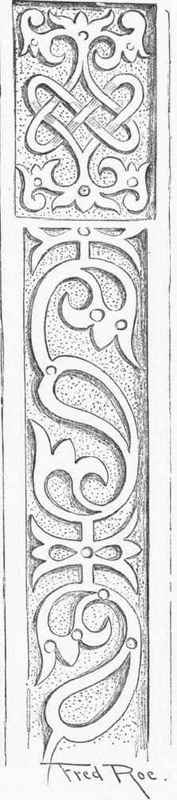
STRAP CARVING, SEVENTEENTH CENTURY.
Continue to:


My Books

