


The Renaissance - And After. Part 4
Description
This section is from the book "Old Oak Furniture", by Fred Roe. Also available from Amazon: Old Oak Furniture.
The Renaissance - And After. Part 4
It is from the reign of Charles II. that we date the introduction of light soft-wood furniture. Its greater adaptability to the handling of the carver speedily made the softer material fashionable, whilst its popularity was also assisted by the vast loads of timber which were shipped over from the shores of the Baltic to make good speedily the havoc wrought by the great Fire of London. It is even asserted, though I cannot pretend to say with what truth, that a certain unpopular insect which nowadays bears the honoured name of one of our oldest titled families came over with the white wood, and, unfortunately, came to stay, and that its uncomfortable presence in England before this date was unknown.
A raised surface in the centre of the panel was much in vogue during the latter part of the seventeenth century, and many of Wren's City churches exhibit this feature in such fittings as their pews, pulpits, and wainscotting. In West-Country cupboards, chests, and settles, dating from the commencement of the succeeding epoch, such panels were frequently headed with an ogee-shaped arch, a curious reintroduction of a Gothic feature.
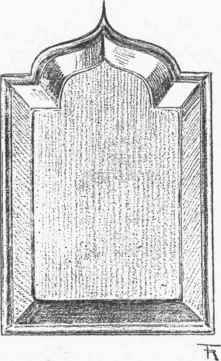
OGEE-TOPPED PANEL, LATE SEVENTEENTH OR EARLY EIGHTEENTH CENTURY.
During the seventeenth century distinctive local types of furniture began to spring into existence. Traces of these differences of type are to a great extent becoming lost, and yearly become more difficult to detect, owing to the removal of pieces from one part of the kingdom to another through sales or change of residence.* One of these local types is the Welsh sideboard or buffet, which attains to the height of three stories, the upper story consisting of a shelf supported by pillars. This emanated almost exclusively from Wales or places on the Welsh border, such as Shrewsbury. From this part of the country likewise comes the high-backed dresser. Dressers of different decorative types may be found all over the kingdom, but those with the superstructure of shelves at the back may usually be traced to the West of England. In Yorkshire and Lancashire, again, we have the excessively high-backed chair - a most uncomfortable piece of furniture, which was certainly not made even so far south as the Midlands.
* Local individualities, which have now disappeared, were common amongst most handicrafts in England during the seventeenth century. The discernment of the Charmouth blacksmith regarding the shoeing of Lord Wilmot's horse during King Charles II.'s flight from Worcester is a striking instance of the readiness with which such county differences were once recognised. 'Lord Wilmot's horse had to be shod ere he could depart, and the blacksmith, . . . noting that the three remaining shoes had been put on in different counties lying around Worcester, pointed it out to the ostler, whose suspicions had already been aroused by the mysterious proceedings of the guests at the inn. . . .' - 'The Flight of the King,' by Allan Fea.
A peculiarity that we find in the Eastern Midlands is the studding of chests with the date and the initials of the reigning monarch in brass or gilt nails. Such initials were sometimes incised and inlaid with lead or pewter, but, though this may have been a local peculiarity, I have not succeeded in identifying it with any particular district. On the investigation of these local types a volume in itself might be written - or might have been some forty years ago, for the conditions of modern life have tended to obliterate the evidence, and what could now be brought together only with infinite pains would hardly be conclusive.
The use of the wood of the pear-tree, followed by mahogany, had already at the commencement of the eighteenth century made oak somewhat unfashionable, but its use still lingered, though it can scarcely be said to have any individual features characteristic of the period. The latest types of old oak are not very interesting, as they are for the most part very degenerate in design and nondescript in style. The mouldings, if any, are flat and meaningless, and the proportions of panels not infrequently bad, while the decoration, when it exists, seems to have been only some weak attempt to imitate a bygone style, to which, at a little distance, the piece seems to belong. A closer examination of such pieces usually discovers essential differences in detail from the style imitated. Eighteenth-century specimens are frequently dated in bold characters, but the poverty of the detail is such that dates are not needed to enable the connoisseur to decide the lateness of their origin. I have myself seen an oak coffer carved with the most extraordinary Gothic arcading, in the centre of which was the representation of a human figure under a canopy.
The sight of this at a little distance would have induced one to believe that a veritable treasure had been discovered, but a nearer inspection disclosed a date somewhere in the eighteenth century, together with the fact that the figure wore a three-cornered hat, a wide-skirted coat, and high-heeled shoes. I do not believe that this absurdity was due to the Strawberry Hill Gothic taste of Horace Walpole. It was the production of some artisan living in some out-of-the-way rural district who knew nothing of fashions in architecture, and had possibly never seen any building of a considerable size except his village church. In fact, it was a survival and not a revival. It is only fair to say, however, that such combinations as these are rare, the oak carving of the Georgian period being generally a bastard representation of Elizabethan or Stuart design.
Allied to this particular class of furniture are many of the pieces which originally emanated from the northernmost counties of England, and on which, during long winter evenings, the isolated farmer or yeoman amused himself by carving roughly-executed 4 designs, bearing a faint resemblance to some decorative style previously in vogue. These are the pieces which the true connoisseur discards or passes by. They have no real decorative importance, and but little intrinsic value.
Continue to:


My Books

