


Colonial And Later Periods. Part 4
Description
This section is from the book "The Old Furniture Book", by Hannah Hudson Moore. Also available from Amazon: The Old Furniture Book.
Colonial And Later Periods. Part 4
The social life in Philadelphia in Revolutionary times was easy and agreeable, consisting of the original Quaker families and another class connected with the government, and these two gave the tone to society. The pleasures of the table were the only luxuries which the sedate Quakers allowed themselves, and the city was famous for the quality of its Madeira and French wines, and the wonderful cooking of West India turtle. In 1778 differences in rank were strongly marked. The labourer wore his leather breeches, checkered shirt, and neat's-hide shoes. The queue or club was still worn by men of fashion; so were rich broadcloth coats of every colour except scarlet, which was seen only on the "backs of soldiers, Carolinians, and dancing-masters." Winthrop Sargent, a Philadel-phian himself, writing of this time, says:
"Silver tankards and china punch-bowls were evidences of prosperity, as were the small mirrors in wooden frames, and the mahogany tea-boards that are still sometimes met with in the lumber-rooms of old-time houses. Glass tumblers were rarely seen, a dipper for the punch-bowl, or gourd or cup for the water-pail supplied those who did not have recourse to the vessel itself."
This latter statement seems hardly compatible with " elegance," but there were certainly great extremes to be met with even in the Capitol City, as Philadelphia was at that time.
When it became fashionable to have tables round or oval, it was no longer possible to use forms or settles at them. So chairs took their place, and we notice with greater frequency in the inventories "sets" of chairs, six, twelve, and occasionally twenty-four. These early chairs, straight-backed (Figure 46), with rush or bass bottoms, or of carved wood or leather, were hard to sit upon, so cushions were provided in large numbers and of varying degrees of elegance. These rush-bottomed chairs with turned wood frames remained in use for many years. They were made with different degrees of elaboration, one of the two in Figure 46 showing a more ornamental banister back (i. e.the vertical slats) than the other. These two chairs have seen much service, but are uncommonly well preserved, and belong to Mr. William M. Hoyt, of Rochester, N. Y. They were frequently painted dark green, a fashion said to have come to us from Holland. As chairs grew more comfortable the decrease in the number of cushions is very marked.

Figure 46. RUSH-BOTTOMED CHAIRS.
With the increase in comfort in household belongings a corresponding increase in the elegance of dress was visible. There was a "court circle" in America as well as in England. Broadway, as early as 1700, presented a brilliant sight at church time. Lord Bel-lomont was governor, and Colonel Bayard and his wife were citizens of wealth and importance. On such an occasion as church-going, on a fine spring morning, Mrs. Bayard wore no bonnet, but a "frontage", a sort of headdress of rows of muslin stiffened with wire. She also wore a "steenkirk", or voluminous necktie, which fell over her bodice. The skirt of her purple and gold atlas gown was cut away to show her black velvet petticoat edged with two silver orrices, and short enough to show her green silk stockings and fine embroidered shoes. Her hair was powdered and her kerchief scented with rosewater.
The furniture in use at this time has been already shown in Chapter I (Old Oak, Old Leather, Turkey Work, Etc). Oak chairs, leather chairs, and those of cane are all mentioned. We find entries of "12 cane chairs with black frames" (1712); "6 Spanish leather chairs" (1703); "one fine chest of drawers," of maple (1703); "a fine chest of drawers of olive and walnut wood" (1705) and other similar items.
Furniture was now being made in the Colonies in quite large quantities, and New England was actively engaged in the furniture business, which employed many cabinet-makers. Salem had James Symond as early as 1714, and others, with each succeeding year. Lynn had John Davis by 1703, and Marble-head, which was expected to become a great commercial centre, had at least a dozen more or less celebrated between 1729 and 1780. Figure 47 is an example of home-made furniture. It is known to collectors as the Connecticut chest, because this design is found only in that vicinity. Quite a number of such chests are in existance, all bearing the same pattern carved on the panels. They are of oak, often with pine tops, backs, and bottoms. The one shown has the top of oak; the turned drops and ornaments are of pine stained black; its height is 40 inches, width 48 inches, and breadth 22 inches. It is at Deerfield, Mass. . In the eighteenth century ministers were often glad to turn their hands to some work which would eke out their slender stipends. We have seen how Mr. Ripley of Concord increased his. - The Rev. Theophilus Pickering, of Salem, in 1724, made furniture.
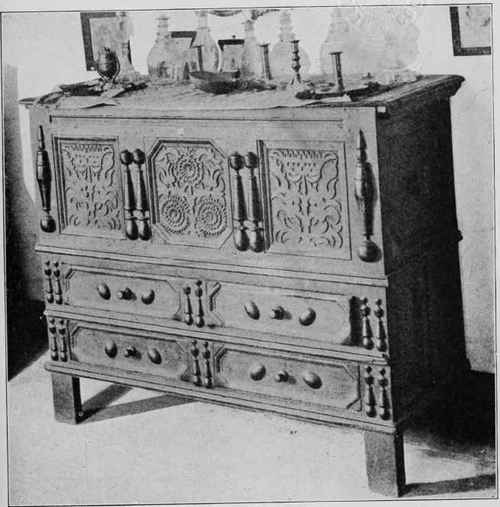
Figure 47. CONNECTICUT CHEST.
Pieces are still in existance which he made, sturdy and in good order, showing that he put his best work and best wood into this business, as he put his best thought into his pulpit labour.
The woods used by these cabinet-makers embrace all kinds, walnut, maple, cherry, nut-wood (hickory), poplar, ash, and pine. American dealers imported mahogany also in quantities, and it was for sale in planks as well as made up into furniture.
"New York Gazette and Weekly Mercury" for 1774 published the following advertisements.
"To be sold by Leonard Kip, A quantity of New Beef by the barrel, Honey by the barrel or half barrel, Albany boards and planks, Highland butter in firkins and European Goods. Which he will sell very low for cash or short credit, at his store in Dock Street opposite Mr. Gerardus Duyckinck's."
Continue to:


My Books

