


Colonial And Later Periods. Part 5
Description
This section is from the book "The Old Furniture Book", by Hannah Hudson Moore. Also available from Amazon: The Old Furniture Book.
Colonial And Later Periods. Part 5
The following also appeared in many issues of the paper.
"Mahogany Furniture, 3 elegant desks & book cases, 1 chest upon chest of drawers, 1 lady's dressing-chest & bookcase, 3 desks & 1 pr. card tables, 2 setts of chairs, 3 dining-tables & 5 breakfast tables, 1 clock-case furnished with a good plain 8 day clock, Sundry stands, etc. The above articles are well made and most of them are of wood of the first quality and will be sold as low as any furniture of equal value in the city by Willett & Pearsey, cabinet & chair-makers, at the sign of the clothes-press nearly opposite the Oswego Market, at the end of Maiden Lane."
In Philadelphia, renowned for its manufacture of household goods, the trade was so large and important that the "Journeyman's Cabinet & Chair-maker's Philadelphia Book of Prices' was issued. In a second edition (1795) are given the prices of many local furniture-makers, such as:
"A plain mahogany high-post bedstead £1. 4s. 6d.
"A plain sofa 6 ft. long, with 6 legs, fast back & no low rails £1- 8s. 0."
The desk shown in Figure 48 is a piece found at Bedford Springs, Pa., a place which was known as a "resort" as early as 1778, and had houses with plastered walls, quite an unusual luxury in country regions, though as these Springs were frequented by the fashionable society of Philadelphia and New York, who went for the waters, special effort was used to make the place attractive. The desk is mahogany and solid, not veneered. It has a roll-top of the style made by Sheraton, which falls back behind the drawers and cupboards. The brasses are new, and the lid has been restored; otherwise the desk is as it was made. It stood for many years in one of the little outside houses near the main hotel, and when, a number of years ago, a visitor asked to buy it, the proprietor told him the piece was known as "Jimmy Buchanan's desk." Mr. Buchanan was in the habit of spending his sum-mers at Bedford Springs and always occupied the room where this desk was. In 1857, when as President Buchanan he arrived at Bedford, the proprietors in his honour had refurnished his room. They were congrat-ulating themselves that the President would be gratified at what they had done for him, when he suddenly came into the room and demanded in a rage what had become of the desk.
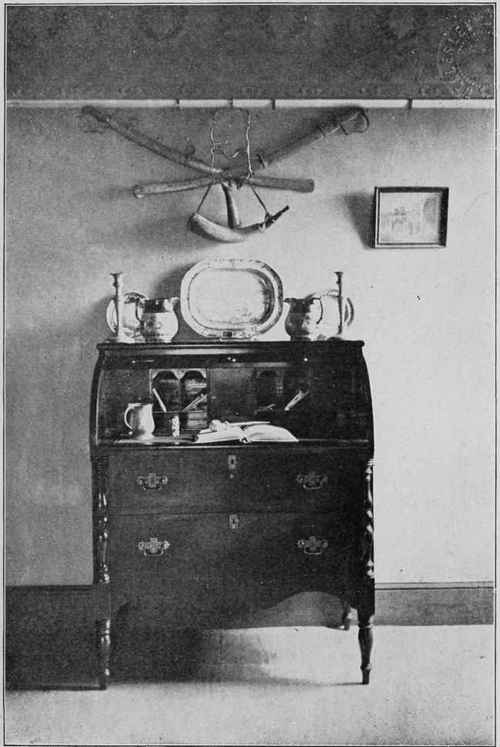
Figure 48. MAHOGANY DESK.
If it was not forthcoming he would go elsewhere. He could use it, he said, to write on, and then the drawers were roomy and just suited him for his clean shirts. It is needless to say that the desk was brought down from the garret, and was never removed from the room when President Buchanan visited there.
The desk is in company suited to its age, the larger powder-horn hanging above it being a veteran also. If is seventeen inches long and ten inches broad at the largest end. It bears the following inscription cut in quaint old letters on lines drawn so that they should go straight:
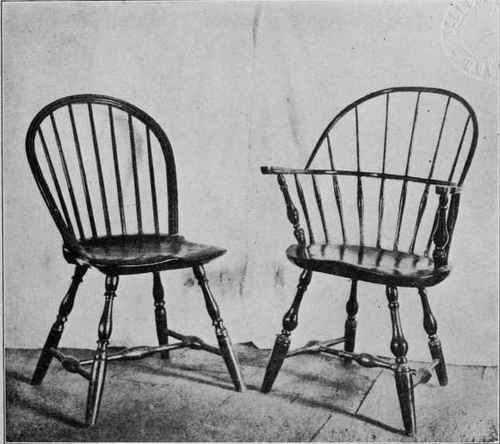
Figure 51. WINDSOR CHAIRS.
"This is William Norton's Horn made at Qubeck ye 10 day of Aprill 1776. I powder with my Brother Ball we wound them all that in Our way may chance to fall."
The smaller horn bears the date 1810, and the two swords were used in the General Training days of the first quarter of the nineteenth century. All these relics belong to Anthony Killgore, Esq., of Fleming-ton, N. J.
During the first quarter of the eighteenth century, and even a little earlier, houses were built with wainscoting and panelling, and it was the fashion to build into walls cupboards for the display of china and plate. Frequently they were placed in the corner of the room, and were either with or without doors. Such a cupboard was called a "beaufait," which was sometimes shortened to "bofet," or "buffet," according to the taste of the owner. Figure 49 shows a specimen. The house from which this beaufait came was built in 1696 in Vernon Place, Boston, Mass., by William Clough. Two years later he sold it, and it passed through several hands by inheritance and sale till in 1758 it was bought by Captain Vernon, who with various members of his family held it for seventy-five years. The cherub's heads which ornament the cupboard are somewhat unusual on a piece of furniture of this kind, and it has also a very handsome shell at the top. It is now at the Old State House, Boston.
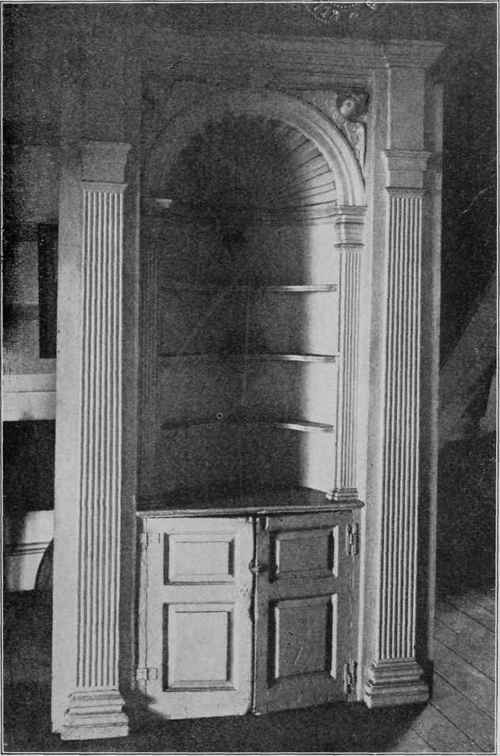
Figure 49. CORNER CUPBOARD.
Mention is also made in many inventories of "Court cupboards," and "livery cupboards."The former were light movable shelves, making a kind of sideboard, and used to display plate and porcelain. A livery cupboard was somewhat similar. It had usually but three shelves and stood upon four legs. It sometimes had a drawer for linen, but no doors. Mugs and cups were hung from the bottom of the shelves, and a ewer stood below. These were put in what was called the dining-parlour, a stately room on the second floor never used to dine in. (See Figure 50 showing the banquet room at Independence Hall, Philadelphia, with the beautiful moulding, wainscot, and over-mantel which were seen in handsome houses in the middle of the eighteenth century.) It was many years before the dining-room was set apart for meals. At first only a screen gave privacy, but gradually the dining-room grew in favour. The early dining-rooms held beds, as well as the parlours, they being given to guests on account of the warmth. Joint stools were there, and Flanders chests, in which the mistress often rummaged, so that the guest should see the goodly store of clothes and linen owned by the family.

Figure 50. BANQUET-ROOM, INDEPENDENCE HALL, PHILADELPHIA.
As was the custom in England, many wealthy men had their furniture made to order, often in their own houses, where the cabinet-makers came and worked. Sometimes they imported their own woods, as in the case of Mr. Champlin, a merchant of Newport, R. I., who brought home with him in 1762, from a voyage in the West Indies, some logs of mahogany, from which he had several pieces of furniture made. Watson, in his "Annals of New York," says that the use of what was foreign and modish was noted earlier in New York before the Revolution than elsewhere.
Continue to:


My Books

