


Old Oak, Old Leather, Turkey Work, Etc. Part 5
Description
This section is from the book "The Old Furniture Book", by Hannah Hudson Moore. Also available from Amazon: The Old Furniture Book.
Old Oak, Old Leather, Turkey Work, Etc. Part 5
Figure 3 represents a good specimen of one of these early chests. It is of English make, entirely of oak, the boards of the bottom being as heavy and solid as lead. The top is a heavy plank of oak with a fine grain. The chest is panelled within and has one till. The lock is modern, and some nails have been driven to hold the chest together, for the back legs as well as the sides are worm-eaten. This chest is three feet nine inches long, twenty-eight inches high, and twenty inches wide, and is in good condition save for the nails. Its date is about the last quarter of the seventeenth century. It was found in New York State and belongs to Mr. W. M. Hoyt of Rochester. While oak and pine were the most common materials for these chests, olive-wood was sometimes used, as we have seen, and sometimes the panels were of cedar, and the ornaments of some of the softer woods, like pine or maple, coloured and stained to imitate ebony. American walnut came into use late in the seventeenth centufy, but, although used in furniture and popular as a veneer, it was not used for chests. Cypress wood was also in demand as a material for chests, the aromatic smell keeping off the pest of housekeepers, the moth.
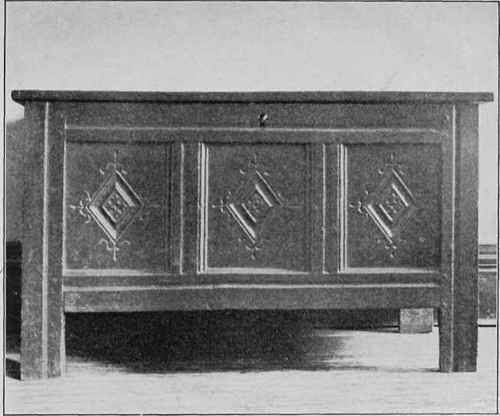
Figure 3. OLD OAK CHEST.
In summer time the heavy woollen tapestries and woollen clothes of the family were stowed away, and the former, at least, from their cost and the labour expended upon them, had to be carefully protected.
The roughest sort of a chest was called a "standard," and in it were packed the more perishable movables and furniture; and in moving from one residence to another these standards were carried by pack-horses or on rude carts. Chinese chests of teak-wood, lacquer, or cedar are very rarely met with, though you will sometimes see them in old homes in England, where some ancestor of the family followed the sea.
The inventory of the estate of Colonel Francis Epes, of Henrico County, Virginia, dated October 1, 1678, is a long and varied one. The first article recorded is "One foure foot chest of drawers seder Sprinkled new, but damnified £i-io.o." Further along are mentioned "one middle size calve skin truncke with drawers. One old leather truncke with lock and key . . . one old middle size chest with lock and key. One small old chest with lock and key. Two other old chests without keys and one without hinges."
Quite a number of chests and trunks for one family when it is noted that they had chests of drawers also. When the Rev. Samuel Sewall, so well-known from his voluminous diary, returned from a trip to England in 1689, he brought with him on the ship "America" a trunk for each of his three children, with their names and the dates of their births carved thereon. Presumably these trunks did not come over empty. He brought also a sea-chest, a barrel of books, a large trunk marked H. S. with nails, two smaller trunks, a deal box of linen, a small case of liquors, and a great case of bottles. He slept on a feather bed laid above a straw bed on the voyage, and was comfortably covered with a bedquilt.
American oak was used, however, in many American-made chests. Some of the early chests, particularly those found in the United States, stand flat on the ground. Others have legs,, sometimes formed by the continuation of the stiles, as those parts of the chests are called which hold the panels on the sides. The two boards which occupy the top and bottom of the sides and back and front are called the rails. The upper rails in some of the chests of early make have a row of carving on them which adds still further to the beauty of the chest, and in some instances the stiles are also carved. Ordinarily, however, the stiles are plain or with but a slight moulding, and the rails are quite plain. Geometric patterns in arched, diamond, or square form were early employed, each maker copying industriously the patterns used by other makers and only occasionally having the originality to design for himself. After the legs formed by the continuation of the stiles came legs made in the shape of great balls such as were used on much Dutch furniture and were copied by the English makers.
The great Dutch kas, or chest, was a very large and ornamental piece of furniture, carved, painted, or decorated in marquetry. Such pieces are unusual now, most of them having been gathered in by collectors or museums, the Dutch towns along the Hudson, as well as Albany and Schenectady, having been pretty well picked over.
The evolution of the bureau from the chest is an interesting study, and shows plainly the different periods through which the useful and homely "kist " passed before it emerged into such an ornamental thing as the carved and decorated highboy. The first step in its upward career was taken when a drawer was added below the chest proper. This came as early as the last half of the seventeenth century, those chests belonging to the first half being without drawers. Sometimes this single drawer was divided, and the very earliest specimens had the runners on which the drawers moved on the sides, and not on the bottom, as came later. The sides of the drawer were hollowed out in a groove, and a stout runner was affixed to the side of the chest. Such a chest is shown in Figure 4. With the appearance of drawers came a difference in ornamentation, and mouldings in great variety were used, beading and turned drops also coming in for use. These patterns were merely the familiar mouldings used in wainscots and panellings put to the purpose of adorning the chests. The early chests without drawers ran in the neighbourhood of five feet long and twenty-four inches high.
As the drawers were added, the chests naturally, rose in height, and to prevent their becoming too bulky they decreased in length.
A nice example of one of these early oak chests, mounted on turned legs and with curved strainers, is shown in Figure 5. It is in a fine state of preservation and has the original brass escutcheons. It was evidently intended as a receptacle for valuables, as both drawer and chest are made to-lock. It belongs to the Waring Galleries, London. Two drawers followed one, the chest portion still retaining its prominence, and in this simple way the chest of drawers grew from the box-like affair of 1600 and later. By 1710 chests were looked upon as "old," and so advertised for sale, although they continued to be made until the middle of the eighteenth century. They were too useful to be abandoned by a people who were obliged to be often on the move, and who needed some stout receptacle in which to carry their household and personal goods.
Continue to:


My Books

