


Old Oak, Old Leather, Turkey Work, Etc. Part 6
Description
This section is from the book "The Old Furniture Book", by Hannah Hudson Moore. Also available from Amazon: The Old Furniture Book.
Old Oak, Old Leather, Turkey Work, Etc. Part 6
There are chests which are peculiar to certain localities, notably in New England, which were doubtless made by a single cabinet-maker, his workmen and apprentices. They are almost entirely confined to these localities, and are therefore of less interest to the collector in general than such pieces as are more widely distributed. Under this head comes that style of receptacle known as the Hadley Chest, and the Connecticut chest shown in Chapter V (Colonial And Later Periods). The Dutch chests were often of pine, painted, only the choicest ones being of walnut. One inventory records a "chest brought from Havanna," - probably Spanish.
After matters became a little less anxious for the early settlers, personal comfort began to be thought of more, and such colonists as had brought no chairs began to send for them to England or have them made in America. Every ship from England took out fresh comforts, and the dignitaries of the colonies had substantial household gear. Tables, chairs, beds, and carpets, - these latter not for floors, but for use as table-covers, - are mentioned with great frequency in the inventories, and the settlers' house, albeit many of them boasted of but four rooms, had more than a modest degree of luxury.
The New Haven Colony - as indeed did all the Colonies - had, as her chief officers, men used to the best that England afforded, and the following inventory speaks for itself. John Haynes, governor of Connecticut, in 1653 left an estate at Hartford valued at £1,400. In his hall, one of the most esteemed parts of the house at this period, were,the whole valued at ,£8 13s. 10d. The parlor had velvet chairs and stools, also Turkey-wrought chairs, and a green cloth carpet valued at £1 10s. There were also curtains of say, curtain rods and "valiants," many napkins, as these were necessary from lack of forks, and much Holland bed and table linen. There were many chests and "lean-to" or livery cupboards.
5 leather and 4 flag-bottomed chairs.
1 tin hanging candlestick.
1 firelock musket.
1 carbine.
1 pr. cob-irons.
1 gilded looking-glass.
1 table and 3 joined stools.
7 cushions.
1 matchlock do.
1 rapier.
1 iron back.
1 smoothing-iron.
"The men's chamber," had "a bedstead with two flock beds; one feather boulster, one flock do.; one blanket; one coverlet." His best rooms had feather beds. In the cellar were many brewing-vessels and wooden-ware, while the kitchen had a complete "garnish" of pewter, but not a single piece of crockery. Brass candlesticks, iron possnets and porringers, and the useful brass warming-pan were here also. Theo-philus Eaton, also governor of Connecticut, left in 1657 an inventory of goods of even greater value.
Even earlier than this, rich furniture was imported by those who could afford it, and in 1645 a Mistress Lake, sister-in-law of Governor Winthrop the younger, sent to England for the furnishings for her daughter's new house. There were many items in the list, and among them were only one "bedsteede of carven oak; 2 armed cheares with fine rushe bottums; three large & three small silvern spoons, & 6 of norne."
As late as 1755 "armed cheares' were highly esteemed, and Joseph Allison, of Albany, N. Y., bequeathed two to his second son, a walking-cane to his firstborn, and to his youngest son some clothes. Chairs, stools, and cushions are mentioned in many inventories as being covered with "set work;" this was heavy woolen tapestry much after the fashion of Oriental rugs, and most durable. It is rather unusual to find no mention of leather chairs in inventories, for they were used in America late, in 1600, and chairs covered with "redd lether," as well as with Spanish leather, are of frequent occurrence.
Lion Gardiner was one of the chief proprietors of Easthampton, L. I., in 1653, where he passed the last ten years of his life "rummaging old papers" and in other peaceful pursuits. The inventory of his estate is set out fully and seems scant enough.
2 Great Bookes.
4 Great cheirs.
13 peeces of hollow pewter.
5 pewter spoons A broad how Horses.
Swine Bedding Cooking utensils A cheese press.
several bookes.
15 peeces of pewter.
4 porringers & 4 saucers.
A stubing how.
A little how.
Cattle.
Clothing.
2 pastry boards.
A cickell.
A churn.
It was this same Lion Gardiner who, after the Pequot War, bought from the Indians the island Monchonock, embracing thirty-five acres of hill and dale. The price paid was a large black dog, a gun, some powder and shot, a few Dutch blankets. This is the place which we know to-day as Gardiner's Island. The "great cheirs" mentioned in the inventory were, no doubt, either Turkey-work or leather, and seem to be the only articles of this kind of furniture possessed by him.

ITALIAN CHAIR. Same Period.
In 1638, in London, a man named Christopher took out a patent for decorating leather, which somewhat reduced its cost. Up to this time all leather was imported from Spain or Holland.
Figure 6 is a fine example of a Portuguese or Spanish leather chair, as they were variously called, and shows well the splendid and ornamental leather as well as the rich carving seen particularly on the front brace. The leather is fastened to the frame with large brass nails, and that part of the oak frame which is exposed is turned work. On many of these chairs there are three little metal ornaments on the curved top. In this example two are lost. Besides the carving on the front brace, a pattern which was often adopted and copied by English and Dutch cabinet-makers, this chair shows well that form of foot which came to be known as the "Spanish foot." It is seen on all makes of furniture, and with some variations of form, but always turns out at the base, and has the grooved work so conspicuous in Figure 6. There is no doubt that this was an exceedingly popular style of chair, for there are many examples almost exactly like this in many collections. This particular one is in the Boston Museum of Fine Arts.
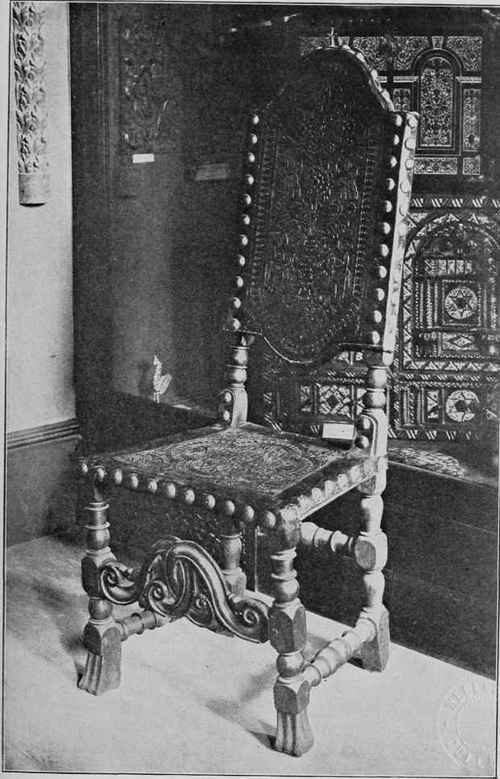
Figure 6. SPANISH LEATHER CHAIR.
Continue to:


My Books

