


Colonial And Later Periods. Part 8
Description
This section is from the book "The Old Furniture Book", by Hannah Hudson Moore. Also available from Amazon: The Old Furniture Book.
Colonial And Later Periods. Part 8
Andrew Faneuil died in 1738, and his favourite nephew and chief heir, Peter Faneuil, did not hesitate, on account of the cost, to have an elaborate and seemly funeral. Three thousand pairs of gloves were distributed, and later two hundred mourning-rings were given to intimate friends. Peter Faneuil, now a wealthy young man by inheritance as well as by his own exertions, lived in the old house with his maiden sister. This same year, 1738, he sends to London for "a handsome chariot with two setts of harness," and a coachman warranted to remain sober. A few months later he writes for china and glass from England, for table-cloths and napkins from France, and he sends for silver spoons, "forks with three prongs," all to have upon them the Faneuil crest. "Let them be very neat and handsome," says he.
The next order is for silver candlesticks and a punch-bowl of silver holding two gallons, also to be decorated with the family crest. His clothes were also a matter of concern, and he sends to London a pattern of a piece of Duncy, orders buttons of the newest fashion to match it, of mohair silk, and knee-straps. Nor is he less scrupulous about his sister's affairs, and sent all the way back to London six pairs of stockings which had been sent of worsted instead of "3 pairs thread hose, and 1 pair Galous hose, and 2 pair of thread ditto."
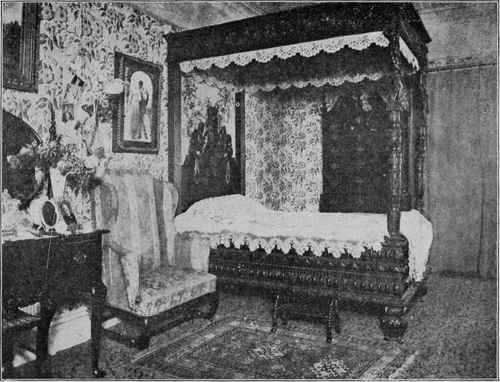
Figure 56. CARVED OAK BEDSTEAD.
Boston at this time (1738) seems to have had some luxuries demanded by New York, for an order comes to Peter Faneuil to send there "a dozen red Turkey or Morocker leather chairs." One of these easy-chairs cost £14. 14 s. In 1742 Peter Faneuil gave to the city of Boston the hall called by his name. It was built of home-made brick (Salem had a brick-kiln as early as 1629), but the glass in the windows was brought from England in Mr. Faneuil's own ships. The first furnishings bought by the selectmen for Faneuil Hall were "two pairs of brass candlesticks with steel snuffers, and a poker, for the town's use."
Peter Faneuil's inventory, filed in 1742, contains items under 158 heads, and makes quite a volume of manuscript. It includes not only his and his uncle's gatherings in the way of household goods, but the contents of warehouses, cellar, coach-house, and stables. The house was handsomely furnished. In the best room were, "12 carved vineered chairs & couch, £105; I pier glass,;£100." Other costly articles were, "I buffet with parcel of china delph & glass, £199." There were, besides, 1 chimney glass and arms; 1 marble table; 1 large Turkey carpet; 1 compleat brass sett, hearth-dogs, tongs, shovel, and bellows; 1 copper tea-table; cups, saucers, tea-pot, stand, bowl and sugar-dish; 3 alabaster bowls and stands; 1 large oval mahogany table, 12 plain walnut-frame leather-bottom chairs; 1 prospect of Boston, 2 landskips on copper, and the Temple of Solomon."
The "Great Centre Hall" must have made a quaint appearance, since here hung the fire apparatus; "1 large entry lantern; 12 baggs and buckets, and books £50."
The sleeping-rooms were handsomely equipped, and each was furnished with its appropriate colour. The list includes: 1 harrateen bed, bedstead and window curtains, matrass and two green silk quilts and feather-bed, £65 3 scones with arms 1 bureau, 1 table, 1 pr. brass-faced dogs, 1 fire-shovel, tongs bellows, and one Turkey carpet, ,£107.
Peter Faneuil's own room was not lacking in comforts, as is shown by the enumeration of: 1 silver-hilted sword, 1 pair of pistols and 1 powder-flask, £15; 1 case 6 razors, bone penknife, strap, 2 bottles, looking-glass tipt with silver; yellow mohair bed-counterpane, feather-bed, bolster, 2 false pillows, false curtains, 6 chairs, 1 great chair, 2 stools, window curtains," etc.
The furnishings of this room, exclusive of the small-arms, was valued at .£245. He had "6 lignum-vitae chocolate-cups lined with silver ", which were probably Dutch, for among the goods of Sara Van der Vulgen, of Schenectady, at about this same period, was a great "saler' or salt-cellar, made of lignum-vitae, bound with silver and standing on three little silver feet.
In Mr. Faneuil's kitchen were many utensils of copper, pots, pans, and kettles, together with an "engine and cistern." He had many jewels, 1,400 ounces of plate, including a shaving-basin worth £40. There were silver snuff-boxes, seven gold rings, and "chrystall buttons set in gold." Just before he died he sent to London for " six gross of the very best London King Henry's cards ", for his store no doubt, for cards were becoming more popular among the descendants of the Puritans than they had been.
In 1729 Governor Burnet, of New York and Massachusetts, died, leaving behind him a long list of valuable personal goods. He owned as many as seventy chairs and twelve tables. The chairs were of mahogany and walnut, with leather or bass bottoms, and one easy-chair was covered with silk. Twenty-four chairs had seats of red leather, a noble set, and there are two chairs now in the Yale University Library which belonged to Governor Burnet, and which are of the exact style of what we call Chippendale. They were made more than twenty-five years before the " Director " was published, but are made of mahogany with richly carved knees, ball-and-claw feet, with carved and ornamentally pierced splats, handsome upper rail curved and ending in the little ears before mentioned.
In all the inventories of wealthy and poor alike there is mention of candlesticks, sconces, girandoles, etc. The "entry lanthorns," as well as the perforated tin ones, were made to hold bits of candles and lamps are few and far between. It was not till 1783 that the flat-wick lamp was invented, the lamps before that time being pewter and glass, with small, round, string wicks, burning whale oil. When the question of lighting was so difficult, it is no wonder that the pioneers were in the habit of going to bed at dark and rising with the sun. The bayberry or candleberry was of recognized value, and the laws of Brookhaven, as early as 1687, forbade the gathering of the berries before September-15, under a penalty of a fine of fifteen shillings.
Continue to:


My Books

