


French Furniture. Part 2
Description
This section is from the book "The Old Furniture Book", by Hannah Hudson Moore. Also available from Amazon: The Old Furniture Book.
French Furniture. Part 2
Consider the life of one of these courtiers under the reicm of Louis XIV. Here is the routine of the Due de La Rochefoucauld, Master of the Hounds:
- "He never missed the king's rising or retiring, both changes of dress every day, the hunts and promenades likewise every day, for ten years in succession. Never sleeping away from the place where the king rested, not able to stay away all night, and yet obliged to dine away from court."
Even after the court etiquette became more stiff and precise,and the formal manners arranged by Louis and Madame de Maintenon were in daily practice, the smaller details of life remained as elegant as possible. Hoopskirts of such size as has been mentioned were too enormous for chairs, so a sort of stool without arms or back became a necessary article of furniture. One sofa, two armchairs, and nine stools were a proper proportion for a set to furnish a room, and these were stiffly set about the walls, leaving the middle of the room quite bare.
In Figure 72 is shown part of the bedroom of Louis XIV. at Versailles, with the elaborate decorations which were lavished on that palace, and the furniture which accompanied it. Tapestry-covered chairs and hangings of the richest embroidery were all in harmony with the splendid walls. The tall bronze girandoles were Cupids supporting branches of flowers in ormolu to hold candles. Over the doors were portraits or mirrors surmounted by carved and gilt figures with garlands of flowers. The decorated Boulle cabinet on the right is very different in its lines from those articles as seen in the succeeding reign, when everything assumed a lighter air. The curtains to the bed could completely enfold it, and to their sheltering depths the great Louis is said to have retired before removing his wig.

Figure 72. BED OF LOUIS XIV AT VERSAILIES.
The chairs shown in Figure 73 are of this period, the one upon the right retaining its original covering, the woodwork being carved and gilt. The cane chair on the left is of walnut, and the one in the centre, carved and gilt, is a French adaptation of a Flemish design.
It is difficult to re-people one of these splendid rooms and consider a period when, as M. Taine says, "life was wholly operatic." The grandee lived in a state of luxury and grandeur. His trappings were as magnificent as he could make them, and his household was filled with military as well as civil appointments, approaching as nearly to that of the king as possible.
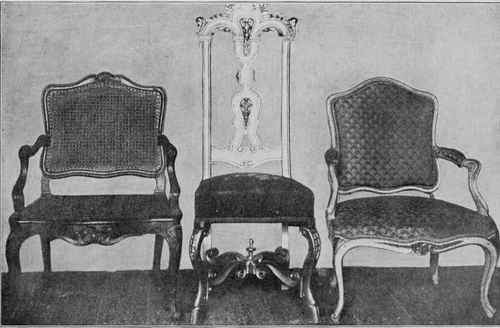
Figure 73. CHAIRS OF THF PERIOD OF LOUIS XIV.
The king must have a stable, so at Versailles were 1,875 horses, 217 vehicles, and 1,458 men who were clothed in liveries costing 540,000 francs a year. This is but a single item in the great total considered under fifty or sixty heads. To wait on the king himself, 198 persons were required; some fetched his mall and balls; some combed his hair; others watched his dogs; and there were those who tied his necktie after it had been properly folded. Some there were whose sole business it was to stand in a corner which was not to be left empty.
The policy which prescribed the custom at court was all for ostentatious display. St. Simon says:
"He (Louis XIV.) was pleased to see a display of dress, table, equipages, buildings, and play; these afforded him opportunities for entering into conversation with people. The contagion had spread from the court into the provinces and to the armies, where people of any position were esteemed only according to their table and magnificence."
Louis had so dominated the whole court life that he had brought his courtiers to believe that the main thing in life for layman and churchman, and for women and men alike, was to be at all hours and in every place under the king's eye and within reach of his voice.
With all this army of personal attendants to feed, clothe, and shelter, the repairs to houses and furniture represented immense sums yearly, and many establishments were taken under royal patronage in order to command their products and to reduce the expenditures.
The history of French furniture is quite closely connected with the history of tapestry, for after a time it was used as a covering. Francis I., who appreciated the value of this textile as an ornament as well as a covering for his walls, and unwilling to buy all his pieces from the skilful looms of Flanders, started a factory in 1531 at Fontainebleau. In 1603 a new factory was started at Paris, under royal patronage, in the workshop of a family of dyers named Gobelin. The first workers were Flemish weavers who were brought over to teach the craft to Frenchmen. Louis XIV. protected the factory through the mediumship of that great financier, Colbert, who appointed Le Brun, the artist, director of the works. In 1667 the factory became the property of the Crown, and most artistic and elegant productions were made.
Not only in France did the Gobelins find patronage, but in England as well their work was in great demand. Evelyn writes in the last years of the reign of Charles II.:
- "Here I saw the new fabriq of French tapisstry; for designe, tendernesse of worke, and incomparable imitationn of the best paintings beyond anything I ever beheld. Some pieces had Versailles, St. Germain's, and other palaces of the French King, with huntings, figures, and landskips, exotiq fowls, and all to the life rarely don.1'
The golden age of Louis XIV. saw also the golden age of tapestry, for it was during his reign that the proud and royal factory at Aubusson was at its highest estate. The tapestries sent out from this factory were not mere imitations as close as possible of painted pictures. The limitations of the process were ever considered, and the number of gradations in every tint was limited so that the dangers of unequal fading reached their lowest point. The beautiful borders which surrounded the central picture were designed and executed with the same care that was bestowed on the centre, and formed a part of the whole that could ill be spared.
Continue to:


My Books

