


French Furniture. Part 3
Description
This section is from the book "The Old Furniture Book", by Hannah Hudson Moore. Also available from Amazon: The Old Furniture Book.
French Furniture. Part 3
The tapestries worked late in the seventeenth century and early in the eighteenth, before the spirit of commercialism had been suffered to encroach on what up to that time had been carefully fostered art work, were all examples of great beauty and merit. In 1694, Louis having lost interest in the manufactory, and Colbert and Le Brun being dead, the works at the Gobelins' factories declined, and they became financially embarrassed. Still the great name was in high esteem, and its more than national reputation was retained. The splendid works which had been sent out from the loom, "The Triumph of Alexander," "The History of the King," "The Elements," and "The Seasons," were no longer in demand. Fontaine's fables and "The Adventures of Don Quixote" took the place of the more dignified designs, and at last sets of chairbacks and sofa covers were woven where previously historic subjects of heroic size had been demanded. Every year there were " Chancelleries " made, - series of hangings adorned with the royal arms, which the king gave to his chancellors.
"The Adventures of Don Quixote" consisted of a set of from twenty to twenty-eight pieces, and so pleased the public taste that sets were being continually woven from 1723 till the times of the Revolution. They were varied by the different colours of the background, and also by having different borders, some of them designed by artists like Lemaire the younger, and of great beauty. By 1736 the manufactory once more received assistance and patronage from the Crown, and famous old models were renewed, and two new sets, from "The Story of Esther," and "The Story of Medea and Jason," were designed. About the middle of the century came the fatal desire to copy paintings as they came from the hand of the artist, and the traditions which had governed the labor of the tapestry-worker for centuries were thrown aside. In vain the workmen protested: good taste and the principles of decoration were sacrificed, and the artist triumphed. The only check to the artist's exactions was the immense cost of production, for the painter was totally ignorant of the practical difficulties which had to be overcome in carrying out his designs; and as the tapestry-workers were paid by the piece they could no longer calculate or limit the cost of execution.
The Beauvais tapestries were long granted superior excellence in flower forms, trees, etc., and for figures also, and they held to the styles in which they excelled. But the Gobelins after 1740 no longer did work which was not fashionable and profitable. In 1755 Boucher, the well-known artist, was appointed director of the Gobelins, and, like his predecessors, believed in simulating, as far as possible the painter's art. There is tragedy in the history of the devoted band of workers who, ill-paid, and not sufficiently recognized, laboured at the looms and in the dye-house to carry out the artist's ideas. One of them Quimiset, a chemist of undoubted ability, committed suicide. Neilson and Audran were both ruined financially; and yet these servants of the crown were not allowed to leave Paris to better their fortunes.
The Gobelins began to produce tapestry for furniture only during the last half of the eighteenth century. This work was undertaken in hopes of financial profit, for the competition of woven and embroidered stuffs from England, as well as the novelty of English paper-hangings, had crippled them excessively. The very first pieces made were for four chairs and a sofa, in 1748. These furniture tapestries became immediately popular. Screens, seat, sofa and chair backs, showing scenes, figures, ribbon-work, and garlands brought up the failing fortune of Gobelin and made, Beauvais wealthy. From this latter factory came those coverings, with designs after Boucher, set in wooden frames of the richest carving and gilt.
The cost of these works was as great as brocade and velvet, and crowded out the embroiderers, who in turn aimed, with the means at their command, to rival the efforts of the tapestry-workers. Then came that most sumptuous combination of painting with embroidery, and in 1743 the Due de Luynes describes a new set of furniture for the queen's bedroom.
"It is of white gros de Tours, embroidered and painted, and is quite complete, consisting of the bed, its hangings, the fauteuils, and curtains."
During the Revolution, in 1793, a bonfire was made in the courtyard of the Gobelin factory, and a set of hangings with designs of "The Visit of Louis XIV. to the Gobelins," several portieres, and a set of " Chancelleries" were burned. On another visit the cartoons of Raphael were destroyed, those of "Esther" and "Medea" thrown out, and everything with a tendency toward aristocracy discarded.
The terms "Beauvais," "Aubusson," etc., do not give their names to any particular style of tapestry. The various factories wove according to their requirements, and used silk, woolen, silver and gold thread as the design called for it. In Figure 74 are given examples of work from these famous establishments. The Louis XIV. screen is a silk panel, the pattern being Flora, surrounded by Cupids and wreaths and garlands of flowers. The design is by Berain, and was made at the Gobelins; the frame is richly carved and gilt.
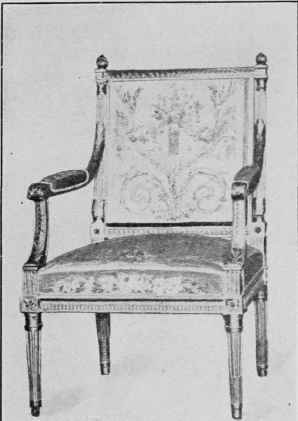
BEAUVAIS, LOUIS XVI.
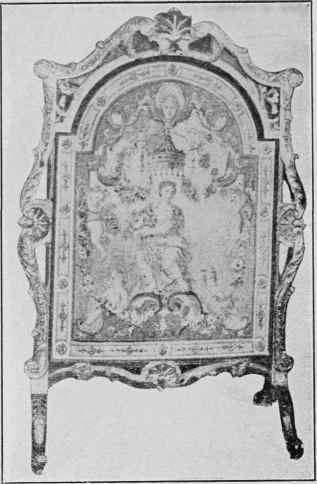
GOBELIN, LOUIS XIV.
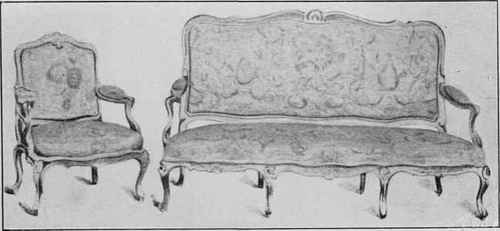
Figure 74. AUBUSSON, LOUIS XIV. TAPESTRY FURNITURE.
The Louis XVI. chair is covered with Beauvais tapestry - baskets of flowers and scrolls. The lovely tints are hardly faded, or they have so faded in harmony that it resembles the changing hues of mother-of-pearl. The wooden frame is carved and gilded, a fit setting for the beautiful tapestry. The sofa and chair are but two of a set, the other pieces being nine more chairs. These are of the Louis XIV. period and are covered with Aubusson tapestry, - crimson peonies on a pale-green ground. The bow leg and carved knees are similar to those shown in Figure 73, and, like the one on the right in that illustration are gilded. At a recent sale held in Paris, when the great collection of Madame Lelong was dispersed, the prices obtained for these old tapestries, whether wall-coverings or on furniture, were absolutely astonishing. A screen with four panels of Beauvais tapestry illustrating La Fontaine's fables brought $3,700. One seat, of carved and gilded wood, covered with a piece of Beauvais, brought $2,000, and four chairs in carved and gilded wood with Beauvais tapestry coverings brought $41,000. These prices, while sensational, give some idea of the esteem in which these antiques are held.
Continue to:


My Books

