


Cupboards And Sideboards. Part 4
Description
This section is from the book "Furniture Of The Olden Time", by Frances Clary Morse. Also available from Amazon: Furniture of the Olden Time.
Cupboards And Sideboards. Part 4
Illustration 80 shows a Hepplewhite sideboard with a serpentine front, the doors to the side cupboards being concave, as well as the space usually occupied by bottle drawers, while the small cupboard doors in the middle are convex. A long rounding drawer extends across the centre and projects beyond the cupboard below it, while a slide pulls out, forming a shelf, between the long drawer and the small cupboard. There are no bottle drawers in this sideboard. The doors are inlaid with a fan at each corner, and fine lines of holly are inlaid around the legs, doors, and drawer. The silver pieces upon the sideboard top are family heirlooms. The large tea-caddies at each end are of pewter finely engraved. This sideboard is owned by Francis H. Bigelow, Esq., of Cambridge.
A charming little sideboard owned by Mr. Bigelow is shown in Illustration 81. The ordinary measurements of sideboards like the last two shown are six feet in length, forty inches in height, and twenty-eight inches in depth. These measures, with slight variations, give the average size of Hepple-white sideboards. Occasionally one finds a small piece like Illustration 81, evidently made to fit some space. This sideboard measures fifty-four inches in length, thirty-four in height, and twenty-three in depth. It has no cupboard, the space below the slightly rounding drawer in the centre being left open. There are fine lines and fans of inlaying in satinwood, and in the centre of the middle drawer is an oval inlay with an urn in colored woods. The handles are not original, and should be of pressed brass, oval or round. The silver service upon the sideboard is of French plate, made about 1845, and is of unusually graceful and elegant design.

Illus. 80. - Hepplewhite Serpentine-front Sideboard, 1790.
Hepplewhite's sideboards seldom had fluted legs, which seem to have been a specialty of Sheraton, though the latter used the square leg as well. A feature in some of Sheraton's designs for sideboards was the brass railing at the back, often made in an elaborate design.

Illus. 81. - Hepplewhite Sideboard, about 1795.
Illustration 82 shows a Sheraton sideboard, or side-table, with brass rods extending across the back, and branches for candles at each end. This railing was designed to support the plates which were stood at the back of the sideboard, and also to keep the lids of knife and spoon boxes from falling back against the wall. The branches for candles were recommended for the light which the candles would throw upon the silver. This side-table is very large, measuring six feet eight inches in length, thirty inches in depth, and thirty-eight from the floor to the top of the table. The wood is mahogany, inlaid with satinwood. It is unusual to find such a piece in this country, and this is the only example of an old Sheraton side-table or sideboard with the brass railing which I have ever seen here. It is owned by John C. Maclnnes, Esq., of Worcester, and it was inherited by him from a Scotch ancestor.

Illus. 82. - Sheraton Side-table, 1795.
Sheraton speaks of a "sideboard nine or ten feet long, as in some noblemens' houses," but he admits that "There are other sideboards for small dining-rooms, made without either drawers or pedestals."
A charming little side-table, or sideboard, is shown in Illustration 83, belonging to Dwight M. Prouty, Esq., of Boston. It is of mahogany, and is inlaid with three oval pieces of satinwood, giving the little piece a very light effect. The legs also add to that appearance, the reeded upper section tapering down to a turning and ending in a plain round foot, which looks almost too small for such a piece. The outline of the body is curved down to the legs, making an arch upon the front and sides. A sideboard of distinctly Sheraton design is shown in Illustration 84. It has the reeded legs which are the almost unmistakable mark of Sheraton. The ends of this sideboard are straight, and only the front is rounding in shape, unlike the sideboard in Illustration 75, which forms a complete semicircle. The wood is of mahogany, inlaid with fine lines of holly. The little shield-shaped escutcheons at the keyholes are of ivory. There are three drawers above the cupboards and two bottle drawers. Upon the top, at each end, is a wine-cooler of Sheffield plate, and in the centre is a mahogany inlaid knife-box similar to the one in Illustration 78. This sideboard is owned by Dwight Blaney, Esq., of Boston.

Illus. 83. - Sheraton Side-table, 1795.

Illus. 84. - Sheraton Sideboard with Knife-box, 1795.
A Sheraton sideboard of later date is shown in Illustration 85. It is of mahogany, and was probably made about 1800. The arched open space in the middle was left for the cellaret, which was the usual accompaniment of the sideboard in those days of hard drinking. The top of this sideboard is surmounted by drawers, with a back above the drawers.
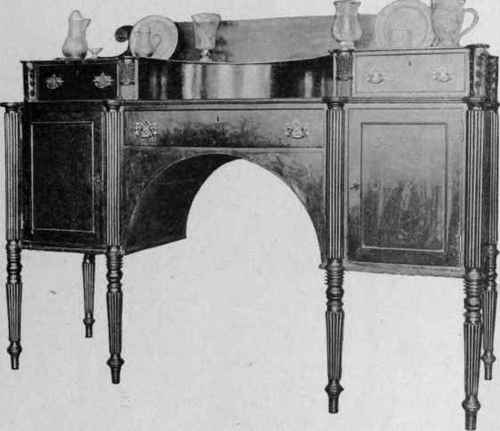
Illus. 85. - Sheraton Sideboard, about 1800.
The legs and the columns above them are reeded, and the little columns at the corners of the upper drawers are carved, the inner ones with a sheaf of wheat, and the two outside corners with the acanthus leaf. This sideboard was formerly owned by Rejoice Newton, Esq., of Worcester, from whom it has descended to Waldo Lincoln, Esq., of Worcester.
Continue to:


My Books

