


Cupboards And Sideboards. Part 3
Description
This section is from the book "Furniture Of The Olden Time", by Frances Clary Morse. Also available from Amazon: Furniture of the Olden Time.
Cupboards And Sideboards. Part 3
The Sally came to Wiscasset, Maine, and the story told "down East" is that there was a plot to rescue Marie Antoinette, and the Sally was laden for that purpose; and that a house had been built in a Maine seaport for the queen, whose execution put an end to the plot, and sent the Sally off to America with her rich cargo. I cannot help thinking that if the story be true, Marie Antoinette was spared many weary days of discontent and homesickness; for the temperament of the unfortunate queen, luxury loving, gay, and heedless, does not fit into the life of a little Maine seaport town one hundred years ago. When the Sally arrived, her cargo of beautiful things was sold. Legends of Marie Antoinette furniture crop up all around the towns in the neighborhood of Wiscasset, but, singularly enough, I have been unable to trace a single piece in Maine except this sideboard. Miss Elizabeth Bartol of Boston, whose mother was a granddaughter of Colonel Swan, owns several pieces. Colonel Swan's son married the daughter of General Knox and took the sideboard with him to General Knox's home in Thomaston, Maine, where it remained for many years.
The sideboard is made of oak (showing its English origin) veneered with mahogany. The lines upon the front and the figures upon the legs are inlaid in satinwood, and the knife-box is inlaid in the same wood. The top of the sideboard is elaborately inlaid with satinwood and dark mahogany, in wide bands, separated by lines of ebony and satinwood, and crossed by fine satinwood lines radiating from the centre. The handles and escutcheons are of silver, and the top of the knife-box is covered by a silver tray with a reticulated railing. The coffee-urn is of Sheffield plate, and the sideboard with its appurtenances appears to-day as it did one hundred years ago in the house of General Knox. It is now owned by the Hon. James Phinney Baxter of Portland, Maine.
Knife-boxes were made of different shapes, to hold knives, forks, and spoons, and a pair of knife-boxes was the usual accompaniment to a handsome sideboard. The most skilled cabinet-makers were employed in their manufacture, as each curved section had to be fitted most carefully.
Illustration 76 shows an urn-shaped knife-box of mahogany inlaid in lines of holly. The interior of the box is fitted with circular trays of different heights, and through the little openings in these trays the knives and spoons were suspended.
Illustration 77 shows an urn-shaped knife-box opened. The top rests upon a wooden rod which extends through the middle of the box, and instead of turning back with a hinge, the top slides up on this rod, and when it is raised to a certain height it releases a spring which holds the rod firmly in its place. This urn knife-box is in the Pendleton collection in Providence, Rhode Island.
Urn-shaped boxes were designed by Adam, and are shown in his drawings, to stand upon pedestals at each end of the side table, to be used, one for icewater, and one for hot water, for the butler to wash the silver, not so plentiful then as now. Very-soon the urn-shaped boxes were utilized to hold the knives, forks and spoons. Adam, Shearer, Hepplewhite and Sheraton show designs for knife-boxes, many of them elaborately carved or inlaid, but they must have been very costly, and within the means only of such noblemen, who, in Sheraton's words, "are unrestrained with the thoughts of expensiveness."

Illus. 76. - Urn-shaped Knife-box, 1790.
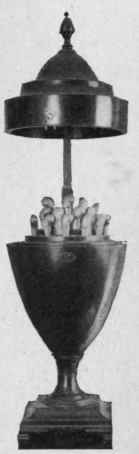
Illus. 77. - Urn-shaped Knife-box, 1790.
The usual shape of knife-box found is shown in Illustration 78, owned by Mrs. Clarence R. Hyde, of Brooklyn, N. Y. It is inlaid both outside and inside and the handles and fittings are of silver. The books of designs show boxes of this shape, with the lid put back, as in this illustration, and used to support a large silver plate.
Mahogany was chiefly used in sideboards, with inlaying of satin-wood, holly, king, tulip, snake, zebra, yew, maple, and other woods. Occasionally one finds a sideboard veneered with walnut. The curves at the front vary considerably, the ends being convex, and the centre straight; or the ends concave, forming with the centre a double curve. A sideboard with rounded ends and only four legs was made in large numbers around Philadelphia.

Illus. 78. - Knife-box, 1790.
Illustration 79 shows a Hepplewhite sideboard owned by the writer. It is of mahogany veneered upon pine, and it was probably the work of a Connecticut cabinet-maker of about 1790. Six chairs, made to go with the sideboard, are similarly inlaid, and the knife-boxes, which have always stood upon this sideboard, have fine lines of inlaying. There is one central long drawer, beneath which, slightly recessed, are doors opening into a cupboard, and two bottle drawers, each fitted with compartments to hold four bottles. There is a cupboard at each curved end, with a drawer above. The coloring of the wood used in this sideboard is very beautiful. Each drawer and door is veneered with a bright red mahogany, with golden markings in the grain, and this is framed in dark mahogany, outlined in two lines of satinwood with an ebony line between. The oval pieces above the legs and the bell-flower design upon the legs are of satinwood. The combination of the different shades of mahogany with the light satinwood is most effective. The handles are new. When this sideboard came into the possession of the writer, the old handles had been removed and large and offensive ones of pressed brass had been fastened upon every available spot, with that love for the showy which seizes upon country people when they attempt the process known as "doing over." The lids of the knife-boxes open back with hinges, and the interior is fitted with a slanting tray, perforated with openings of different shapes to hold knives, with the handles up, and spoons with the bowls up. A fine line of inlaying goes round each of the openings. The handles and escutcheons of the knife-boxes are of silver. Upon the top of the sideboard are several pieces of Sheffield plate. At each end is a double coaster upon wheels, with a long handle. Another double coaster, somewhat higher and with reticulated sides, stands beside the coffee-urn, and two single coasters are in front. All of these coasters have wooden bottoms, and were used to hold wine decanters, the double coasters upon wheels having been designed, so the story goes, by Washington, for convenience in circulating the wine around the table.

Illus. 79. - Hepplewhite Sideboard and Knife-boxes, about 1790.
Continue to:


My Books

