


Tables. Part 4
Description
This section is from the book "Furniture Of The Olden Time", by Frances Clary Morse. Also available from Amazon: Furniture of the Olden Time.
Tables. Part 4
Illustration 258 shows a set or "nest" of Chinese tea tables owned by Dwight M. Prouty, Esq. They and the tea caddy case are lacquered in black with Chinese scenes in gold. These sets of tables were brought by ships in the Chinese trade, and were fashionable among the tea drinkers of early times.
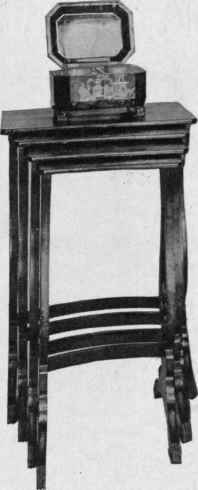
Illus. 258. - Lacquer Tea-tables, Eighteenth Century.
From about 1786 the designs of Shearer, Hepplewhite, and Sheraton entirely superseded the fashions of the fifty years preceding, and the slender tapering leg took the place of the cabriole leg. Illustration 259 shows a Hepplewhite card-table, of about 1789, with inlaid legs, one of which swings around to support half of the top, which is circularwhen open. Upon this table is a mahogany tea tray with handles at each side and a raised rim with a scalloped edge to keep the cups and saucers from slipping off. Oval trays of this style are not uncommon, of mahogany with inlaying, but this tray is shaped to fit the table top. This table and tray are owned by the Concord Antiquarian Society. The china upon the tray is Lowestoft, so called.
Illustration 260 shows two typical Hepplewhite card-tables owned by the writer. They are of mahogany, the square, tapering legs being inlaid with a fine line of holly. The front of one table has an oval inlay of lighter mahogany, and small oval pieces above each leg. The edge of this table is inlaid with lines of holly. The front of the other table is veneered with curly maple, and has a panel in the centre inlaid with an urn in colored woods. There is a row of fine inlaying in holly and ebony upon the edge of the top. This table was rescued by the writer from an ignominious existence in a kitchen, where it was covered with oilcloth and used for kitchen purposes. The leaf of each of these tables is supported by one of the legs, which swings around.

Illus. 259. - Hepplewhite Card-table with Tea-tray, 1785-1790.
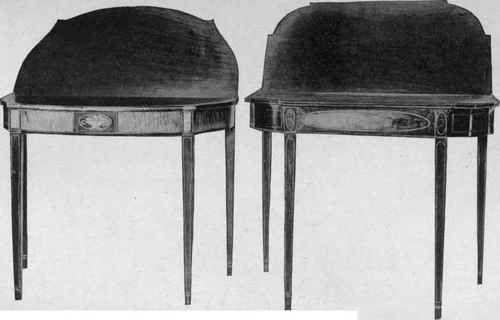
Illus. 260. - Hepplewhite Card-tables, 1785-1795,.
Illustration 261 shows a Sheraton card-table of the best style, with reeded legs and the front veneered in satinwood. It is owned by Irving Bigelow, Esq., of Worcester.
The Sheraton card-table in Illustration 262 is of a few years later date than the one in Illustration 261, with slightly heavier legs, reeded and carved. The curves of the front of the table are extremely graceful. It belongs to Dwight Blaney, Esq.
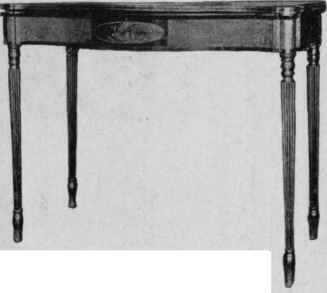
Illus. 261. - Sheraton Card-table, 1800.
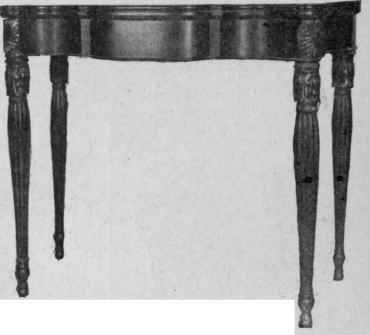
Illus. 262. - Sheraton Card-table, 1800-1810.
Illustration 263 shows a Sheraton stand, called a "what-not," made of mahogany, with reeded legs. The posts above the legs are veneered in bird's-eye maple, and the two drawers are veneered in satinwood. The handles are of bone or ivory. The effect of this little stand is most airy and light. It belongs to Mr. Blaney.
Illustration 264 shows a mahogany dining-table and one of eight chairs which came from the John Hancock house in Boston. They are now owned by Clinton M. Dyer, Esq., of Worcester. They were made probably about 1810. The legs of the table end in the Adam foot. The table which has both leaves dropped shows the position of the legs when the table is not in use; each leg swings around to support the leaves when in use. The table with slightly rounded corners can be taken apart, and the extra table put between the two sections, the leaves being fastened together by a curious brass spring. Each leaf measures five and one-half feet in length. The drop leaves are twenty-six inches wide, and the table, when all the top is spread out, measures five and a half by twelve feet. The chair is made after the style of the late Sheraton chairs, with carved drapery upon the back.
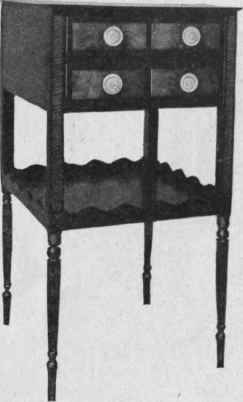
Illus. 263. - Sheraton "Whatnot," 1800-1810.
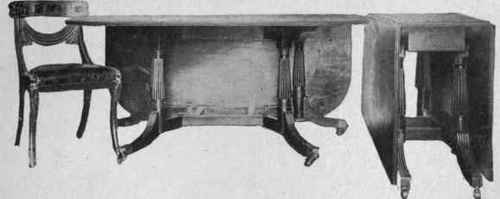
Illus. 264. - Sheraton Dining-table and Chair, about 1810.
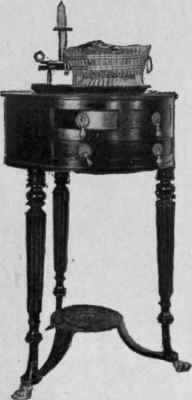
Illus. 265. - Sheraton Work-table, about 1800.
Illustration 265 shows a circular work-table of very graceful design.
The wood is mahogany, and the little feet are of bronze. There are three drawers, the two upper ones opening with a spring and revolving upon a pivot. In these little drawers may still be seen the beads remaining from the time, about 1800, when it was fashionable for young ladies to make bead bags. The table top has an opening in the centre, which originally had a wooden cover, and the space below the top was utilized to hold the work. At the back of the top are two short turned posts supporting a little shelf, to hold a candlestick, or to have fastened upon its edge the silver bird which was used by needlewomen of those days to hold one end of the work. This little table is owned by the Misses Hosmer of Concord.
Continue to:


My Books

