


Concrete Posts
Description
This section is from the book "Practical Concrete Work for the School and Home", by H. Colin Campbell. Also available from Amazon: Practical concrete work for the school and home.
Concrete Posts
Concrete posts are made of various sectional shapes but square and rectangular sections are most common. In a fence post the strains are greatest at ground level. If one pushes hard against the top of a post, the concrete on the side where the force is applied is in tension, or is resisting a strain that tends to pull it apart at the ground line, while the concrete on the opposite side is in compression, or is resisting a crushing strain. This has been explained elsewhere in the discussion of the principles of reinforcing concrete.
How To Reinforce Posts
Reinforcement is placed in a concrete fence post so as to give it additional strength and at a point as near the outer surface of the post as possible because the outer surface is the first portion of the post that has to resist this tension or bending strain. Reinforcement placed at the center of a post is of very little value unless the amount used is relatively excessive. A small but proper quantity correctly placed near the surface is much more effective. If the post section is round the four rods should be in position in the concrete corresponding to the corners of the square. In posts of square, rectangular or triangular sections the rods should be near each corner.
Tables Of Materials
Accompanying tables give various dimensions for posts, also the reinforcing required. It will be noticed that round rods are specified. Attention is called to this because many persons think that ordinary wire is suitable for reinforcement. This is true only in part, which is when the cross-sectional area of the wires used equals the corresponding cross section of the rods for which substituted. Barbed wire and similar scrap material should not be used as reinforcing because it is difficult to place and it is not certain that the required amount of reinforcement will be used.
Types Of Post Molds
There are many types of fence post molds on the market, and while it is perfectly practicable to make a wood mold for concrete fence posts, it is in general best to use some one of the commercial types of molds. In making wood post molds only clear, straight-grained lumber should be used. To prevent the pieces of which the mold is constructed from warping or bulging out of shape due to moisture absorbed from the concrete, the lumber should be saturated with a mixture of equal parts of boiled linseed oil and kerosene. The surplus should be wiped off before placing concrete. Wetting the mold just before placing the concrete will be an additional precaution against the concrete sticking to it.
Table 1 Dimensions Of Concrete Line Posts, And Materials Needed
DIMENSIONS | Volume of Post in Cubic Feet | Weight Post in Pounds | Amount of Reinforcing Metal Required | MATERIALS | ||||||||
1-Cement 3-Sand | 1-Cement 2-Sand | 3-Stone or Pebbles | ||||||||||
No. Posts Per Barrel Cement | For 10 Posts | No. Posts Per Barrel Cement | Fob 10 Posts | |||||||||
Length | Top | Bottom | ||||||||||
Sacks Cement | Cu. Ft. Sand | Sacks Cement | Cu.Ft. Sand | Cu.Ft. Pebbles or Stone | ||||||||
(1) | (2) | (3) | (4 | (5) | (6) | (7) | (8) | 0) | (10) | (11) | (12) | (13) |
6'6" | 3"x3" | 5"x5" | .7 | 107 | Four | 15.1 | 2.6 | 7.9 | 21.1 | 1.9 | 3.8 | 5 8 |
7'0" | 3"x3" | 5"x5" | .8 | 115 | 1/4' | 14.0 | 2.8 | 8.5 | 19.5 | 2.1 | 4.2 | 6.2 |
7'6" | 3"x3" | 5"x5" | .85 | 123 | Round | 13.2 | 3.0 | 9.1 | 18.4 | 2.2 | 4.4 | 6.6 |
8'0" | 3"x3" | 5"x5" | .9 | 131. | Rods | 12.3 | 3.2 | 9.7 | 17.1 | 2.4 | 4.7 | 7.1 |
6'6" | 4"x4" | 5"x5" | .9 | 133 | Four | 12.2 | 3.3 | 9.8 | 17.0 | 2.4 | 4.8 | 7.2 |
7'0" | 4"x4" | 5"x5" | 1.0 | 143 | 5/16' | 11.3 | 3.5 | 10.6 | 15.8 | 2.6 | 5.1 | 7.7 |
7'6" | 4"x4" | 5"x5" | 1.05 | 153 | Round | 10.6 | 3.8 | 11.3 | 14.7 | 2.8 | 5.5 | 8.2 |
8'0" | 4"x4" | 5"x5" | 1.1 | 163 | Rods | 9.9 | 4.0 | 12.1 | 13.8 | 2.9 | 5.9 | 8.8 |
6'6" | 5"x5" | 6"x6" | 1.4 | 197 | Four | 8.2 | 4.9 | 14.6 | 11 4 | 3.6 | 7.1 | 10.6 |
7'0" | 5"x5" | 6"x0" | 1.5 | 213 | 3/8' | 7.6 | 5.3 | 15.8 | 10.6 | 3.8 | 7.7 | 11.5 |
7'6" | 5"x5" | 6"x6" | 1.6 | 228 | Round | 7.1 | 5.6 | 16.8 | 9.9 | 4.1 | 8.2 | 12.3 |
8'0" | 5"x5" | 6"x6" | 1.7 | 243 | Rods | 6.6 | 6.0 | 18.0 | 9 2 | 4.4 | 8.8 | 13.2 |
Table 2 Dimensions of corner posts and materials needed
DIMENSIONS | Volume of Posts in Cu. Ft. | Weight of Posts in Pounds | Amount of Reinforcing Metal Required for Each Post | MATERIALS | |||||||
1-Ce.MENT 3-SAND | l-Ccmcnt 2-Sand | 6-Pebbies or Stone | |||||||||
No. Posts Per Barrel Cement | For 1 Post | No. Posts Per Barrel Cement | FoR 1 Post | ||||||||
Length | Size | ||||||||||
Sacks Cement | Cu.Ft. Sand | Sacks Cement | Sand Cu. Ft. | Pebbles Cu.Ft | |||||||
0) | (2) | (3) | (4) | (5) | (6) | (7) | (8) | (0) | (10) | (11) | (12) |
8'0" | 6"x 6" | 2.0 | 288 | Four | 5.6 | .7 | 2.1 | 7 8 | .5 | 1.0 | 1.6 |
8'0" | 7"x 7" | 2.7 | 392 | 1/14 | 4.1 | .95 | 2.0 | 5.7 | .7 | 1.4 | 2.1 |
8' 6" | 7"x 7" | 2.9 | 416 | Round Rods | 3.9 | 1.0 | 3.1 | 5.4 | .8 | 1.5 | 2.2 |
8'0" | 8"x 8" | 3.6 | 51! | Four | 3.1 | 1.3 | 3.8 | 4.4 | .9 | 1.8 | 2.8 |
8'6" | 8"x 8" | 3.8 | 544 | 9/16' | 3.0 | 1.35 | 4.0 | 4.1 | 10 | 2.0 | 2.9 |
9'0" | 8"x 8" | 4.0 | 575 | Round Rods | 2.S | 1.4 | 4 3 | 3.9 | 1.1 | 2.1 | 3.1 |
8'0" | 10"xl0" | 5.6 | 799 | Four | 2 0 | 2 0 | 5 9 | 2.8 | 1.4 | 2 9 | 4.3 |
8'6" | 10"xl0" | 5.9 | 850 | 11/16 | 1 9 | 2.1 | 6 3 | 2.6 | 1.5 | 3.1 | 4.6 |
9'0" | 10"xl0" | 6.2 | 899 | Round Rods | 1 8 | 2.2 | 6.7 | 2.5 | l.6 | 3.2 | 4.8 |
10'0" | 5"x 5" | 1.7 | 2.50 | Four 3/8' | 6 4 | 6 | 1 0 | 9 0 | .4 | .9 | 1.4 |
12'0" | 5"x 5" | 2 1 | 300 | Round Roils | 5 4 | 7 | 2 2 | 7.5 | .5 | 1.1 | 1.6 |
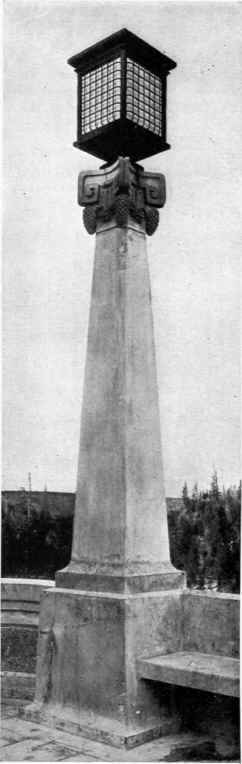

Two attractive types of concrete lamp posts. The principles of post manufacture apply to these as to other types of concrete posts. Much of the attractiveness of such concrete work comes from the surface finish given to it after forms have been removed.

Suggestion for concrete lamp post.

Designs for gate posts.
Continue to:


My Books

