


Steam Hardening, Or "Curing," Concrete Products
Description
This section is from the book "Practical Concrete Work for the School and Home", by H. Colin Campbell. Also available from Amazon: Practical concrete work for the school and home.
Steam Hardening, Or "Curing," Concrete Products
General
In the commercial manufacture of concrete block, brick, tile, fence posts, and other small concrete products, it is best to arrange for hardening the products in steam rooms. These rooms are called "curing chambers," and the process of hardening in this way is commonly known as steam curing. However, the word "curing" as used in this sense should not be taken to mean a drying action as the effect of hardening or curing concrete products in steam rooms is exactly the reverse of drying, that is, the products are kept in a warm, vapor-laden air which not only hardens them more rapidly, but more uniformly, as a combination of warmth and moisture produces the most favorable conditions for uniform hardening of concrete.
For home work it is not usually practicable to arrange to harden concrete products by using steam, but for school work it is possible to build a small chamber for steam hardening many small ornamental products which can thus be given an important finishing touch of concrete workmanship.
Design For Small Portable Steam Curing Chamber
Accompanying sketches, Plates 44 and 45, show details of a small portable steam curing chamber that can readily be attached to any source of low pressure steam supply, even to a steam heating system such as used in the ordinary residence. The chamber consists of a steam-tight box, 3 by 4 feet in plan and 3 feet 6 inches deep. The roof must be sloped so condensation will drain toward the sides and not fall directly on the concrete, thus pitting it while soft. The chamber is built of steel framing covered with sheet steel. The frame consists of two 2-inch by 2-inch angle irons. These are joined where necessary by rivets. After the frame has been assembled, the metal covering, which consists of No. 18 gage steel plate, is riveted to the framework. Rivets should be set close enough together so that when tightened, all joints formed will be steam-tight without calking. Two Z-bars 1/4 by 3 inches are cut out, as shown in one of the detailed sketches, to receive rollers and bearings. These rollers are to make it easy to slide a platform bearing the objects into the chamber or even to slide the objects themselves in while resting upon the rollers. These Z-bars are riveted to the steel plate sides of the chamber so that the bearings of the rollers will be 5 1/2 inches above the bottom of the chamber, as shown. The door to the chamber is made of No. 18 gage steel plate riveted to 2-inch by 2-inch angles and provided with a liner as shown. The door opening is reinforced with the same size of angles at the sides, top and bottom. At the bottorn of the door there is a bent strip of No. 18 gage steel plate attached to serve as a drip to catch and properly dispose of the water condensed from the steam. The door is attached to the chamber by two 4 by 5-inch brass hinges which are riveted to the door and to the door frame.


To make the door opening practically steam-tight, a rubber gasket is attached to the inner face of the outside edge of the door. Latches are attached to the door as shown. The bottom of the chamber is fitted with flanges for overflow and drain pipes as shown in section B-B.
A 1-inch steam pipe fitted to flanges runs longitudinally across the bottom of the chamber, as shown in section B-B and section ABCD. The lower side of this pipe is perforated at intervals of 1 1/2 to 2 inches by small holes to permit entrance of steam from the source of supply. As shown in Plate 44, the outer end of this pipe is connected with a steam radiator.
The riser line should be provided with a regulator and shut-off valve, the regulator being placed between the valve and the radiator. The overflow pipe should be about 4 1/2 inches above the bottom of the chamber, thus assuring from 4 to 4 1/2 inches of water will remain in the chamber so that the steam can issue through this water and thus be completely saturated. Dry steam, that is, steam under pressure, must never be admitted direct to a chamber of this kind, as it would dry the products rather than harden them.
The eight rollers shown are made of extra heavy 1 1/2-inch galvanized iron pipe and rest in roller bearings, as shown in one of the detailed sketches. The door and door frame should be true so that there will be no warped surface to shut against, thus insuring a snug fit when the door is closed.
An alternative method of forming the roof for the steam chamber is to carry up the corner angles 3 feet 6 inches high and make the roof flat instead of sloping. This is shown in one of the sketches in Plate 44. But in order to permit the condensed steam to trickle down the sides of the chamber and not drip on the products being hardened and so mark them while soft, a light galvanized hood is attached to the roof suspended therefrom by means of three light galvanized iron bolts, the lower ends of the hood being riveted to the sides. If this form of construction is used it will be necessary to bend the hood slightly out of shape so that it may pass through the door of the chamber for attaching in proper position, but being of light metal it may readily be bent back to proper shape and position after attached to the roof by the suspension bolts. These bolts should be about 4 inches long and threaded their entire length. Four nuts will be required for each bolt-two to form shoulders, which will keep the hood at the required distance from the top of the chamber.
Lighter steel than No. 18 gage may be used for covering the chamber, but this weight is recommended because the steam will rust the metal and a lighter gage would therefore be less durable than the heavier one.
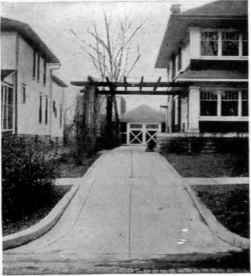
A concrete driveway from the street to the home garage at the back of the lot is many times better than a pair of ruts and a string of mudholes.
Continue to:


My Books

