


Shaping Reinforcement
Description
This section is from the book "Practical Concrete Work for the School and Home", by H. Colin Campbell. Also available from Amazon: Practical concrete work for the school and home.
Shaping Reinforcement
Instead of using steel rods or wires for reinforcement as shown on Plate 21, page 122, for bowls or basins such as in fountains, expanded metal or wire mesh may be used, and in many cases will be preferable. Whenever expanded metal or wire mesh is used for such purposes, it will be necessary to cut the flat sheets so that the reinforcement when bent up will conform to the lines of the product. This is called developing the sheet of reinforcement. For example, in order to have the reinforcement for the basin of the fountain shown on Plate 21 conform to the shape of the basin, it will be necessary to cut the flat sheet as shown in Plate 41. After the necessary cuts have been made, the sheet should be bent along the dotted lines as shown and the laps securely wired with black stove wire. If the bowl is larger in diameter than the one shown, a greater number of radial cuts may be required.

Developed Sheet of Wire Mesh reinforcement for Basin.
When the bowl is flat, such as the one referred to, these radial cuts may be made as shown, but if the bowl is hemispherical it will be necessary to cut the sheet as shown in
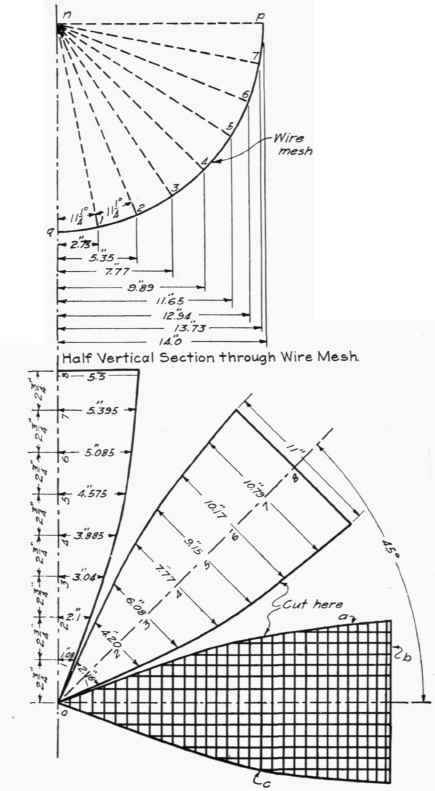
Developed sheet of Wire Mesh reinforcement. (Reinforcement for Hemispherical Bowl.)
Plate 42. This illustration shows a convenient method for laying out such developed sheets. In this case the flat sheet is composed of eight equal sectors, two and one-half of which are shown in plan. When these sectors are bent up so that their edges meet, they will form a hemisphere. The length of the flat sector along the center line is equal to the length of the arc of a circle shown in the upper part of the drawing. In this example it was found convenient to divide the sector into eight equal parts, each 2 3/4 inches long. The 90° vertical arc is also divided into eight equal parts, the length of each part measured on the circumference being equal to 2 3/4 inches. The dimension at the outer edge of the flat sector, 11 inches, is equal to one-eighth of the circumference at the outer edge of the reinforcement at p when the sectors are bent into the form of a hemisphere. The dimension 10.79 inches is equal to one-eighth of the circumference at the point (7) in the half vertical section through the wire mesh with a radius of 13.73 inches. The dimension 10.17 inches is equal to one-eighth of the circumference at (6) when the radius is 12.94 inches. Each successive dimension toward the center of a sheet at (0) is equal to one-eighth of the circumference at its respective point shown in the half vertical section. The developed sheets for hemispherical bowls of any diameter may be laid out in a similar manner. A practical illustration of developing these sheets may be had by cutting an orange in two equal parts and slicing the peel into eight equal parts from the circumference of the orange to the bottom and laying the eight sectors thus formed flat on a table. The shape of the orange peel sectors will be almost identical with the sectors shown in plan on Plate 42.

Plan of Sheets Assembled.

Developed Sheet with lap.
The developed sheet for square bowls is shown in Plate 43.
It is important to securely wire all edges of developed sheets in order to secure the necessary strength required from the reinforcement, that is, to make the reinforcement truly continuous.

One way of ornamenting concrete is to inlay colored tile in the surface. This gateway with flower boxes shows the artistic possibilities of concrete.
Continue to:


My Books

