


Plans For Four-Room Stucco Birdhouse For Martins
Description
This section is from the book "Practical Concrete Work for the School and Home", by H. Colin Campbell. Also available from Amazon: Practical concrete work for the school and home.
Plans For Four-Room Stucco Birdhouse For Martins
Plate 46 shows various details of a cement stucco bird house for martins. This house rests on a concrete floor or platform 22 inches square. The bird house itself consists of four rooms, making a structure 16 inches square. The various parts are the platform or floor, outer walls, roof and partitions. The platform, or floor, is built of a square piece of metal lath or expanded metal stuccoed, that is, plastered on both sides with cement mortar to a total thickness of 1 inch.
Four holes should be arranged for in this platform by inserting greased wood plugs into the mortar and through the metal lath while the plaster is soft, to receive the rods (r) at the corners of the house.
The outer walls are formed by first nailing together the wood uprights (a) and wall plates (d). These are shown in the plan at the lower left-hand side of the illustration and in the section at the upper center. These rods are stapled to the sides of the corner posts (a) as shown. Intermediate or side posts (c) and the center post (b) may be difficult to hold in proper position unless temporarily secured by means of stay laths (e) as shown in a portion of the partition in the upper right-hand sketch. After metal lath or expanded metal has been fastened to posts (c) and (d), the temporary stays (e) may be removed. Metal lath or expanded metal, which is the ground work of the partitions, is first cut to the desired size so that the upper edge when set up will be slightly below the roof. The outer walls are then set on the platform so that the four projecting rods (r) will be embedded in the holes previously provided for them. This prevents side movement of the frame while applying the cement mortar or stucco. Partition walls are placed inside the outer wall and the posts (c) nailed to wall plates (d). The exterior walls and partitions should then be plastered with cement stucco. Before applying the plaster to the exterior walls, small cores.
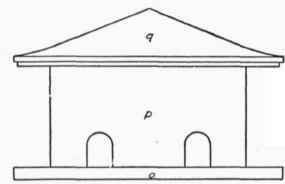
South Elevation.

Section at A-A.

Partition c-b-c Showing Metal Lath Attached.
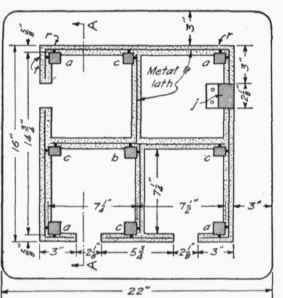
Plan.

Roof Plan Showing Framing and Metal Lath.

Elevation Section B*B Core for Entrance.
such as shown in the sketch at the lower right-hand of Plate 46, should be set in cut-outs previously made to provide entranceways to the various rooms.
The roof is composed of roof plate (f) shown in the plan at the lower center of Plate 46, and the hip rafters (g) and (h). After the rafters have been framed, they should be nailed together at the peak, and to the roof plate. Metal rods are then fastened to the upper surface of the rafters, as shown, following which metal lath or expanded metal cut to triangular shape is attached to the rods and rafters.
Various details of preparation for plastering the roof are shown in the center sketch at the extreme right-hand portion of Plate 46. Cement mortar is troweled into the metal lath or mesh. After the stucco has become thoroughly hard, the roof section is placed on top of the wall plates as shown and fastened to them either with clamps or wood screws, but first there is placed a bed of mortar at the top of the concrete surface and level with the top of wall plates. The walls are then set in a bed of mortar on the platform and the four rods (r) grouted into holes provided for them, that is, the rods are permanently set in these holes by pouring around the rods a thin cream-like mixture of cement and water.
This plan may be enlarged or otherwise modified without in any particular respect changing the essentials of the design. Any kind of metal fabric or expanded metal may be used. Other sizes of posts, rafters and wall plates may be substituted for the size shown.
Proportions and shapes of bird houses may vary, but the same principles of construction when concrete or stucco is used apply to all types.
Each bird house must be planned to meet the particular habits and characteristics of the species of bird for which it is intended.
Continue to:


My Books

