


Form Details And Practical Designs. Part 3
Description
This section is from the book "Practical Concrete Work for the School and Home", by H. Colin Campbell. Also available from Amazon: Practical concrete work for the school and home.
Form Details And Practical Designs. Part 3
Cores
A form such as shown can be used for the exterior form of a square flower box. Of course a core or inside form is then required. Although the core may be made of a solid block of wood tapered so as to permit withdrawal, this is not good practice as the block is almost certain to swell and be difficult to remove.

Cores similar to those shown in Plate 4 should be used. They require no taper since they are planned particularly with a view to easy removal. Sides e, d and c are similar in every respect. Parts a and b have beveled or splayed edges, so that when knocking down the core the cleat h may be withdrawn from the metal brackets m and the side a easily removed. The sides e, d, c, and b are then successively withdrawn. Sides c, d, e, and b are fitted with blocks j to hold the core form square. Blocks k are nailed to the workbench when the form is set up to hold the core centered.
Plate 5 shows a form such as described assembled and with concrete in place. Similar core forms are used for square hollow columns or piers. A small flower box like this is cast bottom side up, that is, the top of the mold is the bottom of the object. Attention should be drawn here to the distinction between the bottom of the object and the bottom of the form. That part of the form which rests upon the workbench or upon the platform upon which the work is being- done will hereafter be referred to as the bottom of the form, while the bottom of the concrete object being described will always be referred to as the bottom regardless of its position when being cast.

Plate 6 shows various details of a solid knock-down core. Such a type of core or inside form may often be used to advantage in small concrete products. Completely assembled, the form consists of a solid block of wood with rounded or beveled corners at the top and side edges. This is then cut into four blocks as shown. The top view of this core illustrated at section A-A shows how the blocks are numbered. Numbers to correspond with those on the tops of the various pieces should also be placed on the bottom so that when the mold is reversed the core may be withdrawn. Section No. 1 is withdrawn first, then No. 3, then No. 2, then No. 4. The importance of numbering the pieces and the order in which the blocks should be withdrawn must be impressed upon the worker. The four blocks are held assembled by fine wire or string. The underside of the core should be bored with small holes which will snugly receive corresponding dowel pins or nails set in the workbench. These pins or nails will prevent side movement or shifting of the core.

Section A-A.
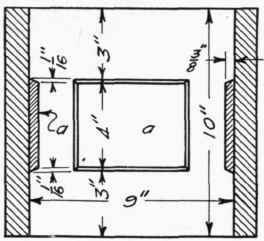
Section.
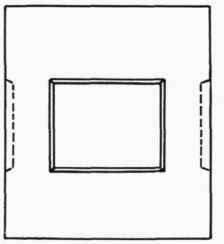
Elevation.
Plate 7 illustrates a form for solid block or a flower pot which introduces slight decoration in the form of depressed panels. The exterior form is the same as that shown in Plate 3 except that thin pieces of wood are nailed on the inner surface of the form as shown at a to provide for depressed panels in the finished object. Small brads or finishing- nails should be used for this purpose and countersunk with a nailset, the head-holes being then filled with putty so that nail hole markings will not appear on the finished concrete. The pieces a should have a slight draft or bevel around edges, say, about 1-16 of an inch, so that the form may be withdrawn without injuring edges of the depressed panel.
The next elaboration of this simple form is to vary it for casting an object with raised panels as shown in Plate 8. Instead of nailing pieces on the inside face, as described in the last plate, pieces x are properly attached to the interior face of the forms. It is important that the ends b and c be made square as shown, but the ends of pieces x must be mitered. If not mitered the form cannot be withdrawn from the concrete without injury to the surface.

Forms of this kind may be elaborated in various ways to serve for square columns and piers which it is desired shall have either depressed or raised panels.
Plate 9 shows various details of a rectangular form for a flower box. Such forms are similar in every respect to the simple square forms previously described. In order to prevent the sides of the form from bulging in or out when placing or tamping concrete, braces should be placed at convenient points along the sides. These will keep form pieces properly lined up. Blocks a and b are nailed to the workbench to keep the outside form and core from shifting.
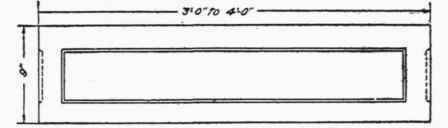
Simple Box, with Depressed Panel

Plan or Form and Core Assembled PLATE 9
At the upper portion of Plate 9 a variation of form is shown whereby raised or depressed panels may be provided for.
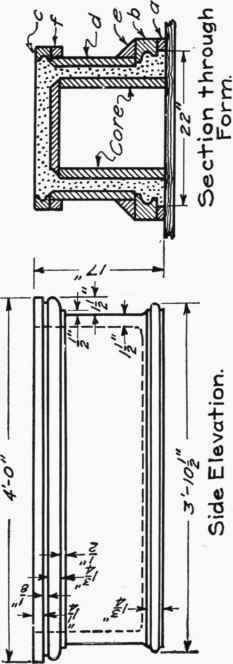
Plate 10 is a slight elaboration of the design shown in Plate 9, in that a different kind of ornamentation is provided for in making the form. The core and other details of the form are in general like those previously described. The parts a, b, and c which provide for the ornamental molding on the concrete object may be built up as shown in the sketch illustrating a section through the form. Because of overhang on the object the ends of the exterior form must be mitered. In preceding examples there was no such overhang, hence the sides of forms did not overlap a corner of concrete and could readily be withdrawn. Unless the mitered joint is made in this case it is practically impossible to remove forms without injuring the object. Pieces b and c may be made of stock molding or trim and nailed to the remainder of the form, or they may be formed from suitable pieces of wood in a wood-working shop. Parts a, b, c, d, e, and f must be securely nailed together before the mitered joint is cut.
Continue to:


My Books

