


Form Details And Practical Designs. Part 2
Description
This section is from the book "Practical Concrete Work for the School and Home", by H. Colin Campbell. Also available from Amazon: Practical concrete work for the school and home.
Form Details And Practical Designs. Part 2
Division Of Forms
As mentioned elsewhere some forethought must be given to planning forms for concrete objects having unusual shapes, and in such planning care should be taken to arrange to divide the forms into sufficient parts to make removal from the object easy.
Plate 2 shows some such details. At the left of the plate is a form for a column having twenty-four flutes. In this case it is necessary that the form be divided in six sections so that each may be withdrawn in the direction of the arrowhead without binding at any point. The dotted lines parallel to the direction
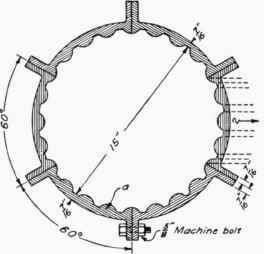
Sectional Plan of Form for Fluted Column
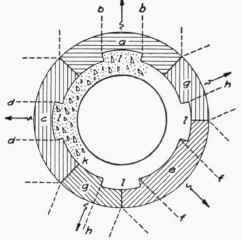
Product with projecting surfaces Correct and Incorrect methods of the arrowhead show that the form will clear all flutings without injuring the edges. In this particular case the flutings are shallow. If they were deeper these sections could not be withdrawn without injuring the edges. In such a case the form would have to be divided into more than six sections.
It is always necessary first to lay out the column in plan to determine the number of sections required. The form which is described is supposed to be of cast iron. The sections are bolted together. Although it is possible to make such forms of wood it involves considerable work and owing to the tendency of wood to swell when wet, metal forms are more practicable for repeated use where high-grade work is required.
At the right of Plate 2 there is shown in section a form for a product having projecting surfaces such as pilasters or lugs. The form is shown partly filled with concrete to illustrate the object k. There is a correct and an incorrect way of making forms for such objects. Segment e has joints at the middle points of projections l. When withdrawn in the direction of the arrowhead the form will clear the concrete as is indicated by the parallel dotted lines f-f. This is the correct method if the form is divided into four segments similar to e. If the form is divided into four segments similar to a having the joints midway between two projections the segments cannot be withdrawn in the direction of the arrowhead, nor in any other direction, without breaking the edges of the projection as shown by the parallel lines b-b. If the edges of the projection on the product are parallel with the line drawn through the center of the product as shown at c then joints midway between the projections would be permissible and the form could be divided into four segments similar to c. These segments could be withdrawn in the direction of the arrowhead as indicated by the dotted lines d. If the form were divided into eight parts then each part would be similar to segment g which could be withdrawn in the direction of arrowhead without injuring the edges of projections as shown by line h parallel to the face of this projection.
The foregoing examples illustrate the underlying principles of correct and incorrect methods of dividing forms for practically all circular concrete objects. Other objects will require only a variation of these principles, to conform to the shape of the object.
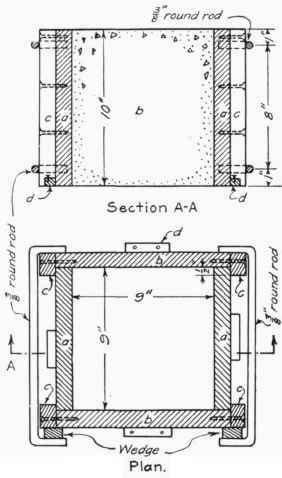
Plate 3 illustrates details of a form for solid concrete block 9 inches square by 10 inches high. This form may be built of 1 or 1l/2 inch lumber. The ends of the sides a should be square. The ends of the sides b have cleats nailed to them as shown at c. These cleats hold sides a securely in position while concrete is being placed in the form. Sides b are held in position either by metal clamps and wedges, or by any one of the numerous commercial clamps such as used by wood workers for holding pieces together while gluing. When assembling a form the four sides are set up on a workbench or table to which blocks d are nailed in position to hold the form square. When blocks d are attached to the workbench, nails should not be driven all the way in. This will permit pulling them easily without hammering or blows that would injure the concrete.
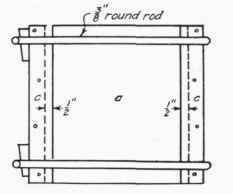
Elevation.
Continue to:


My Books

