


Form Details And Practical Designs. Part 3. Part 3
Description
This section is from the book "Practical Concrete Work for the School and Home", by H. Colin Campbell. Also available from Amazon: Practical concrete work for the school and home.
Form Details And Practical Designs. Part 3. Part 3
Suggested Method for Cutting cants with the Grain.

Fish pond, with concrete block wall, on an Indiana Farm.
Plate 17 gives various details of forms for round-top table with cylindrical pedestal. The form for the top is the same as that illustrated and described in connection with Plate 14. The form for the cap is built up of pieces a and b. The core is the same as for a square pedestal. Form for the shaft is built up of segments m and n. Sheet metal o is bent to the desired curve and attached to the uprights q. Joints of this metal should abut instead of overlap and should be smooth to prevent after markings on the concrete. Uprights q are clamped or bolted as shown. Pieces p are nailed or screwed to segments m.

Section at B-B.

Plan of Base Form.
Plate 18 shows design for round top table with cylindrical pedestal cast in one piece. Form for base of pedestal is made of three segments a turned to the desired shape in a lathe. Cap is made of three segments b also turned to the desired shape. Top piece c may be made of one piece with hole in the center for tenon. This hole should be slightly tapered so that c may be withdrawn easily. It should not be fastened to b because it must be lifted off the casting or object before other forms are removed. The forms should be filled up to the top of b, then piece c is put on and weighted down and filled with concrete to the top.
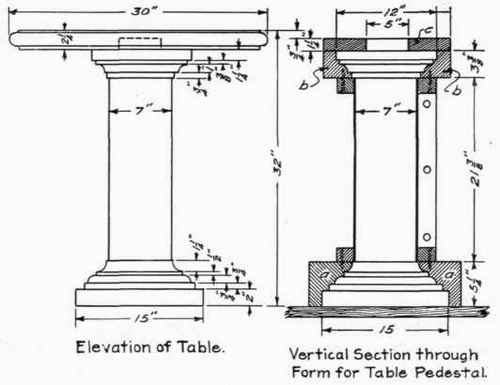
Plate 19 shows a pedestal for sundial. This is the same as that shown in Plate 18. The dial slab is cast separately and attached to the pedestal by cement mortar. In using the preceding designs for building this pedestal the mortise and tenon should be omitted.

Elevation of Sun Dial.
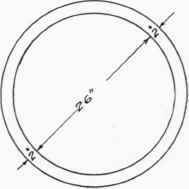
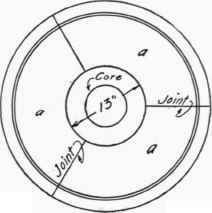
Plate 20 shows design for a concrete bird bath or fountain. The same pedestal is used as for the two preceding- objects. The core consists of one piece b. The basin or bowl is cast bottom side up. The core should have a slight draft at edge a to make
Plan op Bird Bath
Plan of Form for Basin.

Elevation of Biro Bath.
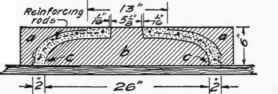
Form and Core for. Basin, assembled withdrawal easy. Reinforcement consists of rings of light rods wired to radial rods as shown in the lower portion of Plate 21, or expanded metal or wire mesh fabric may be cut and developed to form the reinforcing required.
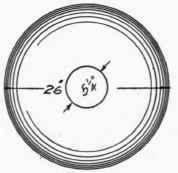
Plan of Core.
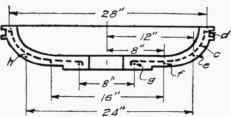
Section through Basin showing reinforcement

Plan of Reinforcing Rods assembled

An elaborate entranceway of concrete. The columns carry artistic receptacles for electric lights.
Plate 22 shows various details of a garden fountain. The pedestal is the same as that illustrated in plates immediately preceding except that the tenon is 7/8 inch high. The basin of the fountain is identical with that illustrated in Plate 20. The nozzle of the fountain is built up of pieces a, b, c, d, e, and f as shown in the upper right-hand sketch of Plate 22. Part d is turned out in a lathe and nailed to parts c, b, and a. Part f is nailed to d

Elevation of Fountain and e. This form is made in three segments as previously described. Suitable arrangements must be made for water pipe and overflow. The nozzle spray is of metal and is fitted in the top of the nozzle pipe. The pedestal, basin, and bubbler standard are connected as shown in the illustration at the left-hand portion of Plate 22.

Vertical Section through Top of Pedestal.
Plate 23 illustrates a cylindrical form similar to that shown in Plate 17. This is to be used for a plain cylindrical flower pot which is cast bottom side up. The core is the same as that described in connection with Plate 6 except that it is square instead of cylindrical. The top and bottom sections of the form should be marked with figures 1, 2, 3, and 4. Part 3 shown in the sketch illustrating a section through the core at B-B is withdrawn first. Then part 1 is taken out. Pieces 2 and 4 can then readily be removed.

Concrete roads like this may cost a little more than some other kinds in the beginning, but they are cheaper in the end than any other road. There are thousands of miles like this in the United States.
Continue to:


My Books

