


Bending Wood
Description
This section is from the book "Woodworking For Beginners: A Manual for Amateurs", by Charles G. Wheeler. Also available from Amazon: Woodworking For Beginners.
Bending Wood
To bend a piece (without steaming or boiling) which is to be fastened so that but one side will show, make running a gauge line along the edge (see Gauge), that the cuts may be of equal depth. This will practically, so far as bending is concerned, make the piece thinner, and it can readily be bent and fastened in position. The nearer together and the deeper the cuts are the more the piece can be bent - that is, up to the breaking-point. Hot water can be used on the face side. Such curves can sometimes be strengthened by driving wedges, with glue, into the saw-kerfs after the piece is bent to the desired curve (Fig. 468).

Fig. 467.
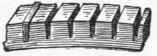
Fig. 468.
To make a small piece of wood pliable, so that it will bend to any reasonable extent (which, however, depends much upon the kind of wood), soak it for some time in boiling water, when it can usually be bent into the desired shape. It must be securely held in position until the moisture has entirely left it, or it will spring back to (or towards) its original shape. This drying will take from several hours to several days, according to the size of the piece and the condition of the atmosphere. There is almost always a tendency to spring back a little towards the original shape, so it is well to bend a piece a little more than you wish it to remain, except where it is to be fastened so that it cannot spring back.
Wood which naturally bends easily (particularly thin pieces) can often be made pliable enough by simply soaking in cold water, but hot water is usually more effective. Anything which you cannot manage with the hot water you can take to a mill or a ship-yard and have steamed in a regular steam-chest, which is really nothing, in principle, but a big wooden or iron box, with a steam-pipe running into it, in which the pieces are kept until the steam has made them pliable. Wood is now bent for many purposes by "end pressure," but this is impracticable for the amateur.
To bend the ends of pieces like skis, hockies, etc., a big kettle or common wash-boiler full of boiling water can be used. An apparatus for long sticks, as ribs for a canoe, can be made with a piece of iron pipe of suitable size. Plug one end tightly and stick it firmly in the ground, so that the pipe is fixed in a slanting direction. Put water in the pipe, build a fire underneath, put the sticks in the pipe, stuff a rag loosely in the upper end and the apparatus will be in working order (Fig. 469).
You must often have some sort of form or mould for bending the piece and for holding it while drying. For some kinds of bending, where there is no occasion to be accurate, you can often bend a piece around some corner or common object, as a barrel, log, etc., and tie it in place until dry, or fasten it with cleats, but for nice work you should make a form or mould. If you wish to bend ribs, for instance, which should be accurate in shape, you can cut a piece of board or plank to fit the concave side of the desired curve. Fasten this piece upon any flat surface, as an old plank, and bore holes for wooden pins around the curve at such a distance from the pattern piece or mould that the piece to be bent can be firmly wedged against it, as shown in Fig. 470 ; or you can attach blocks instead of pins - any arrangement by which the bent piece can be wedged in place. A strap of hoop iron or other metal or even a thin piece of wood can be placed outside of the stick to be bent, to prevent the wood splitting or splintering on the outside, as it is liable to do if bent much, unless of good quality and straight grain, but there is no need of doing this in many cases.

Fig. 469.
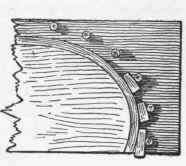
Fig. 470.
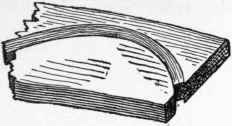
Fig. 471.
Another way is to have the mould or form in two parts, as the two parts of a board or plank through which the curve has been sawed (Fig. 471). The piece to be bent is put between the two forms, which are then pressed together by clamps, wedges, or a lever. This is a good way for short pieces which cannot easily be bent, or which do not readily cling to the required curve.
Another form of bending-mould is shown (an inverted view) in Fig. 472. In this case the pieces to be bent are held in place by easily made clamps.
A simple way to make a form for bending strips is to cut the curve out of a piece of plank, or boards nailed together (Fig. 473). The end of the strip is then caught against the cleat and the piece bent around the curve.
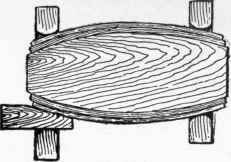
Fig. 472.
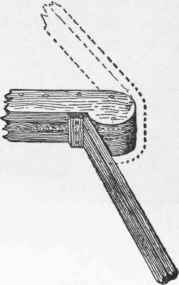
Fig. 473.
If it tends to spring off the curve, you must contrive some way to clamp, wedge, or even tie it in place. As a piece must be left on the form until dry and set, if you have a number to bend, it may be better to make a form wide enough to bend them all at once. Take any boards, or build a curved addition on the end of a box, and contrive a wider form on the same principle (Fig. 474.)
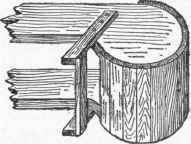
Fig. 474.
For ribs, and the like, the stock should be got out so that the annual layers will be at right angles to the direction of the nails with which the pieces are to be fastened, or parallel with the curved sides of the pieces.
Continue to:


My Books

