


Skis
Description
This section is from the book "Woodworking For Beginners: A Manual for Amateurs", by Charles G. Wheeler. Also available from Amazon: Woodworking For Beginners.
Skis
To make as perfect skis as possible they should be of rift stock, that is, split out instead of sawed; but this may seldom be practicable for you and is not really necessary. Good straight-grained sawed stock will answer, but be sure that you get clear, strong stock - air-dried if possible. Always avoid kiln-dried stock for anything which is to be put to sudden and violent strain, if you can get that which has been naturally seasoned (see Chapter III (Wood).).
Ash is very good (white ash the best); spruce, light and strong; oak, strong but heavy. Any strong and elastic wood will do, if not too heavy. If you can get stock which is naturally sprung in a good curve upward and is satisfactory in other respects, take it, for a convex curve upward underneath the foot gives spring and elasticity and helps prevent the skis from becoming hollowed too much by the weight of the body. This curve is not necessary, but the better ones are purposely so made. Skis are sometimes used in very rude forms - as two strips of wood with the 10 front ends shaved down and bent up at an angle. Small ones can even be made of staves from barrels, but these are very unsatisfactory.
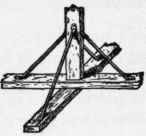
Fig, 209.
Fig. 210.
Before beginning work read carefully Marking, Rule, Square, Drawknife, Plane, Spokeshave, in Part V., and look up any other references.
First get out the pieces of the required size. The length for a man is usually about 8' and the width about 4", though they are used even as long as 12' or 13'. From 5' to 8' long and from 3 1/2" to 4" wide will probably be right for you, but the dimensions depend on your size, of course. Next taper the forward ends, as shown in Fig. 211. You can mark both edges alike by drawing the curve free-hand or with a spline (see Spline) on a piece of stiff paper, from which you can cut out a pattern for drawing the curve on the wood. Next make the pieces thinner towards the ends (Fig. 212), noticing that the forward end is thinner than the after end and is shaved down more quickly so that the stock may be thin where the toe bends up. This requires great care unless the grain is very straight, for a little hasty slashing will make too deep a cut (see Paring, etc.). Good forms are shown in Figs. 213 and 214, the former showing sections at the middle and the latter nearer the ends, but as the toe is approached the top should become fiat for ease in bending. This shaping can best be done by the draw-knife, spokeshave, or plane.

Fig. 211.

Fig. 212.

Fig. 213.

Fig. 214.
Bend the points of the toes upwards about 6" above the horizontal line to ensure their riding clear of obstructions, but there is no gain in curling them up a foot. For the process of bending, see Bending Wood. Then turning the skis over, gauge (see Gauge) parallel lines for the grooves on the bottom. Work the grooves out with the gouge or with the saw and chisel (see Gouge and Grooving) unless you chance to have the plane designed for this purpose.1 Make these grooves shallower as they approach the toe, leaving no groove where the toe bends up.

Fig. 215.

Fig. 216.

Fig. 217.
Balance the skis lengthways on a stick or your finger and put stout leather straps just forward of the balancing point. These can be riveted or even screwed to the edges of the skis (Fig. 215), but a better way is to put them through slots cut in the wood (Fig. 216). Gauge accurately for the slots, marking on both edges, and bore in from both sides (see Boring). The slots must then be cleaned out with chisel and file (see Mortising). An easier way and fully as strong is to cut grooves (Fig. 217) with saw and chisel and cover them with thin strips securely screwed on (Fig. 218). Some use a second lighter strap to go above the heel. This can be screwed to the edges if you use it. Strips screwed across under the instep (Figs. 219 and. 220), or behind the heel (Fig. 221), to prevent the foot sliding back are sometimes used.' For racing the Norwegian skis are turned up at the rear end also.
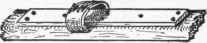
Fig. 218.
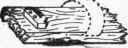
Fig. 219.
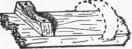
Fig. 220.
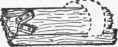
Fig. 221.
1 All of this work can be done cheaply at any mill, leaving the rounding or bevelling of the edges and the bending of the ends for you to do yourself, and for that matter the rounding or bevelling can be done by machine.
The pole, like the skis, must be of light, strong stuff, and can be round or eight-sided (see Rounding Sticks). To shape the tapering end make the stick uniformly eight-sided for the whole length first and then plane each side down at the end to get the taper. The hole in the disk must not be quite so large as the diameter of the pole, so that it cannot slip up farther than the tapering part (Fig. 222). Many dispense with the disk.

Fig. 222.
Finally smooth skis and pole with scraper (see Scraper) or glass, and sandpaper (see Sandpaper), and finish with plenty of raw linseed oil or with oil, shellac, and varnish, in successive coats (see Finishing). If open-grained wood is used it can be filled to good advantage with a coat of good wood-filler well rubbed in (see Finishing), and the bottoms can also be rubbed with wax or tallow, if you wish.
Continue to:


My Books

