


Canvas-Covered Canoes
Description
This section is from the book "Woodworking For Beginners: A Manual for Amateurs", by Charles G. Wheeler. Also available from Amazon: Woodworking For Beginners.
Canvas-Covered Canoes
To make a really good canoe wholly of wood requires a degree of skill much greater than can be expected of the beginner, or than is attained by the average amateur. Any boy or amateur can, however, with the help of canvas and with a very few tools and at slight expense, make some simple varieties which will serve the purpose satisfactorily. The canoe is sharp at both ends, requires only a paddle, and is light enough to be easily handled ashore. If carefully made, a canvas canoe will be strong, durable, and not difficult to mend, though repairs are seldom necessary if proper care is taken. If canvas of good quality is used, it will not be easily punctured or torn as one might think, but will stand an amount of banging around, running into snags, dragging over obstacles, and abuse generally, that would badly injure any but the best of wooden canoes.
The variety of designs for canoes which has developed or been evolved from the more primitive forms is in these days almost endless, and the number of types from which to choose is confusing. The purpose for which the canoe is to be used will help you somewhat in selecting the type -whether for paddling only, or sailing, or for cruising and general use, and whether for a river or small pond, or for the deep and rough water of a lake or bay. All these matters must be considered in determining the beam, depth, shape of the midship section, the draught, degree of sheer, whether to have keel, centre-board, or neither, and other points. This is too complex a subject to be treated in a hand-book on wood-working, and you can easily obtain the desired information, as well as detailed instructions for drawing the plans, from some good book on the subject.
A caution against making the framework too light and without sufficient stiffness may not be out of place. One frequently sees canoes, made by young boys, of such flimsy pieces and covered with such weak cloth that one is surprised that they can live in the quietest mill-pond, which is really testimony to the tenacious strength of a canvas-covered boat when properly made. A certain degree of flexibility is one of the desirable features of these boats, but they should always have sufficient stiffness to maintain their general shape in all weathers and in all waters to which a canoe is suited; therefore be sure to make a frame which will keep its shape of itself without relying upon the canvas to hold it together.
It is quite common to see these boats which (otherwise well built) lack stiffness lengthways - that is, in the longitudinal vertical section. Such boats after a little use become bent up in the middle, or " hog-backed." This is entirely unnecessary. Be sure, before putting on the canvas, that your frame is stiff enough lengthways to keep its shape permanently. If by any fault in your planning you find that it is not so, be sure to add extra stiffening braces inside before putting on the canvas, or your boat will probably be a failure.'
1 Unless too heavily loaded, a canvas-covered canoe will float in case of a capsize, but some form of air-chambers is desirable and a safe precaution in any small boat. It is hardly safe to rely upon your ability to build watertight compartments in the ends of canvas (or wooden) boats, as is sometimes recommended - that is, as a part of the regular construction of the boat. It is not easy for an amateur to do this. It is better to have the air-tight compartCanvas-covered boats should always be kept out of the water and under cover when not in use, as long-continued exposure to the water will be injurious.
An easily constructed paddling canoe, 14' or 15' long, and with beam about 30", will first be described.
It should be understood by the novice that this first form of construction here given is not that adopted by the professional boat-builder. It is given simply as a process by which one untrained in the more regular methods of construction can turn out a cheap and serviceable canoe, and at the same time acquire experience which will be of use if he should later attempt the more scientific, but also more difficult, details of construction used by regular boat-builders.
Before beginning work read carefully Marking, Rule, Square, Saw, Plane, Nailing, Painting, in Part V., and look up any other references.
Care should be taken to select clear, straight-grained stock, free from knots, checks, and other defects, and thoroughly dry.
Having made your working drawings for a canoe of the size and proportions which you may think best to adopt, begin the actual work by getting out moulds (Fig. 433) upon exactly the same principle as in the case of the flat-bottomed canoe just described, except that they will be of curved outline, as this is to be a round-bottomed ments made separately and independent of the boat itself. Copper boxes or air-tanks fitted to the space at the ends are the best and the only really reliable expedient, but they are expensive. Light wooden boxes covered with canvas and thoroughly painted can be used, as well as galvanised boxes or even varnish cans sealed and painted. Any such contrivance can be made tight at first, but is always liable to become leaky (except by the use of copper tanks), particularly as it is usually concealed from examination.
Boat. Get out also a bottom strip or keelson with stem- and stern-pieces, which can be alike.
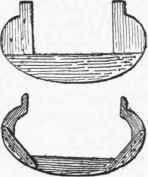
Fig. 433.
The arrangement and method of fitting these parts is evident from the illustrations. The keelson can be laid along the edge of a plank or some fiat surface and blocked up towards the ends to give the desired degree of curvature or rocker. First fit in place the centre mould and then the two at the ends of the well-hole (Fig. 434), with the stem-and stern-posts (Fig. 435). These can be temporarily tacked or stayed in place until you are sure the positions are right. The coaming frame or wash board around the well-hole can now be put on, which will hold the three middle frames securely, and the two deck-strips running lengthways from the well-coaming to the tops of the stem- and stern-posts can be attached (Fig. 435). Next fit the two gunwale-strips, putting in also the remaining moulds or frames. After this the lengthways ribbands are to be fitted around the moulds from bow to stern (Figs. 435 and 435a, showing section at end of well). This will complete the shape of the boat.
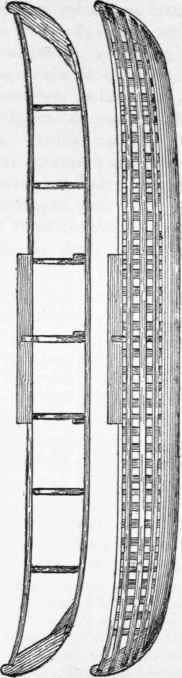
Fig. 435-
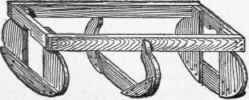
Fig. 434.
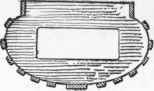
Fig. 435a.
Continue to:


My Books

