


Chapter XIV. A Few Simple Structures. Summer-Houses
Description
This section is from the book "Woodworking For Beginners: A Manual for Amateurs", by Charles G. Wheeler. Also available from Amazon: Woodworking For Beginners.
Chapter XIV. A Few Simple Structures. Summer-Houses
A form which is quite easy to build, and which is attractive when overrun with vines, is shown in front elevation (Fig. 401) and in side elevation (Fig. 402).
Before beginning work read carefully Marking, Rule, Square, Saw, Plane, Nailing, Painting, in Part V., and look up any other references.
The construction is simple. The frame can be of 2" x 3" stock (planed), except the sills, which had best not be smaller than 2" x 4" (on edge). Cross floor-beams can be inserted, as in the floors of the little houses first shown.
The upright members can, however, rest upon posts set in the ground and the floor be dispensed with. Where the parts of the frame cross they can be halved (see Halving). The square joints can be nailed together. The roof can be solid or made of slats several inches apart, resting upon rafters.
The strips for the lattice-work can be about 3/8" thick, and from "to 1 1/4" wide. These can be got out at any mill in long or short strips, which you can cut off as you put them on. Do not lay them too closely together. Put one strip on at the desired angle. Then cut off one or more short pieces by which to gauge the distance for laying the next strip, or get out a piece of light thin boarding of the width of the space between the lattice strips and hold it beside each strip as a guide by which to lay the next one.
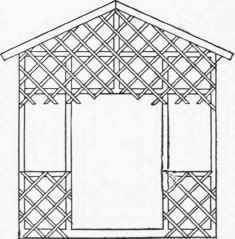
Fig. 401.
This lattice-work, although each strip is so slight, will give the frame great stiffness and strength.
The joints of such framework as this should properly be painted before being put together (see Painting), and it also is a more thorough and neater way to lay the lattice-work strips on supports of some kind and paint them before putting on. They will then only require touching up with paint after the house is done.
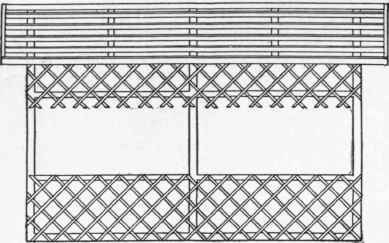
Fig. 402.
The rustic summer-house, or arbour, made of sticks in their natural form, shown in Fig. 403, is in some respects more difficult to build than the preceding, because the ends of so many of the pieces have to be cut at an oblique angle.
Before beginning work read carefully Marking, Rule, Square, Saw, Plane, Nailing, Screws, Hinges, Painting, in Part V., and look up any other references.
First make a platform, as for the other floors, or the upright posts can rest upon posts set in the ground and the floor be dispensed with. Plates can be placed on top of the posts, and rafters extend from the plates at the top of each post to the apex of the roof. These plates and rafters will make a framework on which to nail the sticks which form the roof covering. The remaining details are apparent. Much care is required, however, to put this house together properly, not merely in cutting the angles at the joints, but in sighting, measuring, and testing to ensure its coming together without twisting or winding.

Fig. 403.
Instead of making this house six-sided, it can, if desired, be made rectangular like the preceding one, but keeping the same arrangement of the details. This makes a very pretty design, and in respect to joining the pieces is much easier to make. Another pretty plan is to build a hexagonal, octagonal, or circular house of this sort around a tree trunk. If the roof is fitted too snugly to the tree trunk, the growth of the latter may split the roof apart before the rest of the house is past its usefulness, so you should arrange this part to allow for the growth of the tree.
Continue to:


My Books

