


Cleating
Description
This section is from the book "Woodworking For Beginners: A Manual for Amateurs", by Charles G. Wheeler. Also available from Amazon: Woodworking For Beginners.
Cleating
A simple way to join two or more pieces of board or plank to make a wider piece is to cleat them. If short, they can be cleated across the ends. This can also be done to keep a single board from warping (Fig. 493). Such a cleat should not be glued unless the width is very slight, on account of the expansion and contraction across the board being so much greater than that lengthways of the cleat (see pages 50-53). Screws (which are best), nails, or dowels should be used, as they will give some play to the pieces. A groove can also be made in the cleat, into which a tongue on the end of the board is fitted. Grooves can be cut in both cleat and board and a tongue or spline inserted (Fig. 494). These are operations best done by machinery. This end-cleating does very well on small work and where the tendency to warp is not too great. For heavier work, as doors, cleats on the side are better, but they are sometimes in the way, and not always desirable on the ground of looks. This is a strong way. Side cleats should be fastened with screws (see Screws) or clinched nails (see Nailing), but not with glue, for the same reason as in the case of end cleats. If the cleat is wide enough, do not put the screws in a straight line, but "alternate" them (Fig. 368). See Jointing and Doors and Panels.
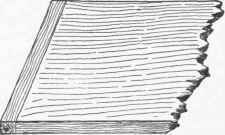
Fig. 493.

Fig. 494.
Continue to:


My Books

