


Effects of Expansion and Contraction of Timber
Description
This section is from the book "Woodworking For Beginners: A Manual for Amateurs", by Charles G. Wheeler. Also available from Amazon: Woodworking For Beginners.
Effects of Expansion and Contraction of Timber
Cracks, curling, warping, winding, or twisting are due to nothing but irregular and uneven swelling and shrinking. Some kinds of wood shrink much in drying, others but little. Some, after seasoning, swell or shrink and curl and warp to a marked degree with every change in temperature and dryness. Others, once thoroughly air-seasoned, alter much less in shape or size under ordinary circumstances.
We have already seen that the heart side of a board tends to become convex in seasoning, owing to the shrinkage of the other side, and that if one part swells much more than another the wood becomes out of shape, - warped, curled, or twisted. If one part shrinks much faster than another, cracks usually result in the quicker shrinking portion. If you stick one end of a green board into the hot oven of the kitchen stove, the heated end will crack and split before the rest of the board has fairly begun to dry. We have seen illustrations of this in the seasoning process, as shown in Chapter III (Wood).
Exposure of one side of a seasoned piece to either dampness or heat will thus cause the piece to curl. The dampness swells the side affected or the heat shrinks it so that the convexity will be on the dampened side, or the concavity on the heated side, as the case may be.
If lumber were of perfectly uniform texture, hung up where it would be entirely unconfined and free to swell or shrink in all directions, and equally exposed all over the surface to exactly the same degrees and changes of heat and cold, dryness and moisture, it would simply grow larger or smaller without changing its form or shape. There woul.d then be no curling, warping or winding. As a matter of fact, however, wood is not uniform in texture, but exceedingly varied, some pieces being extremely complex in structure; neither is it always free to expand and contract in every direction, nor equally exposed on all sides to the alternations of heat and cold, moisture and dryness.
To come to the practical application of these facts, we have seen (in Chapter III (Wood).) that boards for nice work should be planed down equally, as nearly as may be, from both sides; that the mere dressing off of the surface by hand will sometimes cause a board to warp badly; and that it is better to buy stock of as nearly the required thickness as possible, than to plane it down or split it. It should also be noted that when a board is being sawed in two or split lengthwise with a saw it sometimes springs together behind the saw with so much force that the crack has to be wedged open in order to continue sawing (Fig. 695). Sometimes the crack opens wider instead of closing (Fig. 696). You see from this that you cannot always be sure when you split a board that the parts will retain the shape they had in the original board. In working up large pieces into smaller ones, unexpected twists and crooks will often be found in the smaller pieces which did not exist in the original stock. Sometimes mahogany, for instance, will act in this way very markedly. Strips sawed off from a board, for example, will sometimes immediately spring into very crooked forms, as shown in Fig. 697 (which would not be exaggerated if the pieces were drawn of greater proportionate length). In splitting stock flatwise, i. e., making two thinner boards out of a thick board or plank, a similar result often follows. The latent power set free, so to speak, by suddenly exposing the middle of a board, plank, or other timber to the atmosphere sometimes causes curious developments. It being necessary one day to split for a picture frame a large mahogany board, 1" thick by 2' square, with a circular hole already sawed from the centre, the pieces warped and twisted as the sawing went on (Fig. 698), until, just as they were nearly separated, the whole thing " went off " with a report like a toy pistol, breaking into a dozen pieces and scattering them around the shop.
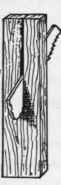
Fig. 695.

Fig. 696.

Fig. 697.
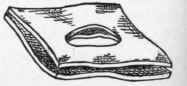
Fig. 698.
In very crooked-grained wood you will frequently find uneven and undulating forms of warping and twisting that you do not find in straight-grained pieces, but such wood is often of the most beautiful figure for indoor work. Where the grain is crooked, cropping up to the surface as in Fig. 701, the cut-off ends of the fibrous structure, so to speak, are exposed in places to the atmosphere. These open ends, " end wood," thus brought to the surface are more susceptible to moisture and dryness than the sides of the bundles of fibrous tissue, which tends to produce unequal swelling, shrinking, and warping.
You will see if you look at the ends of logs and stumps that the heart is frequently not in the centre, in some cases taking such a devious course throughout the stem as to make the grain so crooked that no method of sawing will remove the tendency to warp or twist, just shown. Such trees may show a beautiful grain. Even in straight trees the pith is not usually quite straight, and is apt to take a somewhat zigzag course, due to the crooked way the tree grew when young (Fig. 699).
Imagine, for an exaggerated illustration, that you could see with X-rays the pith as crooked as that shown in Fig. 700. Imagine that from this tree you could saw out the board indicated, keeping with it the whole pith or heart as if it were a wire rope woven in and out of the board, so that the appearance would be somewhat like that shown in Fig. 701. Bear in mind that the annual rings are layers of wood, so to speak, which may vary in thickness, growing around the heart. You will see that these layers, or rings, as they dip below or rise above the surface of the board, will cause the grain to form 34 various patterns, perhaps somewhat as shown in Fig. 701, which makes no claim to accurately showing the grain in this case. In fact, all such variations of grain in lumber are due to the surface of the piece being at an angle with the layers.
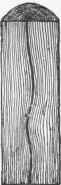
Fig. 699.
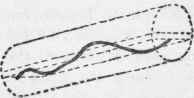
Fig. 700.

Fig. 701.
Continue to:


My Books

