


Preservation Of Forests
Description
This section is from the book "Woodworking For Beginners: A Manual for Amateurs", by Charles G. Wheeler. Also available from Amazon: Woodworking For Beginners.
Preservation Of Forests
Forests are of great value from their effect upon the climate, making it more equable. They tend to cause abundant and needed rainfall and to preserve the moisture when fallen, releasing it to the rivers gradually, and thus preventing abnormal freshets and extreme droughts. By absorbing and parting with heat slowly they cause the changes of temperature to be less sudden than in the open country. They temper the heat, and they serve as a protection, or " windbreak," to adjacent land. Trees, with other vegetation, are essential to the purification of the air. All this is in addition to the obvious uses of supplying fuel and wood for an almost endless variety of purposes, not to speak of the value of trees for shade and as features of the landscape.
The specimens will be most valuable if you can get them out so as to show a longitudinal section along the medullary rays (or through the heart), a longitudinal section at right angles to the medullary rays (or tangential to the annual rings), and a cross section (Fig. 693). It will be an advantage also to show not only the heartwood but the sapwood and bark. If you cannot get such large pieces of even the common woods, a collection of small flat blocks will be well worth making.
The specimens will show to best advantage if polished (one half of each side can be polished) or finished with a dull lustre, and they will be good objects on which to practise finishing (see Finishing in Part V.).
All the information you can pick up about the strength, durability, toughness, elasticity, and uses of the various woods will be sure to come in play sooner or later. The gradations of hardness, density, weight, toughness, elasticity, etc., are almost endless.
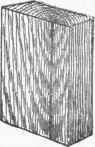
Fig. 693
Notice, therefore, the weight, colour, hardness, density, and characteristic odour of the specimens ; the proportion of heart to sapwood, and the colour of each; the size and condition of the pith; the character of the grain, whether coarse or fine, close or open and porous; the number, arrangement, size, and colour of the medullary rays (when visible); the width and character of the annual rings (when visible), whether wide or narrow, with many or few ducts or resin canals. You will find many things to notice in some woods. Use a magnifying-glass if you can.
Notice also about the bark. Hunt up all the woody stems you can, compare the bark of the different specimens, noting its colour, taste, odour, surface, thickness, and the different ways it cracks and is cast off; and notice how easily you can learn to tell the common trees by the bark alone. Sections of small stems or branches will often show the character of the wood well.
Note what you can about the character and habits of the trees themselves ; the height, diameter, age, and the shape and peculiarities of the leaves. In this connection, a collection of leaves will also be interesting to make. You can soon learn to tell the common trees by their leaves.
Notice how, in some trees, as the pines, spruces, firs, the stem grows right straight up to the top, forming a spire-shaped tree. This is called an excurrent trunk (Lat., excurrere, to run out). Notice how, in other trees, like the elm, oak, etc., the stem branches again and again until it is lost in the branches. This is called a deliquescent stem (Lat., deliquescere, to melt away).
Study the shape and arrangement of the different kinds of trees as shown in outline against the sky; best, perhaps, when the leaves are off. You can learn to tell the common trees by their outline. Do they look stout, firm, strong, and rugged, or delicate, yielding, and graceful ? To a certain extent you can thus form an idea of the character of the wood, as in comparing the pine, with its comparatively light top and slender leaves, with the heavy growth which the trunk of the oak has to sustain in wind and snow.
Preservation of Forests. - Forests are of great value from their effect upon the climate, making it more equable. They tend to cause abundant and needed rainfall and to preserve the moisture when fallen, releasing it to the rivers gradually, and thus preventing abnormal freshets and extreme droughts. By absorbing and parting with heat slowly they cause the changes of temperature to be less sudden than in the open country. They temper the heat, and they serve as a protection, or " windbreak," to adjacent land. Trees, with other vegetation, are essential to the purification of the air. All this is in addition to the obvious uses of supplying fuel and wood for an almost endless variety of purposes, not to speak of the value of trees for shade and as features of the landscape.
The reckless rate at which the forests of the United States are being destroyed is becoming a serious matter, not merely because of depriving woodworkers of the materials with which to work, but because of the influence of the forests upon the climate, the soil, etc., upon which so much of the welfare of mankind depends. At the present rate of destruction many generations cannot pass before the supply of wood will be practically exhausted. It is every year becoming more difficult to obtain native lumber of the best quality and large size.
One of the most serious aspects of the matter, however, is in regard to the washing away of the soil, which owes not merely its origin but its preservation to the forest and other vegetable growths. Professor Shaler tells us that "it is in this action of the rain upon the bared surface of the ground that we find the principal danger which menaces man in his use of the earth."
The individual woodworker may not have control of any forest or wood-lot, but he can at least use his influence indirectly, when opportunity offers, toward needed legislation to restrict, or at least regulate, the improvident waste now going on, and he can in many cases take advantage of Arbor Day to plant at least one tree toward preserving the balance required by nature.
Common Woods and Some of their Characteristics. There are many things to be considered by the beginner when choosing his wood. Many of these points have been treated in Chapter III (Wood). (to which the reader is referred), but a few additional remarks about the various kinds may be of use.
One important thing, however, to be borne in mind before beginning, is to select straight-grained, plain, rather soft, and easily worked stock. With this and with sharp tools you will have every chance of success, while with hard, crooked-grained wood and with dull tools you will be well started on the road to discouragement and failure.
It may be remarked, incidentally, that beginning with soft woods, such as white pine, calls for even keener-edged tools than can be got along with for harder woods, like oak. This, however, though it may seem a disadvantage, is really a good thing, for it compels one to keep his tools sharp. You will soon find that it is impossible to do even passable work in the softer woods without sharp tools, while with harder wood you may succeed by brute force in mauling the work into tolerable shape without being sufficiently impressed by the fact that your tools are dull and require sharpening.
Besides the familiar fact that the heartwood is usually better than the sapwood,1 it may be useful to remember that, as a rule, the wood from a young tree is tougher than that from an old one; the best, hardest, and strongest in the young tree usually being nearest the heart, while in an old tree the heart, having begun to deteriorate, is softer and not as good as the more recently formed growths nearer the sapwood. If the tree is in its prime the wood is more uniformly hard throughout. The sapwood, as a rule, is tougher than the heartwood, though usually inferior in other respects; and timber light in weight is sometimes tougher than heavy wood, though the latter is often stronger and more durable and preferable for some purposes. The application of these statements varies much according to the kind of wood and different circumstances, for the growth and structure of trees is a very complex matter, and the diversities almost infinite.
1 In elm, ash, and hickory the sapwood is sometimes considered better than the heart.
It may be well to bear in mind, considering the great variety of purposes for which the amateur uses wood, the distinction between the elasticity needed for such purposes as a bow or horizontal bar, and the toughness required for the ribs of a canoe, or the wattles of a basket. In the former case the material must not merely bend without breaking, but must spring back (or nearly so) to its former shape when released, as with lancewood or white ash; while in the latter case it must bend without breaking, but is not required to spring back to its orginal form when released, as with many green sticks which can be easily bent, but have not much resilience. These two qualities are found combined in endlessly varying degrees in all woods. Elastic wood must necessarily have toughness up to the breaking-point, but tough wood may have but little elasticity.
Earliest of all trees, historically, come the pines - the conifers - and then the broad-leaved trees. The conifers, or needle-leaved trees, include the pines, firs, spruces, cypresses, larches, and cedars. As a rule they contain turpentine, have a comparatively straight and regular fibre and simple structure, are usually light, flexible, and elastic, and the wood is more easily split or torn apart than that from the broad-leaved trees, and is easily worked. The wood of the broad-leaved trees is more complex in structure than that of the conifers and, as a rule, harder, and for many purposes stronger and more durable.
Besides the woods in general use there are many which have merely a local value where they grow, and a long list could be made of the woods which have but very limited uses, as well as of those which, from their scarcity, hardness, small size, or other peculiarities are practically out of the question for the beginner or the amateur, except on rare occasions.
Continue to:


My Books

