


Wooden Guns And Pistols. Part 3
Description
This section is from the book "Woodworking For Beginners: A Manual for Amateurs", by Charles G. Wheeler. Also available from Amazon: Woodworking For Beginners.
Wooden Guns And Pistols. Part 3
In case of a high double-runner, running foot-boards along each side can be added. A simple way to fasten these is by means of pieces of strap-iron bent as shown in Fig. 252 and screwed to the under side of the seat-board, with the foot-boards fastened to the projecting arms (Fig. 253). The dimensions to which the irons should be bent depend upon the height and size of the double-runner, but you should take pains that the space between the edge of the seat-board and the foot-board is such that the feet cannot become caught.
The problem of contriving a perfectly successful brake for a double-runner has not yet been solved. Like all other apparatus for emergencies it should be as simple as possible. Unless it is sure to work it will be worse than not to have one, as you will come to rely on it. The steersman is usually the one who first realises the need of braking, and when practicable he is the one upon whom it naturally devolves. If he steers with the hands he can brake with the foot against a lever as shown below, but if he steers with the feet it is pretty risky business trying to brake also with the foot and, unless you can contrive some way by which used. These work well if properly attached, and for reasonably safe coasting can be recommended, but where a "spill" is likely to occur, it may be well to consider the chance of being injured by these obstructions in front of the steersman.

Fig 252.
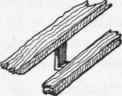
Fig. 253.
Fig. 249 shows the king-post squared at the lower end (and tapering) to be fitted to a tapering mortise in the cross-cleat of the forward sled and held down by the screw and nut at the extreme end. A wheel is attached to the upper end. Any blacksmith can make an arrangement like this, or the bottom of the kingpost can be split (Fig. 250) and screwed to the front sled, and the top can be made with a bar instead of a wheel (Fig. 251).

Fig. 249.

Fig. 250.
He can safely and quickly brake by hand (not an easy thing to do), the brake had best be worked by the rider at the rear. This has some obvious disadvantages. A few ideas are given below, but are not recommended as thoroughly satisfactory.

Fig. 251.
The simple and primitive way, so often used in the country by drivers of heavily loaded sleds, of dropping a chain under the runner is an effective method of braking, provided you have some sure method of dropping the chain under the runners. Fig. 254 shows a method which can be worked from either the forward or rear end of the double-runner. In the plan, or top view (Fig. 254), the details of the arrangement (being beneath the seat) would ordinarily be represented by dotted lines, but in this case, on account of the small size of the drawing, they are shown by full lines, as they would look if the seat-board were transparent. A way of holding up the middle of the chain is shown in Fig. 255. A small block a, perhaps 3" long, is screwed to the under side of the seat and the chain is held against it by the pivoted bar b (which is pivoted to the seat-board by a bolt and is kept in position by the spring), and on the under side of which a piece of metal is screwed at one end, which prevents the chain from dropping. The end of the bar b is connected by a wire with the lever in front. When the lever is pushed by the steersman's foot the bar b is pulled away from the block a and the chain falls by its own weight under the runners of the rear sled, which quickly brings the double-runner to a standstill. Fig. 256 shows the bar held in position by the spring. Fig. 257 shows the position of the bar after the lever has been pressed, with the open space which allows the chain to drop. The same apparatus can be worked from the rear end of the double-runner by simply having the wire to be pulled led back (Fig. 258), where it can be worked directly by the hand or you can contrive a lever to be raised.

Fig. 254.

Fig. 255.

Fig. 256.

Fig. 257.

Fig. 258.
A method of braking sometimes used is by means of a crooked lever formed from an iron rod, one end of which is pulled up by the hand while the lower part has one or more prongs which dig into the surface and stop the sled. Fig. 259 shows a form sometimes used, and Fig. 260 a top view showing position of the handle and prongs when not in use. Any blacksmith can arrange this apparatus, which is attached to the rear sled. A similar arrangement can be contrived to work by the steersman's foot if desired. One prong, attached to the under side of the seat-board, can be arranged as suggested (side view) in Fig. 260a.
The double-runner should be thoroughly oiled, and a coat of shellac, followed after a day or two by a coat of varnish, will add much to its durability as well as to its appearance. Lubricate the working parts with soap or tallow.

Fig. 259.

Fig. 260.
If you have a gong, it should be worked by someone other than the steersman.

Fig. 260a.
The rear sled is sometimes arranged to swivel like the front sled and to be steered by a second steersman, somewhat a f t er the fashion of a long hook-and-ladder truck. This gives good command of the double-runner on curves.
Continue to:


My Books

