


Wooden Guns And Pistols. Part 2
Description
This section is from the book "Woodworking For Beginners: A Manual for Amateurs", by Charles G. Wheeler. Also available from Amazon: Woodworking For Beginners.
Wooden Guns And Pistols. Part 2
The seat may be thinner than the runners, and is to be fitted between them and to be screwed to the cross-pieces (see Screws). The thickness of the stock for the seat must be borne in mind when laying out the mortises in the runners.
Machine-planed stock is, of course, as smooth as is necessary for a sled, but smoothing by hand (see Plane, Scraper, and
Sandpaper) will give a nicer surface. The runners can be shod at the blacksmith's with half-round irons, or round steel can be used with iron at the ends. In case of steel spring irons the runners can be slightly grooved on the edge, so far as may be necessary to keep the irons in place. The irons can be 1/2" to 5/8" in diameter.
Finish with paint (see Painting) or with oil, shellac, and varnish (see Finishing).
A " double-runner," " bob," or " traverse " sled can be built to good advantage. The sleds can be made as just described, or ready-made ones can be used. See that they are well put together, of the same width, and securely braced, as the strain upon them is great. The length of the double-runner is a matter of choice, of course. As to the height and width, however, if the coasting is straight, smooth, and comparatively safe there is no objection to a high seat, with a comfortable foot-board on each side for the passengers' feet, if you wish. But if you are going to coast on long, rough hills, with sudden curves and pitches to be taken in uncertainty and at whirlwind speed - the kind of coasting for real fun and exhilaration - avoid the luxurious top-heavy double-runners frequently seen. Make the sleds rather broad (18" is not too wide for the "track" of a 16' sled; which is a very long sled, however), and keep the height of the top-board down to about 10" or less.
Before beginning work read carefully Marking, Rule, Square, Saw, in Part V., and look up any other references.
The seat-board can be from 8' to 16' long, and about 12" to
14" wide. Board thickness is sufficient for a short seat, but if long a 1 1/4" plank should be used. If you have in mind to make a very long sled you should consider, before beginning, that you must either use a quite thick plank to get the necessary stiffness, which will add to the weight of the double-runner, or the plank must be stiffened or " trussed " with rods beneath like a bridge, which will add to the expense and labour. It should be of strong, elastic, straight-grained wood, free from bad knots or defects, as the strain upon it is great. It should not be too yielding and springy, however, or it may sag inconveniently. Clear hard Southern pine or ash is good. A plank of stiff spruce of good quality will do. The rear end can be rounded, as shown (Fig. 243).

Fig. 243.
Machine-planing is sufficient for the sides of the seat-plank, but the edges should be planed carefully (see Plane), and the angles slightly rounded off with the plane, spokeshave, or rasp and file (see Spokeshave, Rasp, and File) to prevent splinters.
To enable the front sled to turn properly, get out two pieces of 2" plank, as shown in Fig. 244, about 3" wide and as long as the width of the sled, one being tapered toward the ends on the under side. The tapering is important, as it diminishes the friction when the front sled is turned. Screw one of these pieces firmly across the top of the front sled and the other across the lower side of the seat-board (see Screws), a hole being bored through the centre of each cross-piece (as well as through the seat-board and the top of the front sled) for the king-bolt upon which the front sled turns. Find these centres accurately and bore carefully with a bit 1/16" larger than the king-bolt (see Boring). The front sled should turn very freely and easily, and have plenty of play, but the bolt should not fit loosely enough to make the double-runner rickety.
A washer can be inserted between the cross-pieces. Sometimes a thick rubber washer is used to lessen the shock (Fig. 245).
To give the ends of the rear sled freedom to play up and down (without turning sideways) in passing over the inequities of the surface the arrangement shown in Fig. 243 (and enlarged in Fig. 246) is good. Do not make this of 7/8" stock. Pieces of plank should be used, the dimensions being so arranged that the seat-board will be equally raised from the front and rear sleds. The pins at the ends of the cross-piece should be not less than i" in diameter (1 1/4" is better) and should be carefully cut (see Paring and Rounding Sticks). The best way is to have them turned to fit the holes in the rocker-shaped pieces. The latter should be longenough (about 1') to prevent danger of the woodbreaking apart near the hole and to allow for screwing firmly to the seat-board. Another way, sometimes adopted, is to use two cross-cleats with two bolts (queen-bolts) and thick rubber washers (Fig. 247), the bolts being loose enough in the holes to allow the necessary amount of play. Ropes or chain can be fastened from the rear sled to the seat-board, to prevent too much dropping of the former.

Fig. 244.

Fig. 245.

Fig. 246.
Many arrangements for steering have been invented. A cleat at the forward end of the seat-board to brace the feet against, the sled being guided by the ropes held in the hand (Fig. 248), is a simple way, though requiring more strength and steadiness of arm, when the coast is rough or dangerous, than is possessed by many steersmen. The brace for the feet should be bolted to the seat-board or strongly screwed from above and beneath. Another equally simple way is to screw the brace for the feet upon the forward sled (Fig. 243), cutting a shallow gain in the tops of the runners to hold it more securely. In this way of steering the arms can reinforce the legs, or the steering can be done by the legs alone. It is a very effective method, which gives a high degree of control of the forward sled without cumbersome tackle and leaves the seat-board free of obstructions.1

Fig. 247.
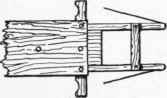
Fig. 248.
1 Various contrivances for steering with a wheel or cross-bar are sometimes
Continue to:


My Books

