


Bits
Description
This section is from the book "Woodworking For Beginners: A Manual for Amateurs", by Charles G. Wheeler. Also available from Amazon: Woodworking For Beginners.
Bits
The auger-bit (the sizes of which are arranged by sixteenths of an inch) so commonly used with the bit-brace, consists, at the cutting end, of a spur, two scoring-nibs, and two cutting-lips. You will see from Fig. 480 that the spur a, acting like a gimlet point or a screw (which it is), starts the bit by drawing it into the wood so that the scoring-nibs b make a circular cut around the circumference. As this cut deepens, the cutting-lips c slice away the wood to be removed in the form of shavings, which are brought to the surface as the boring proceeds.
This bit can be sharpened with a file, the scoring-nibs being sharpened from the inside, lest they be made to score a circle too small for the rest of the bit, while the cutting-lips are filed from the under side.
The centre-bit is a useful tool, particularly for very thin stock. The spear-like point a (Fig. 481), acting as a centre, the point b cuts a deep ring, and the edge e, which is bent so as to form a flat chisel, scoops out the pieces of wood, and so a round and smooth hole is made. This bit does not cut very well with the grain. It can be sharpened with a small oil-stone. It is well to bore a trial hole with this bit in a piece of waste wood when exactness is required, because the spur is not exactly in the centre, so that the hole cut is a trifle wider than the diameter of the bit.
The expansion-bit has an adjustable contrivance that enables it to bore holes of various sizes, but such tools are hardly necessary for beginners, though very convenient and often used by carpenters.
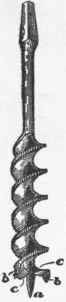
Fig. 480.
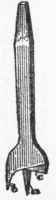
Fig. 481.
The gimlet-bit is a common form, but is easily dulled and bent and is likely to split delicate work. The quill-bit is excellent, except for end grain. Shell-bit, gouge-bit, pod-bit, spoon-bit, duck's-bill-bit, etc., are names applied to simple tools good for boring small holes. They are easily sharpened with a stone, work quickly and leave a smooth hole, but do not cut so well in end grain. They are not as much in use as formerly, the twist-drill taking their place for many purposes.
^earners, or tapering bits (half-round, square, octagonal, conical), are useful to enlarge holes and occasionally to make them conical. Reamers for metal are also useful.
For other forms of boring implements, see Awls and Twist-drill. See also Boring and Countersink.
Continue to:


My Books

