


292. Water In Timber. Continued
Description
This section is from the book "Bench Work In Wood", by W. F. M. Goss. Also available from Amazon: Bench Work In Wood.
292. Water In Timber. Continued
298. Kilns, of which there are many forms, are large structures fitted with machinery for circulating dry, hot air about the lumber that is placed in them. The lumber is piled upon light trucks, which are run into the kiln upon lines of track. The doors are then closed and steam is turned into the coils of pipe by which the air is heated. Moisture-laden air escapes through a chimney and is replaced by dry air taken in below the pipes. In operation, the green lumber is introduced into that end of the kiln from which the moist and heated air is discharged, and cars containing the seasoned lumber are removed from the other. By this arrangement the cars progress through the kiln, the dryest air coming in contact with the dryest lumber, and that which is most heavily laden with moisture, with the greenest lumber. This course prevents too great rapidity in the process of seasoning. For seasoning green lumber, kilns require about one week for each one-inch thickness of material. Lumber seasoned by air-drying, and designed for inside work, can be made sufficiently dry to avoid all chance of further shrinkage, if placed in the kiln from forty to sixty hours for each inch in thickness. In general, more time is required for hard woods than for soft, and, usually, the former must be seasoned at lower temperatures than those which may be employed with the latter. In any case, the temperature is limited by the tendency of the wood to check; for if the drying process is forced too rapidly, the lumber will be injured.
299. Shrinkage in timber occurs whenever it loses moisture. In the process of seasoning, shrinkage may reduce the width and thickness of a timber fully eight per cent, but it has little effect on its length. Wood cannot be seasoned so well that it will not shrink whenever the surrounding dryness is increased. It also has a tendency to shrink after having its surface removed, as in finishing by use of a plane. This is due to the reopening of the pores, which in the fibers of the old surface had become closed by contraction; in this way new passages are furnished for the escape of moisture.
300. Swelling occurs in timber whenever it absorbs moisture. Most woods give up moisture more readily than they receive it; therefore, a timber is less likely to swell when transferred from a dry atmosphere to a moist one than to shrink when the conditions are reversed. A slight variation, however, in the amount of surrounding moisture is sufficient to produce a perceptible change in the dimensions of a piece of wood. Paint upon all exposed surfaces is some protection against such changes, but it will not serve entirely to suppress them. As a rule, the softer a wood is, the more readily it shrinks and swells.
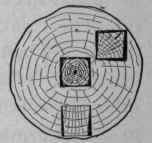
301. Warping in wood is a change of form resulting from unequal shrinkage or swelling. In Fig. 316, which represents the end of a log, it will be seen that, besides the lines defining the annual rings, there are others extending outward from the center in all directions; these have already been defined as medullary rays. In some woods they are hardly discernible; in others they distinctly mark the cross-section of the timber, and they are not very much shortened by shrinkage. In the process of seasoning, the bond between the rays and the wood fibers next them becomes weakened, and therefore, as shrinkage occurs along the circumference of the annual rings, there is a tendency to cleavage on lines at right angles to the rings, naturally the lines of least resistance, i.e. the medullary rays. If the seasoning is carefully done, no checks will appear, but the tendency is always apparent. For example, if a log is cut longitudinally into five pieces, the middle piece will, by the contraction of the annual rings in shrinkage, become thinner at the edges than at the center, as shown by Fig. 317. The other four pieces will warp as shown, the surface of each piece which in the log was nearest the center becoming the convex side after shrinkage. The shrinkage of a square joist will vary according to its position in the log relative to the heart, as indicated by Fig. 318. Thus it will be seen that in the cross-section of a timber, changes resulting from shrinkage can be foretold whenever the character of the end grain can be determined.
Fig. 316
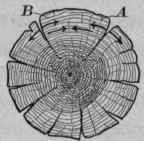
Fig. 317
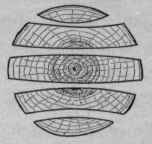
Fig. 318
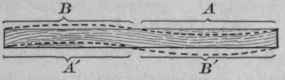
Timbers also warp in the direction of their length. When not due to the subjection of one part to dryness or dampness, to the exclusion of other parts, this can be traced to uneven-ness in the grain, which exposes a greater number of fiber ends in one part of a surface than in another. The more fiber ends there are on a surface, the more readily moisture will pass into or out of the wood, and the more pronounced will be the local shrinkage or swelling, and consequent warping. For example, suppose Fig. 319 to represent the edge of a board having the grain as shown. Moisture will escape most readily from the surfaces marked A and A'. The contraction of the surfaces A and A' will force the board into the shape shown by the dotted line. The most fruitful cause of warping, however, is unequal exposure. One side of a board may be exposed to the sun while the other is not; the side exposed will be found concave both in length and breadth. Heat from a stove or dampness from the ground are common causes of warping. If a board newly planed on all its faces is left flat on the bench, it will after a time be found concave in its upper surface, - a result due to the greater exposure of the upper surface as compared with the lower, which remained in contact with the bench. A piece which has reasonably straight grain, and which has been planed all over, should be left on its edge or end. Pieces of irregular form, that are required to be made into shape accurately, are best prepared when roughly cut nearly to the required dimensions, and allowed ample time to shrink and warp before being finished exactly to size.
302. Decay in Wood is caused by the growth upon it of fungi, which send down little food-seeking threads in all directions into the wood, consuming the cell walls and their contents, and thus producing a disintegration and change of structure which is called rot, or decay. In order to grow,, the fungi must have air, organic food materials, heat, and abundance of moisture; the moisture must not amount to immersion, however, for too much water excludes the air and the fungi cannot live for want of oxygen. Fungus growth is checked by cold and killed by temperatures above 150° F., as well as by the application of certain chemicals to the wood. Perfectly seasoned wood is not likely to rot, especially if it has good ventilation and its surfaces of contact are well protected.
Fig. 319
303. Timber Preservation is effected by filling the pores with some fluid which destroys and prevents fungus growth, and thus protects the wood from decay. Some woods, such as oak, resist the attacks of fungi, and therefore do not rot quickly even under unfavorable conditions. For this reason, only woods of this kind were formerly used in work which was exposed to moisture, as railway ties, bridge timbers, and fence posts. Of late, however, such timber has become very scarce and costly, and much attention is now given to artificial methods of preservation which will give durability to cheaper and otherwise inferior timber.
By "inferior timber" is meant those soft, porous woods which are especially liable to decay. By treating with a preservative, however, they are rendered durable, and red oak may thus be made to take the place of white oak, and loblolly pine, fir, and hemlock may be used for pine in places where resistance to decay is the chief requirement. The preservative treatment never increases the strength of a timber or its resistance to abrasion, but, on the contrary, slightly weakens it; for many purposes, however, the ultimate strength of timber is of far less importance than its durability. The requisite property of the preserving fluid is that it will destroy and prevent the growth of fungi, and for this purpose corrosive sublimate, tar oil, creosote, and zinc chloral are most used.
The manner of applying the fluid depends upon the quantity of wood to be treated. If the quantity is small, the preservative may be applied with a brush, or the wood may be dipped into it. If large quantities of lumber are to be treated, extensive plants are equipped for doing the work. The purpose in all cases is to fill the pores of the wood with the fluid. As a first step, the wood must be thoroughly seasoned in order that its porosity and permeability may be as high as possible. If the wood is absolutely dry, it will take up considerable quantities of the preservative, though a high degree of penetration is not often secured without the use of pressure. A typical process is described in the next paragraph.
Continue to:


My Books

