


Part IV. Timber And Its Preparation For Use Timber
Description
This section is from the book "Bench Work In Wood", by W. F. M. Goss. Also available from Amazon: Bench Work In Wood.
Part IV. Timber And Its Preparation For Use Timber
252. Timber is that portion of the woody material of trees which is serviceable for carpentry and joinery. If the trunks of timber-bearing trees are cut into sections, they are found to be composed of concentric cylindrical layers, separated from each other and evidently quite distinct. One of these layers, Fig. 302, is formed each year during the period of growth of the tree, though false rings are sometimes produced by interruptions of growth, such as are caused by drouths, or by the destruction of foliage by caterpillars. The rings vary in thickness, in density, and in color, according to the rapidity of growth, the length of the season, and other circumstances which may change from year to year.
The outer portion of the trunk of a tree consists of a protective layer of bark. Next to the bark is the bast, then the cambium layer, or zone of growth, and then the sapwood, which is usually lighter in color and less strong and dense than the interior portions, or heartwood. As indicated by its name, the ascent of sap takes place through the sapwood. Water containing small quantities of minerals in solution is taken up by the fibrous rootlets and, passing from cell to cell through the thin walls, ascends through the outer layers of roots, trunk, and branches to the leaves. Here, under the influence of light and heat, the greater part of the water is given off in the form of vapor, and another part, with the salts it contains, is converted into food materials. These travel downward from leaf to branchlet, through the outer layers of the trunk to the roots, disposing of themselves wherever they are needed along the way, in forming new wood, new buds, and new roots. These movements of water upward and food materials downward, take place simultaneously, the water (sap) moving through the sap-wood, and the food materials through the bast and inner cortex.
Fig. 302

As the tree grows older, the cells next to the center of the trunk gradually lose their food products, and other substances are infiltrated into their walls and sometimes into the cell cavities, changing the color in the majority of cases, and increasing the density of that part of the tree; this darker portion is known as heartwood. The ascent of sap is greatest in the spring, and practically ceases, in the trunk of the tree, in winter.
The growth of wood which a tree makes in the spring is usually characterized by thin-walled cells and an abundance of sap. In the summer growth the cell walls are thicker, with the cell cavities correspondingly smaller, and the wood is, therefore, darker. The slight autumn growth is still more dense and dark. The wood of these three seasons taken together is the yearly growth of the tree - the annual ring. In some trees the annual rings are scarcely perceptible, while in others they are quite distinct, - a difference which depends upon the kind of tree as well as upon the climate. For example, in cross-sections of oak and chestnut, the spring growth of the annual ring forms a light porous zone, which is, however, somewhat irregular and shades gradually into the darker and denser zone of summer growth. In other woods, like Southern pines, the change between spring and summer wood is sharply marked, and each annual ring shows two clearly defined bands. In tropical regions, where the change of season is not pronounced, growth is more regular and the layers correspondingly less definite. An examination of the cross-section of any tree trunk will disclose the annual rings, and also the difference in the appearance of sapwood and heart-wood. Fig. 302 shows a portion of such a cross-section.
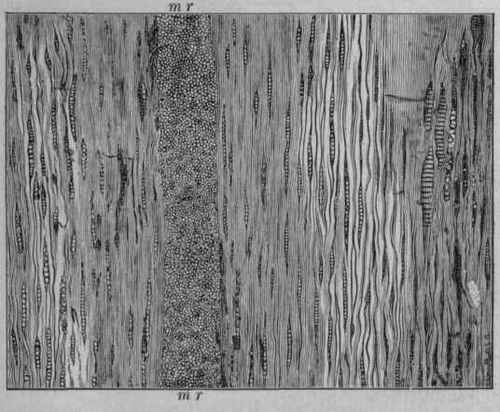
253. The Structure of Wood is entirely cellular, the cells varying in form and size, and performing different functions in the economy of the tree. Some carry water from the roots to the leaves, some store away digested food, and others give strength to the structure and hold it together. Nearly the whole volume of wood, over ninety per cent in pine, is made up of wood cells. Most of these are long and slender, with their length coinciding in direction with that of the trunk or branch they have built up; and in many cases their tapering ends overlap and thus increase the strength and toughness of the stem. They are separated most readily in the direction of their length, as is illustrated by the ease with which wood splits "with the grain." Medullary rays are thin plates of cellular tissue which run from the pith to the bark on all sides, strengthening and binding together the longitudinal cells. To the unaided eye these rays appear as simple lines in a cross-section of wood, and as glistening plates in a longitudinal section. In the oak, the medullary rays are conspicuous in every cross-section, while in some of the softer woods they can hardly be traced. Fig. 303 represents a small portion of an annual ring of spruce, magnified one hundred times. The vertical tubes are wood cells, and mr is a medullary ray part of which has been removed. The circular depressions or pits on the wood cells are thin places in the cell walls; they are very conspicuous in all woods of the pine family. This figure shows also the manner in which the tapering ends of wood cells overlap. The specimen of wood here given is from one of the needle-leaved trees and shows a tangential section on its right face, while Fig. 304 shows a microscopic enlargment of a tangential section of a broad-leaved tree, white oak, with a large medullary ray, mr, and also portions of smaller rays.
Fig. 303
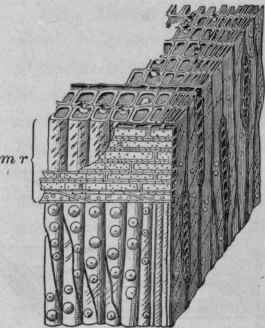
Fig. 304
Continue to:


My Books

