


Part IV. Timber And Its Preparation For Use Timber. Continued
Description
This section is from the book "Bench Work In Wood", by W. F. M. Goss. Also available from Amazon: Bench Work In Wood.
Part IV. Timber And Its Preparation For Use Timber. Continued
Fig. 305
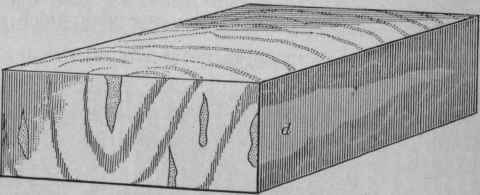
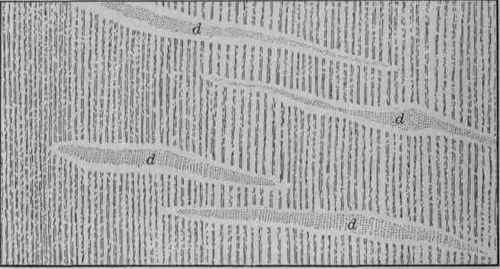
Woods are hard, soft, light, heavy, tough, porous, and elastic, according to the kind and size of the cells and the deposits in the cell walls. They are also easy or hard to work in proportion as their cells are arranged in a simple or a complicated manner; white pine cuts more easily than oak because it is more uniform in structure.
254. Markings of wood depend more upon cell arrangement than upon difference of color. In preparing the more valuable woods for market, therefore, the logs are cut in such a way as to display the cell arrangement to the best advantage, thus increasing the beauty of the wood and, as a consequence, its commercial value. This is illustrated in Figs. 302 and 305. By cutting the tree in a longitudinal plane through the center the annual rings appear in approximately parallel straight lines (a, a, Fig. 302), forming what is known as straight grain. If the tree is not straight, the cutting plane crosses from one annual layer to another, forming "flashes," f, as shown in the tangential section ts. If the medullary rays are well marked and the cutting plane is along a radius of the log, the cut will be bounded by portions of the ray which will extend over a greater or less area, forming "dapples," d, Fig. 305. The appearance of the medullary rays, when thus exposed, accounts for the term "silver rays" which is sometimes applied to them. Another method of sectioning is that of sawing the log into quarters and then into smaller pieces, crossing by cuts which expose the annual rings, as indicated by Fig. 306. This method is termed "quarter-sawing." It greatly increases the cost of the lumber because of waste, but at the same time increases its strength and enhances its beauty, especially in the case of those woods in which the medullary rays are conspicuous.
Fig. 306

Beauty of grain is often developed, also, by a rotary cut which is obtained by revolving a log against the advancing edge of a broad knife or cutter. The result of this process is a thin, broad, continuous ribbon of wood, which may be used as a veneer upon the surface of inferior woods.
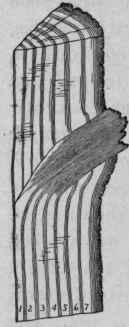
Crooked or irregular grain weakens timber and makes it more difficult to work, and is, therefore, undesirable in material which is to be used in the framing of structures; but it has its value in the realm of ornamentation. Every bend or twist in the growing tree disturbs the regularity of its structure and enhances the beauty of the boards which may sometime be cut from its trunk. When, therefore, a wood is suitable for decorative purposes, its value is increased rather than diminished by such irregularities of grain. Some of the most common markings are knots caused by undeveloped buds which are covered over by the later growth of the tree. Fig. 307 shows a "dead" knot formed by the breaking away of a branch. The branch was a living one for four years, as is shown by the fact that four annual rings are united with it. There is no union with later rings, and still later ones would cover the knot entirely. In woods such as mahogany, satinwood, sycamore, and ash, figures resembling the ripple marks of the sea on fine sand, are due to a serpentine form of the grain, the fibers being wavy in planes perpendicular to that on which the ripple is observed, and those parts of the wood which receive the light being the brightest.
Markings in wood are of value in cases where a handsome finish is required, as in furniture and cabinetwork, and in the inside decoration of buildings. The trees that yield such material are those which have plenty of room for growth, which are exposed to winds that bend and twist, and which have ample light and space for the development of branches. Lumber sawed from such trees will usually contain curls, knots, and wavy grains of great beauty
Fig. 307.
Attention has already been called to the fact that, for structural purposes, straight grain and freedom from knots are desirable. These qualities are most readily found in trees growing under forest conditions; that is, among other trees, where the effort of the growing tree to reach the light, together with a process of "natural pruning" which prevents branches from growing, results in the production of long, straight stems.
255. The Adaptability of the various woods depends on a variety of conditions. The carpenter and builder, who requires a large quantity of material with the least possible outlay of labor upon it, uses those kinds that are abundant and cheap, that are to be had in timbers of large dimensions, that are light to ship, easy to work, fairly stiff, and insect proof. They need not be handsome, hard, tough, or very strong, and shrinkage after the wood is in place is no serious objection. In order that the material may be easily worked, it is necessary that it be soft and reasonably free from curls and knots. The furniture maker uses smaller quantities of material, but he expects to put a large amount of labor upon it, and he requires a wood that combines strength, and sometimes toughness, with beauty and hardness, - one that takes a good polish, that is not easily indented, and that will keep firm joints. For some purposes, it is required that wood shall neither warp nor shrink when in place; it need not be very light, or soft, or insect proof, or very cheap, or abundant in any one kind, or furnish pieces of large dimensions. The wagon maker seeks the qualities of toughness, strength, and hardness combined; the carriage builder, cooper, and shingle maker require straight-grained, easy-splitting woods, with the long fiber which precludes knots; the essentials for telegraph poles are durability, elasticity, and the right proportion of length to diameter; and good railroad ties must be hard, must hold spikes firmly, and must resist the action of the weather.
Continue to:


My Books

