


Chapter IX. Moldings, With Practical Illustrations In Embellishing Work
Description
This section is from the book "Carpentry for Boys", by J. S. Zerbe. Also available from Amazon: Carpentry for Boys.
Chapter IX. Moldings, With Practical Illustrations In Embellishing Work
Moldings
The use of moldings was early resorted to by the nations of antiquity, and we marvel to-day at many of the beautiful designs which the Phœnecians, the Greeks and the Romans produced. If you analyze the lines used you will be surprised to learn how few are the designs which go to make up the wonderful columns, spires, minarets and domes which are represented in the various types of architecture.
The Basis Of Moldings
Suppose we take the base type of moldings, and see how simple they are and then, by using these forms, try to build up or ornament some article of furniture, as an example of their utility.
The Simplest Molding
In Fig. 185 we show a molding of the most elementary character known, being simply in the form of a band (A) placed below the cap. Such a molding gives to the article on which it is placed three distinct lines, C, D and E, If you stop to consider you will note that the molding, while it may add to the strength of the article, is primarily of service because the lines and surfaces produce shadows, and therefore become valuable in an artistic sense.
The Astragal
Fig. 186 shows the ankle-bone molding, technically called the Astragal. This form is round, and properly placed produces a good effect, as it throws the darkest shadow of any form of molding.
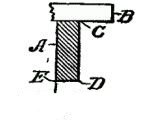 | 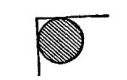 |
Fig. 185. | Fig. 186. |
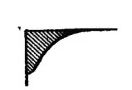 | 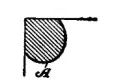 |
Fig. 187. | Fig. 188. |
The Cavetto
Fig. 187 is the cavetto, or round type. Its proper use gives a delicate outline, but it is principally applied with some other form of molding.
The Ovolo
Fig. 188, called the ovolo, is a quarter round molding with the lobe (A) projecting downwardly. It is distinguished from the astragal because it casts less of a shadow above and below.
The Torus
Fig. 189, known as the torus, is a modified form of the ovolo, but the lobe (A) projects out horizontally instead of downwardly.
The Apophyges (Pronounced Apof-I-Ges)
Fig. 190 is also called the scape, and is a concaved type of molding, being a hollowed curvature used on columns where its form causes a merging of the shaft with the fillet.
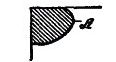 | 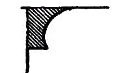 |
Fig. 189. Torus. | Fig. 190. Apophyge. |
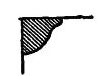 | 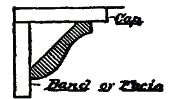 |
Fig. 191. Cymatium. | Fig. 192. Ogee-Recta. |
Continue to:


My Books

