


Feed Scoop
Description
This section is from the book "Shop Projects Based On Community Problems", by Myron G. Burton. Also available from Amazon: Shop Projects Based on Community Problems.
Feed Scoop
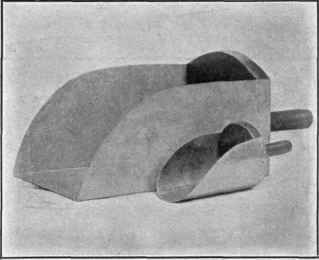
Materials
Poplar (Chap. III., Par. 42) or any soft wood.
1 pc. 7/8"x5 1/2"x6 1/2" S 2 S
Back. 1 pc. 1 1/8"xl 1/8"x5 1/2" rough
Handle. 1 pc. galvanized 10"xl5"
Body of Scoop. 5 dozen 3/4" No. 18 brads.
Introductory Statement
Handy equipment is a great help in making everyday tasks lighter and more pleasant and much of this equipment can be provided without any particular expense.
In every home there are a number of purposes for which neat, well-made scoops would be convenient. The purpose for which the scoop is to be used will determine its size and shape. For house use, in salt, sugar or flour, the smaller neat size would be more appropriate; for use on the farm, in the barn or poultry house, larger and heavier scoops should be provided for handling ground feed and small grain. Such scoops could be made so as to serve as an approximate measure and thus enable one to feed accurate portions in making up rations.
References:
Tin Truth. Follansbee Brothers Co., Pittsburgh, Pa.
Tin - Source, Production and Manufacture. International Encyclopedia.
Tin, in Stories of Industries, Chase and Clow. Educational Pub. Co.
The Story of Iron, Elizabeth Samuel. The Penn Pub. Co.
U. S. Bulletin No. 99, Insect Enemies of Shade Trees.
Feed Scoop
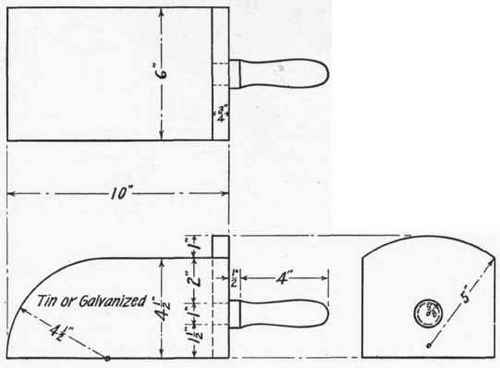
Suggestions For Original Design
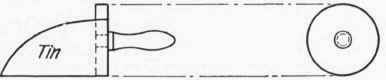
Salt Or Sugar Scoop
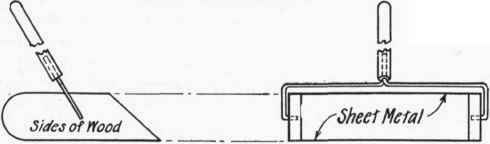
Dust Pan With Long Handle
Feed Scoop Specifications
The Back
Plane one surface of this piece perfectly straight and smooth for a working face (Chapter II., Paragraph 2); plane one edge straight and square for a working edge (Chapter II., Paragraph 4). Square and saw, if necessary, and plane one end square with the working face and working edge for a working end (Chapter II., Paragraph 5). Measure and cut this piece the required length. With the compasses set to the proper radius, lay out the curve for the top edge of this piece, saw out with the coping or compass saw, and smooth with a sharp block plane or wood file. Locate and bore the hole for the handle (Chapter II., Paragraph 9).
The Handle
In shaping a handle of this kind it is well first to make the material perfectly square (Chapter II., Paragraphs 2 and 4); next plane off the corners, making an octagon; then the corners should be planed off until the shape approaches a cylinder. A sharp knife may be used to make the curved shape to the handle. You must depend upon your eye and judgment very largely in shaping such a handle. Do not attempt to take deep shavings; cut away but little at a time, and keep turning the handle from side to side so you may be able to keep the curves the same on all sides.
Continue to:


My Books

