


3. Laying Out The Foundation
Description
This section is from the book "Constructive Carpentry", by Charles A. King. Also available from Amazon: .
3. Laying Out The Foundation
Laying Out The Foundation. (A.) In laying out the foundation of a building where the lots are platted and the streets laid out, the front of the house generally should be parallel to the side of the lot which fronts the principal street. If the lots are narrow and the dividing lines extend at an angle with the front, the house is usually set parallel with the line separating the lots, thus bringing the front at an angle with the street, but square with the dividing line, as in Fig. 1, which shows a dwelling house located upon an irregularly shaped corner lot. In this way the waste of land is reduced to a minimum.
In places where there are building laws, the minimum distance at which the house may be set from the front of the lot usually is regulated, but in any case, it adds to the good appearance of a street to have the fronts of all of the houses upon the same line, and anything which improves the appearance of a neighborhood generally will increase the value of the property there.
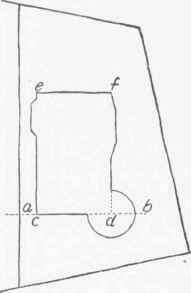
Fig. 1. - Location of a House upon an Irregularly shaped Lot.
(B.) Having located the line of the front of the house (ab, Fig. 1), decide upon the relation of the corner c to the nearest side of the lot. With cd as basis, lay out the greatest rectangle possible to obtain from the plan of the house, as shown by the corners c, d, e, f.
In order to obtain the exact corners of the rectangle, it is necessary to stretch lines, the intersections of which will mark the corners c, d, e, f. That these lines may be stretched permanently and accurately, batter boards (see Glossary) should be erected as shown in Fig. 2, not less than five feet from the sides of the house at the corners which the approximate measurements have located. Three forms of batter boards are shown, the form at c and e being generally used, as it is more rigid than the others.

Fig. 2 -Lating out the Foundation.
After the line of the front of the house cd is located, the line gh should be stretched by means of a piece of strong, small cord about two feet longer than the distance between the batter boards, dropped into the saw cuts which have been made at exactly the right places to locate the line permanently. Tie a stone at each end of the cord to keep it stretched tightly, and to allow it to be removed easily.
Locate saw cut i in the front batter board at a distance equal to that of the side of the lot from the side of the house, and throw one end of the cord m over the rear batter board, each end of the cord being weighted with a stone. The saw cut should not be made in the rear batter board at this time, as the cord may have to be moved when squaring though, if the front line is accurately located, m will be parallel to the side of the lot. Measure from the cut i, parallel with the line cd, the exact length of the foundation of the front of the house (cd), and make saw cut j in the other front batter board; from this another line jn should be stretched to the corresponding rear batter board, and weighted. Parallel to gh, line kl should be stretched to locate the back of the foundation, saw cuts having been made so that the line may be dropped instantly into its place at either end.
It now remains only to make lines im and jn parallel to each other and square with gh and kl. This may be done by laying a square (see Fig. 3) upon the ground as at c, so that the tongue and line gh will exactly coincide, and by bringing line im to coincide with the blade of the square. Measure across the back and make line jn parallel with im.

Fig. 3. - Large Square for Laying out Foundations.
If the work has been done with accuracy, the intersections of the lines at c, d, e, f will denote the corresponding corners of the building; but as it is most important that the building be perfectly square, the work should be proved by measuring the diagonals (c'f', d'e') between the intersections of the lines: if they are equal, they are the corners of a perfect rectangle; if not, move the two points m and n simultaneously in the same direction, until the diagonals are exactly the same length. Having accurately located points m and n, make saw cuts in the batter boards to receive the lines, which may then be removed and replaced as often as necessary. Many carpenters doing the above work use, instead of a steel square, a large square, made like Fig. 3. After the great rectangle is located, the smaller angles and projections in the foundation may be placed by measuring.
It is quite a common custom for the mason and the carpenter to lay out the foundation in the presence of the architect; if a large and important building is being laid out, it is a wise plan to call in the services of an engineer to insure accuracy, and to locate points from which levels may be taken.
4. Excavations. The excavation should be enough larger than the foundation walls at the bottom to allow the footing course to project beyond them and to include, if necessary, a drain to prevent the water in the ground from running into the cellar. Since every inch added to the excavation means that a great deal more earth will have to be removed, this needs careful thought. The sides of the excavation should slope enough to insure that there will be no caving in of the bank.
Finally, the footing course should be far enough from the surface to be several inches below the deepest frost line, and, to insure that the foundations of large buildings will never be thrown out of shape by the action of frost or water, the course should rest still deeper.
Continue to:


My Books

