


Chapter VI. Boarding In. Outside Finish
Description
This section is from the book "Constructive Carpentry", by Charles A. King. Also available from Amazon: .
Chapter VI. Boarding In. Outside Finish
70. Boarding in. (A.) In the warmer sections of the country, the houses are built with nothing upon the outside studding except the siding, but in the North, 1" boards planed to an even thickness are nailed outside of the studding with 8d or 10d common nails. Upon the best houses these boards are often matched; in most cases they are laid as closely as possible, and covered with sheathing or building paper, which increases the warmth of the building.
(B.) If a heavy building is being erected, it is best to lay the boarding diagonally, as at a, Fig. 99; the frame is thereby much strengthened. For an ordinary dwelling house, unless exposed to severe winds, horizontal boarding is sufficient, if the building is well braced at the corners. (See c, Fig. 20; c or d, Fig. 21.)
Diagonal boarding is more expensive than that laid horizontally, as a square the width of each board is wasted, and a man can cover only about two thirds as much surface in a day.
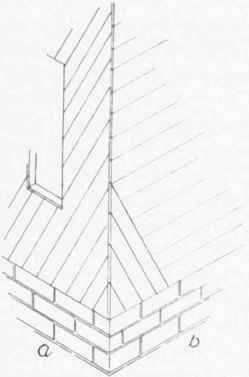
Fig. 99. - Boarding In.
Upon many good buildings, the corners inside of the braces are often laid diagonally, and the rest of the house horizontally. (See b, Fig. 99.)
(C.) In covering or sheeting the roof, matched boards are used in some localities, and are covered with sheathing paper for warmth. This is a good method in a cold climate, but as the air can reach only the part of the shingle exposed to the weather, that part will dry out, and the rest will retain its moisture. This causes one part to warp and split, and the other to decay.
In a climate where durability is a more important consideration than warmth, boards from 2\" to 4" in width are usually laid, for sheeting or sheathing. Between them is left a space about 2" wide, allowing the air from the house to reach the under side of the shingles; this aids materially in their drying, and prolongs the life of the roof.
Continue to:


My Books

