


Lesson XXVI Common Dovetail
Description
This section is from the "Elementary Woodwork" book, by Frank Henry Selden. Also available from Amazon: Elementary Woodwork for Use in Manual Training Classes.
Lesson XXVI Common Dovetail
Stock 121/2 inches long, 41/4 inches wide, and 7/8 inch thick. Dress to 4 inches wide and 13/16 inch thick.

Fig. 89. Common Dovetail.
Square the ends carefully, testing them both from the face side and the face edge. In squaring the ends of this piece use the smooth plane as directed in squaring the end of the 4-inch-wide piece in Lesson 29 (Bench-Hook). Draw lines around each end to mark the inner ends of both mortises and pins. These lines should be about 1/32 of an inch farther from the ends than the thickness of the piece, so that there will be some material to plane off after the joint is glued together. In regular hand dovetailing the pins are not laid out by any measure, but by the eye unaided. They should have the general size and shape indicated by the drawing, and should be cut to nearly correct size with a fine rip-saw. They should then be finished with a chisel. The wide side of the pin is always on the face side of the piece, or the side which forms the inside of the corner. After the pins are carefully smoothed set them on end on the face side of the piece which is to receive them and mark around them with a sharp pencil or knife, as shown in Fig. 90. Do not
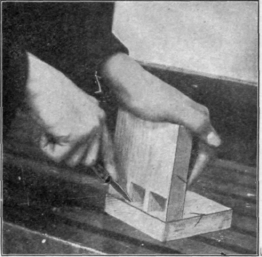
Fig. 90. Scribing Around the Pins for the Mortises.
use the bit in working these mortises, but work them entirely with the chisels.
Sometimes dovetails are laid out of exact shape and size, the pins being marked on both sides and ends, and the mortises lined around with square and tee bevel after one side has been scribed from the pins. Sometimes the mortises are made first and the pins scribed from them, as in Fig. 92. In common drawer dovetailing the ends of the pins and the outside of the mortises are battered down with a hammer after the joint is glued. This battering holds the joint together while drying and helps to fill up any defects in the joint. In our practice work it is better to make the joint so perfect that it will not require either gluing or battering. If your work is well done, place the pieces together without gluing and plane off the waste material at the corner and finish the outer ends as you did the halved dovetail in Lesson 20 (Halved Dovetail). If your piece is not good enough to finish in this manner, cut the mortises off, refinish the pins, and try again. Should you have to try a third time, cut off the pins, refinish the mortises, and scribe a new set of pins from them. This form of dovetail is usually used at the back end of drawers in fine hand-made furniture.
Continue to:


My Books

