


Introduction
Description
This section is from the book "Elementary Woodwork", by George B. Kilbon. Also available from Amazon: Elementary woodwork.
Introduction
The title given to this book was chosen because of the purpose to present fundamental exercises in a simple form for the use of beginners. Effort has been made to detail operations minutely, hoping to be of service to novices, though well aware that no book can be a substitute for an efficient instructor. The arrangement is from the easy to the difficult by successive steps, and is designed to give boys of twelve years and upward primary command of the use of a set comprising the principal wood-working tools. The smaller planes and saws are chiefly used. Other tools are of standard size. Small pieces of wood are used, since elementary instruction can be better given thereby. The different kinds of nail-driving, and the use of gauge and try-square, are first taught on boards prepared by machinery. The ability to use each tool should be mastered before undertaking the study of another.
The lessons described have been given to the ninth, or senior, grammar grade of the public schools at Springfield, Mass., since the organization of the manual training-school at that place in 1886, classes of twelve to nineteen receiving one lesson per week of one and one-half hours' duration, and commencing with September, 1892, the first half of them are now given to the eighth grade, classes receiving one lesson each fortnight. A selection under the title "Ten Lessons in
Manual Training" was published in The New York School Journal between Sept. 26, 1891, and Aug. 26, 1892.
The sixth and seventh grades at Springfield receive manual instruction through the medium of knife-work outlined in a book published by The Milton Bradley Co., entitled "Knife Work in the School Room;" the eighth and ninth grades, through the medium of the within described elementary course; and high school pupils who so elect receive daily lessons for three years in joinery, wood-turning, carving, pattern-making, moulding, forging, iron-filing, turning and planing, and machine construction.
The question is under advisement of writing out a description of high-school work following the method pursued in "Knife Work" and in this book. Whether it will be done will depend somewhat on the acceptance of these two volumes.
Mechanical drawing is given to pupils in the eighth and ninth grades in the ordinary schoolroom, using the 9 in. X 12 in. industrial drawing kit made by the Milton Bradley Co.; and among other things drawn are the manual problems. High-school pupils have an extended course of daily work in drawing, their manual problems being included.
Equipment
Fig. 1 is a front elevation; Fig. 2, a plan; Figs. 3 and 4, left and right elevations, of an individual work bench, 4 1/2 ft. long X 2 ft. wide X 34 in. high. The two end views show tools hanging in position. Other tools are kept, some on the bench top, some in the rack on the back side of the bench, and others in the drawer.
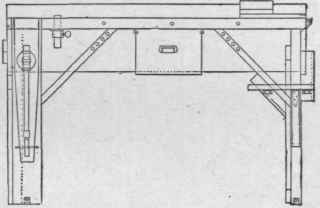
Fig. 1.
To accommodate boys of small stature, movable platforms 4 1/2 ft. long X ft. wide are used, varying in height from 2 in. to 5 in. When not needed, these platforms are buttoned to the back side of the bench. When the arm of a pupil hangs 8 naturally by the side, and the wrist is bent so as to cause the hand to stand at right angles to the body, the hand so held should pass just underneath the 2 in. plank forming the top of the bench. This rule will decide the height of platform needed for any pupil.
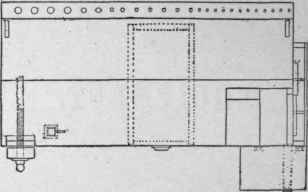
Fig. 2.
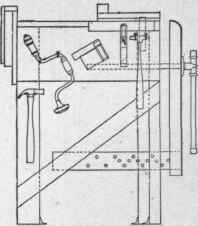
Fig. 3.
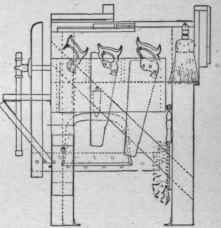
Fig. 4.
A school may be furnished with twelve to twenty-five such benches, according to room or demand. If twenty-five are furnished, and if room allows, a convenient arrangement of them is shown in Fig. 5, each bench being supplied with a stool which the pupil occupies when necessary, and which are gathered around the teacher's desk during class instruction as in Fig. 5.
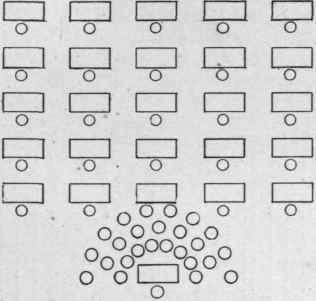
Fig. 5.
Continue to:


My Books

